Category Archives: Ex Miscellanea

MICE/RC

Agents, how do we get the information we want from the sources who have access to it?

Classic intelligence theory references MICE – Money, Intelligence, Conscience, and Ego. A while ago, I recorded this variant in my Spycraft notes:

Material – we have a tangible thing they want (money, coke, hookers).

Ideology – their beliefs are congruent with ours and they want to help us.

Compromise – we find an existing fear (i.e., a secret whose exposure is feared) and leverage it.

Ego – we reinforce (or challenge) their self-worth.

Revenge – we facilitate their need to get back at someone who wronged them.

Coercion – we create a new fear (make them afraid of us, usually) and leverage it.

Twilight: 2000 Edition War

Not much of an edition war, actually. At least, not here, where I’ve turned off commenting.

A couple of months back, someone on the Twilight: 2000 fan forum asked about the relative merits of the game’s second and fourth editions. Having just written up characters for all four editions for the 2025 Character Creation Challenge, I’ve been thinking idly about this subject again. Here’s my take on the best features of each edition:

First edition wins for timeline and setting. It has the deepest library of official publications from which to draw and consequently is the best-developed world. When I’m running T2k, I base my world on the setting presented in the 1e materials, with an alternate-history break point occurring in the early 1980s. I generally like percentile systems, but the mechanics herein are just… odd… in a number of places.

Second edition, specifically its v2.2 iteration, wins for play-by-post. Its mechanics have deeper levels of detail, but that slows me down too much when I’m trying to run a realtime game. I’ve found a number of players willing to try it but none willing to master the rules. Its life path system also tends to generate characters who aren’t competent enough to succeed consistently at the sort of adventuring the setting calls for, so some house-ruling is often necessary for me.

Third edition, i.e. Twilight: 2013, is where I have both some bias and an emotionally complex response. As the lead rules designer, and probably the most visible member of the design team still involved with the T2k fan community, I’m still more than a bit sore about the game’s shitty reception among the existing fan base. Having said that, I also acknowledge that a lot of the mechanics I developed are better suited for computer-mediated play than tabletop pencil-and-paper gaming. Where 2013 sits for me is mainly a source for strip-mining conceptual elements to port to the other editions. Justin Stodola’s work on the ballistics model still sings. The gear library adds the fiddly “what’s in his pocketses?” bits that appeal to my inner twelve-year-old poring over U.S. Cavalry catalogs. I occasionally think about returning to the initiative system to tweak it to feel more like X-Com’s action points, but that would require creative effort better expended elsewhere.

Fourth edition is my current go-to for in-person (or VTT) play. It has enough detail to satisfy my usual groups, none of whom are particularly obsessive about tactical minutiae, and it runs smoothly and quickly enough that I can get an eight-player group through a firefight in a single session with time left over for investigation, exploration, and roleplaying on either side of the combat. It also, generally speaking, offers characters who can be made broadly competent enough to contribute meaningfully outside one narrow niche.

Bachman Turner Overgoth

“What is your character concept?”

“Invulnerable black-clad moody lone wolf in a black trench coat wielding twin titanium monokatanas and smartlinked Desert Eagles firing incendiary moonsilver depleted uranium cold iron explosive tracer bullets while a bloodthirsty yet mournful heavy metal soundtrack wails distantly over the incessant rain that falls like the tears of a thousand fallen angels crying over the heart’s mournful lament for a lost paradise.”

“Um… no.”

I love it when a coterie comes together.

In 1872, a crack team of archons was sentenced to destruction by the Ventrue Justicar for a crime they didn’t commit. These Kindred promptly escaped from a maximum-security conclave to the Anarch Free State. Today, still wanted by the Camarilla, they survive as soldiers of fortune. If you have a problem… if no one else can help… and if you can find them… maybe you can hire… The V-Team.

Brush Workout

Yesterday, I wrapped up primary work on the Clan War figures I’m doing for a friend back in Louisville. (Photos will be forthcoming once I’ve sprayed matte sealant – which may be a while, given current humidity – and flocked the bases.) I’m probably starting to sound like a shill, but I really am quite taken with Army Painter’s self-shading Speedpaints. I used them exclusively for this project and, while nothing is what I’d consider a competition-ready or professional-grade figure, I think they’re all acceptably table-ready.

Speedpaints are not without their flaws. Because of their viscosity, it’s very easy to overflow the area I’m targeting, particularly if the sculpt’s contours encourage flow and pooling. I’m still learning to recognize and avoid that. Their limited opacity makes it difficult for me to apply light colors over dark, so I’ve gotta spent a bit more effort pre-planning, lay down the light colors first, and then avoid the aforementioned overspill with the darker tones. Finally, there are a few colors that simply don’t apply well – the paint runs like rain on a freshly-waxed hood, leaving noticeable areas of minimal or no coverage. I’m seeing this mostly in handful of blues and greys, and I’m uncertain if it’s a production issue or a formulation issue. This is one of those times when I really wish Dad was still alive because I’d love to get a paint chemist’s professional opinion on what’s happening.

Having said all that, for 95% of the painting I do, Speedpaints make the task easier, less onerous, and less frustrating. This means I’ve painted more figures in the last 12 to 18 months than in probably the preceding decade. There’ve been droughts and burnouts – but what the shift from ultramoderns to samurai has shown me is that at least some of the burnout can be mitigated by moving between genres and color palettes.

This batch of samurai wound up being 14 figures – six different sculpts, with some duplicates. Because their primary use is likely to be opposing NPCs, I decided to do a different paint job for each one. This should make it easier for GM and players to designate targets and track health and other statuses, and it’s a better representation of unwashed ronin. This was a fun challenge and it kept things from getting too samey-samey. It also let me tinker with some colors, and some color combinations, that I hadn’t approached in ultramodern figures who were intended to represent urban operators and opposition. In particular, Occultist Cloak turns out to be a great dark grayish-blue (“blackish blue grey” on the official Speedpaints color chart) that’s a solid midnightish option for something that’s supposed to represent black but will show more of the figure’s detail. Lizardfolk Cyan (“greenish blue” on the same source) is, to my eye, a subdued teal with a grayish hue that has a lot of visual appeal (he said, gazing contemplatively at the number of turquoises in his fountain pen ink stash).

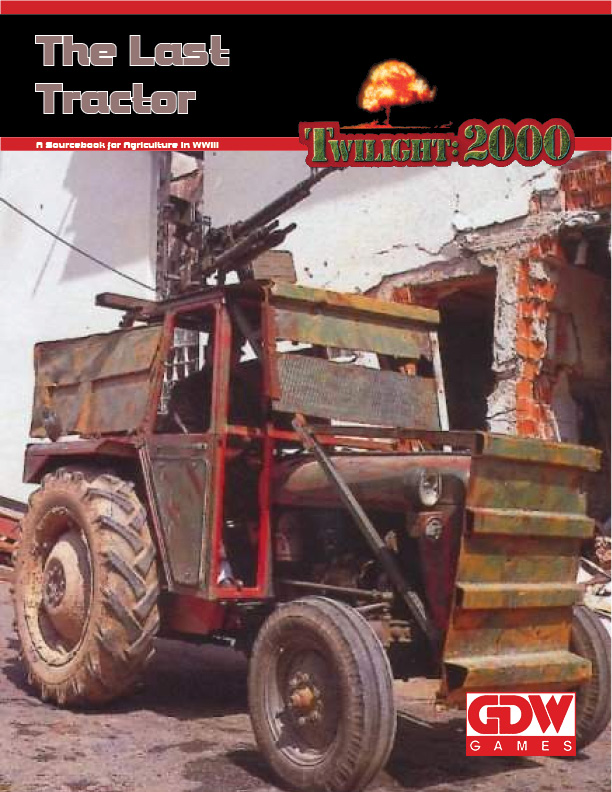
The Twilight: 2000 Avatar Game

Back in the day, my World of Darkness group occasionally dabbled in what were then called “avatar campaigns” – porting the real-world players to the game’s character model. I’ve seen this done in a number of other settings, usually with results as grim and dismal as ours were. Off the top of my head, the only published systems that are designed for it are Outbreak Undead and its SPEW-AI assessment quiz, and possibly Legendlore (it’s been a while since I glanced at it).

During a discussion elsenet about Twilight: 2000 campaigns, someone commented on players who feel that their real-life military experience should entitle them to command roles or better character traits in play, regardless of the normal character creation process or results. I was inspired to provide something to… help… those folks. These, then, are my pre-alpha-test notes for running player-history-based characters. This should work for any edition of the game.

Step One

Bring to the table printed copies of the following:

  • your latest medical examination up to, but not later than, your nation’s official entry into combat (November 1996 for American players in most editions)
  • if claiming military service, your DD-214 or equivalent
  • if claiming education, transcripts from all postsecondary education attended
  • if claiming workplace experience, copies of income tax records for each year claimed that clearly show claimed occupation for that year

Step Two

Assign attributes and skills appropriate to your verifiable personal history up to November 1996 (or equivalent).

If you had no military service history prior to November 1996, assume you were drafted and apply additional skills appropriate to the training an infantry conscript would have received in your nation in 1997.

Step Three

Pass your personal history documentation and character sheet to the player on your right.

Using your choice of red pen, X-Acto knife, or Zippo lighter, audit the materials you just received and correct the character sheet as you deem appropriate.

When done, pass that character sheet to the player on your right. Continue this process until your own character sheet returns to you.

Step Four

Roll 1d20 and consult the following table:

  1. died in transportation accident or enemy attack during deployment or troop movement
  2. died from small arms fire
  3. died from artillery
  4. died from air strike
  5. died from other kinetic effect (e.g., minefield, heavy weapons fire, destruction of vehicle)
  6. died of strategic nuclear strike on critical infrastructure or military installation
  7. died of tactical nuclear strike
  8. died of radiation poisoning
  9. died of untreated chronic medical condition (either existing but previously-undetected or caused by wartime conditions)
  10. died of animal- or insect-borne illness
  11. died of foodborne illness or accidental toxin ingestion (e.g., eating the wrong frog)
  12. died of respiratory illness
  13. died of dysentery
  14. died of dietary deficiencies (e.g., scurvy, rickets)
  15. died of starvation
  16. died of dehydration
  17. died from medical error (e.g., incompetent surgeon, contaminated or incorrect drugs)
  18. died of environmental causes (e.g., heatstroke, hypothermia, drowning, snakebite)
  19. succumbed to despair and self-terminated in a manner of your choice
  20. survived to enter play

Step Five

If you rolled 1 through 19, contemplate the yawning abyss that is your own mortality and the inevitable triumph of entropy over everything you’ve ever been, done, known, loved, created, or experienced. Take two drinks.

If you rolled a 20, do the following

  • Roll a number of d20s equal to the number of edits the other players made to your character sheet. Add the total of all rolls. This is your starting rads.
  • Multiply your starting rads by 10. This is your starting budget for selecting equipment.
  • Roll 1d4-1. This is the number of promotions you earned after November 1996 (or equivalent). Record your new rank, then edit it off your sheet because it doesn’t matter any more.

At this point, you’re probably the only person at the table with a surviving PC. Good luck! You’re on your own!

This is intended as satire and should not be used for actual campaign setup. No grognards were harmed in the making of this post.

Adhesion

I would like to note for the record that Loctite Superglue Gel is the only thing I’ve found that makes assembling multipart miniatures a bearable task in any way whatsoever. It’s not bad for basing figures, either.

That is all.