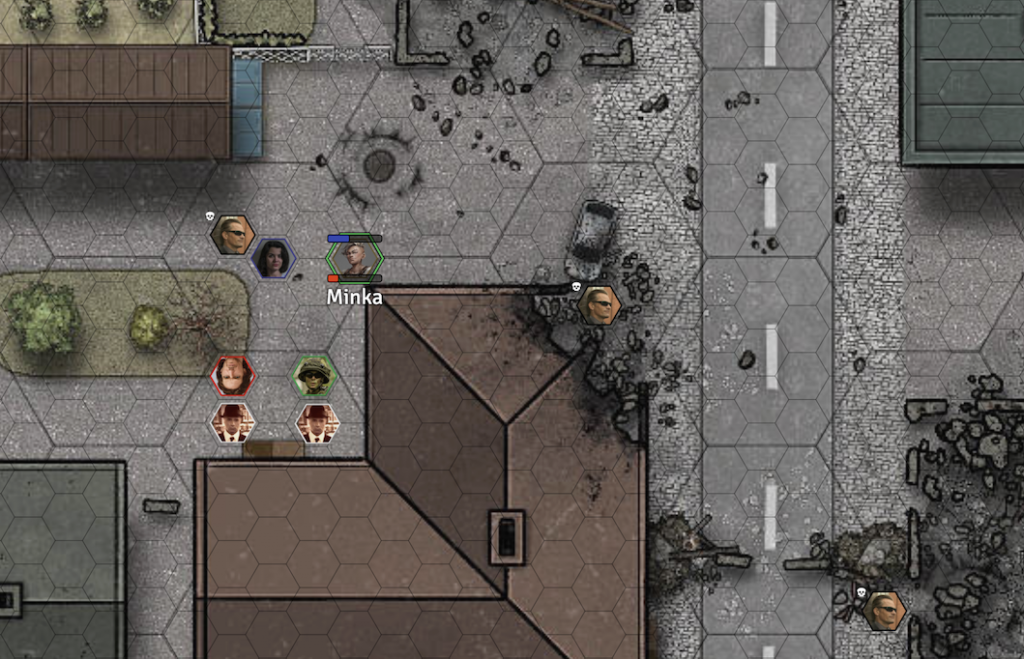
As my PCs are learning (and my players already knew), the world of Kaserne on the Borderlands is not a stock Twilight: 2000 setting. There are definite anomalous elements, starting with their own difficulty in recalling specific events before their arrival in Ponikla. What they’ve experienced so far:
Zenobia grew up in Ponikla and remembers the forest around the village being much less dense. She also recalls the Pilica River being not nearly as wide and deep as it is now. Childhood memories tend to make things bigger than we perceive them as adults… not smaller.
The river water has hallucinogenic properties with possible precognitive visions.
Something has been taking the village’s children… and returning them with missing time. I haven’t had this occur on-screen yet (it was a player-submitted problem for the village) and I really should do something with it soon…
The disappearing/appearing swamp road southwest of Ponikla where they acquired their UAZ-469.
The mysterious circumstances that led to that UAZ-469 being found abandoned and idled dry, with impact damage to the front end and lots of blood splatter on the ground around it.
So far, everyone they’ve encountered from outside Ponikla has had serious issues with long-term memory and any sort of planning or abstract thought, as well as a general inability to comprehend the concept of “map” or other recorded knowledge. Conversation that probes the latter topic has induced some sort of minor seizure, after which the issues have receded.
What’s a map? The PCs have failed to find maps in at least three places they would have expected to find them (highway maintenance facility, mobile command post vehicle, railroad maintenance facility).
For that matter, other recorded knowledge is profoundly rare, too. Ponikla only has about five books. The most blatant and recent example of this is the apparent erasure of a family library that Zenobia remembered being in a relative’s house at the village by the rail yard.
A pack of dogs with healed wounds that should have been fatal.
A couple of instances of weird howling or heavy wind noise coming from the river with no apparent weather pattern to account for this.
Pettimore’s memories of living through events of June through October 2000 before finding himself in Ponikla in May 2000.
I’m not saying there’s a pattern (because I may be making all of it up as I go along)… but there is definitely a direction I’m going with this.
I’m currently running for eight players. We have a private Discord server which we use for all our scheduling, worldbuilding, and between-session communication. Its one limitation is long-term recordkeeping, so I’m considering shifting to a forum for some content, but Discord’s always-on nature makes it very convenient for actual conversations.
(Initial recruiting was easy because everyone is either an original member of, or immediately adjacent to, my college-era World of Darkness gaming group, most of which still maintains contact. So I didn’t have to go far to seek players.)
After some initial shuffling about, we seem to have locked onto a monthly scheduling cycle. At the beginning of the month, I look at my personal and work calendars and determine the nights on which I expect to be available to run. My players typically carve out one evening a week, though we do have some weeks with a weeknight slot and a Saturday slot.
I require them to commit to a date and give me their agenda at least 48 hours in advance so I’ll have enough time to put together a session. I’ll run with as few as three people signed up, though so far I’ve had between five and eight for any given session.
The biggest scheduling problem so far has been player reluctance to commit to a time slot that might exclude someone. I think traditional linear campaigns have given us an expectation of maximizing inclusion. I’ve tried to set different expectations here with the statement that this is more like a LARP (which all my players have experienced, most of them extensively), in which it’s not expected – and, indeed, is often physically impossible – to be involved in everything that happens over the course of a weekend.
I also write campaign posts here with my players in mind. Those who miss a session can get caught up (assuming that it’s pretty close to what the other PCs would have told their character).
Platforms
As previously mentioned, we’re using Discord for scheduling and between-session communication. We also use it for voice comms during play. I’ve set the server to require push-to-talk to reduce the amount of people talking over each other, and because I got tired of interruptions from people yelling at cats.
Our virtual tabletop for this campaign is Forge. This is the first time I’ve used it, but I wanted to give it a shot because of the available official rules pack. One of my players was an early adopter and was able to give me a solid tutorial in its use. The official material isn’t perfect, but it’s a 95% solution for me, which is far better than I could have gotten out of Roll20’s current offerings. I’ll go into a bit more detail on how I handle character management, inventories, journals, and battlemaps in a future post.
The World and the World Map
Previous blog posts have shown the gradual reveal of the world map:
You’ll see this material again
It should be unsurprising that I’m using the Poland map included in the T2k 4e boxed set and the Forge system pack. The players’ home hex, for those following along with the full map, is Af25, the approximate location of the real-world Ponikla.
For reasons which will eventually be revealed in play, I’m running their world map with heavy fog of war. They have to explore a hex to open it up on the world map. However, as the GM, I can see the whole thing. Thanks to Forge’s ability to link journal entries to map icons, I have GM notes on encounters, locations, and factions scattered across the world map. This includes canon locations of major military units (I’m using the 1e continuity) as well as a large amount of material inspired by Jed McClure’s Old School Polish Sandbox hexmap and key.
Places to go, plot to uncover.
This framework enables me to improvise encounters and locations that are somewhat internally-consistent.
Session Prep
When my players decide where they’re going and what they’re doing, I check my GM notes to see if I have anything already there. If not, I’ll come up with something based on nearby items of interest, my random encounter generator, and my overall intentions for the campaign.
For exploring a new hex, I try to seed at least three distinct items. These can be combat encounters, noncombat encounters, interesting problems to solve, recoverable potential resources, or things that tie into the campaign’s overall evolving plot. I also establish what the hex’s terrain is like (starting with the base terrain type[s] shown on the world map) and what was there before the war.
We don’t always get to all of the prepped elements in a single session. Depending on what I had prepped, I’ll either retain it in my GM notes for a later encounter in the same hex, or I’ll recycle it for future use in an appropriate place.
As my PCs start getting out of their home hex region, they’ll start rubbing up against some of the local factions I’ve established. For each of these, I have a home base, an area of influence, resource surpluses and needs, general military strength, and overall agendas. These should enable me to determine how members or leaders of the faction will react to PC actions. Factions will also change over time, either in response to PC actions or as a result of the established trends in the 1e setting and continuity.
Overall, my sessions so far have been about 10% random tables, 40% preparation, and 50% improvisation off the first two elements.
09 July is a day of several projects. At the top of the list is saving Jacob’s life. Red and Minka sedate him as best they can and spend all day removing dead tissue and cleaning out infection. At the end of the procedure, the prognosis is mostly positive. He’ll need to stay under observation for a couple of weeks before Red is comfortable with him traveling, but he’ll most likely be able to heal in time.
Zenobia, still rattled by weirdness in the village by the railyard, busies herself with setting up the still that the team brought back. This doubles Ponikla’s fuel production capacity, and a day of test brewing assures her that she got the work right.
Ellis leads Pettimore, Leks, and Miko back to the highway maintenance shop to retrieve the drilling rig, which he wants to put to work on a well. They also take the opportunity to hook up the trailer-mounted air compressor and jackhammer and drag that back to Ponikla as well. Miko insists on a side trip to check out an abandoned farm and returns with 35 liters of lamp oil and an antique set of leatherworking tools.
Magda has had quite enough of whatever is going on with the lack of written records. She spends her day in the hostel’s common room, carving the beginnings of a regional map into one of the tables.
The team spends the next couple of days down at the railyard, coaxing the four remaining kids out of their collective shell and doing the heavy lifting necessary to relocate the drill press and lathe to Ponikla. Minka and Zenobia have plans for the shop equipment.
(Malvina sends notes back with the team, ostensibly to provide updates on Jacob’s condition. Ellis, who is practiced in his tradecraft, notes that she’s almost certainly slipping codewords in there to reassure the others that she hasn’t been sold to slavers or something of the like.)
On 12 July, the team splits up. Leks, Minka, Pettimore, and Miko make another run to the railyard to recover the locomotive traction motor, as there’s been some discussion around ways to convert that motor to electrical generation via windmill or waterwheel. Ellis, Red, Magda, and Zenobia get to work on the drilling rig, restoring it to operational condition and doing a couple of test bores before trying to figure out the best site for a well. There’s also some fuel brewing to do, as all of this local travel is chewing through the team’s methanol reserves.
Additional salvage during this time :
more personal hygiene supplies
a general array of home furnishings to replace/repair stuff in Ponikla that’s wearing out (furniture, curtains, silverware, etc.)
five 100m spools of electrical wire and 12 blasting caps
a wood chipper (single-axle mount, can be towed behind the UAZ-469)
a set of brass knuckles that will imprint the name MANFRED on anyone punched with them
a fuel drum containing 50 liters of coal oil (the Boxcar Children have been tapping this for lamp oil but will offer to trade it for Magda’s cooking)
20 25kg bags of asphalt mix
a copper sautee pan (which Magda claims for the hostel’s kitchen)
two motorcycle tires
five small batteries
13 July is a day of much-needed downtime… mostly. Zenobia pulls the UAZ-469 and the farm tractor offline for overdue maintenance [overdue because I wasn’t doing a great job of enforcing the need for it until now].
Minka has enough hand tools and scrap metal to start re-creating her blacksmithing setup. It’ll be an extended project [1 week, Stamina roll, Tech (Blacksmith) roll] but this gets her started.
Ellis grabs Leks and a couple of the older locals and goes surveying for well sites.
Pettimore disappears into the woods. He comes back near dusk with a feral pig over his shoulders and a canvas sack full of wild blueberries and mushrooms.
Magda, perhaps foreseeing this, has spent the day with Fryderyka’s partisans and Malvina, salvaging bricks from the village’s scrapyard to build a smoker. It’s nearly done by the time Pettimore drags his bounty into the hostel’s courtyard.
Miko likewise disappears into the forest. He’s headed upriver a bit, keeping his eye on the surrounding territory and looking for the source of suspected contamination on the river.
Red does some medical clinic work, including checking on Jacob’s healing progress, and spends the rest of the day tending one of the stills.
Miko’s Patrol
Adding this separately because it’s the first time I’ve tinkered with my homebrew patrol downtime action.
On the trip out, Miko finds the mummified corpse of a British paratrooper still dangling from his chute in a dense grove of trees. Most of his gear is decayed beyond usability – rust, weather, animals – but Miko does find a pair of laser-protective goggles that look intact. They basically look like dark polarized ski goggles.
He’s at the westernmost edge of his planned patrol route when he sees the wreckage of some sort of structure down at the water’s edge. Creeping closer, he can see fuel tanks, pontoons, pipes… it looks like a military field refueling point, maybe for river patrol boats, maybe for a crossing point here. There’s nothing but scrap left, but it’s a landmark and maybe some of the materials could be salvaged.
On his way back, he spots something odd on the far bank of the river. There’s a spot about 10 to 12 meters wide where the vegetation at the river’s edge is flattened. There are no tracks or footprints that he can see through his binoculars, and no other signs of disturbance, just a swath of evenly-flattened reeds and grass, flattened away from the water and leading up to the firm ground of the riverbank. He’s never seen anything like it before.
The final reconnaissance operation to adjacent hexes sees Red, Leks, Magda, Minka, and Zenobia loading up the UAZ-469 and traveling south.
Current map status.
The team picks up the mostly-paved road heading south out of Ponikla. It leads out to Highway 12, where they encounter the remains of a traffic jam. It looks like someone decided to clear the road with a bulldozer. As would be expected on a major route like this, most of the wrecks are thoroughly stripped, but Leks does find a few usable spare parts on the carcass of a Polski Fiat subcompact.
Feeling a bit exposed on the crumbling blacktop, they cross the highway and continue south. The terrain out here is more of the same: undeveloped grassland and abandoned farms dotted with occasional stands of trees. They’ve been traveling for a couple of hours when they sight an immense industrial building to their west – and a tiny thread of smoke rising from its vicinity. This bears closer examination.
As they move in, the structure resolves into the centerpiece of a complex. It’s a railyard, a maintenance and repair facility for Polskie Koleje Państwowe – PKP or Polish State Railways. It’s taken bombing or artillery damage, with several buildings collapsed and the main depot’s roof in tatters, but enough is intact to give them hope of salvage.
Beyond the depot lies a small village, likely former housing for the PKP workers. Zenobia recalls this place from childhood visits. One of her relatives worked for PKP and lived here.
The team parks the UAZ-469 for a quick getaway and moves in. The smoke trail has vanished, but in the center of the yard are a pair of railcars that don’t look like the others. They’re a passenger coach and a baggage car, concealed from casual view but vividly spraypainted. Lawn furniture and other signs of habitation are scattered around and the smell of fresh baking wafts on the breeze.
A quick Midjourney impression from Magda’s player.
Magda and Minka enter while the rest of the team keeps watch. There’s a brief jumpscare from a terrified cat [tabletop is not great for jumpscares] but the cars are otherwise unoccupied. The passenger car appears to be the living quarters for a half-dozen or so people. The baggage car contains a small crew lounge, which is still in use as a kitchen and communal living area. It’s also full of smoke, the result of someone pulling the damper on the small coal stove without quenching the fire. A pan of small cakes is still cooling on the work surface along with other evidence of interrupted food prep.
It seems that whoever lives here saw the PCs coming and hightailed it. A search around the area doesn’t show anyone except the cat, who is now under another railcar and occasionally growling at Leks. The PCs are still very interested in whoever’s living here, because the clothing sizes suggest kids, but they have other things to do, so they turn their attention to the rest of the railyard.
The one intact maintenance facility is dark, its roof intact and its windows stained with decades of soot and grease. It takes a moment for the PCs’ eyes to adjust enough to make sense of the massive diesel locomotive parked here, opened up for maintenance with its 18-ton Engine of Damocles hanging from the overhead crane. A clipboard full of paperwork indicates that it was pulled in for an overhaul only a few days before the first battlefield nukes flew in September of ’97. The building has been stripped of most portable items, but in a gloomy back corner, the team uncoveres an industrial lathe and drill press. This may be the most excited anyone has seen Zenobia… and she grows even more effervescent when she finds that one of the locomotive’s traction motors has been pulled for rewiring and is mostly-disassembled on a work stand.
Marking this for definite future looting, the team continues moving through the railyard. Many of the railcars here are derailed or damaged, but their census identifies a total of eight passenger coaches, two baggage cars, and a single lounge/bar car that still seem usable (not counting the two inhabited cars).
A couple of missions ago, Leks developed a sudden passion for philately after unearthing someone’s stamp collection. He nudges the team in the direction of the complex’s office and is rewarded with several uncut sheets of Poczta Polska stamps commemorating the evolution of PKP’s locomotive fleet.
Every item in a PC’s inventory doesn’t have to have combat stats.
In a maintenance closet, Minka finds a baseball bat, a few baseballs, and a number of gloves – clear evidence of someone’s capitalist imperialist cultural contamination, especially when combined with the small still that appears to have been in use for PKP staff homebrew purposes. Additional exploration turns up a still-charged fire extinguisher and a four-gas meter (set up for oxygen, carbon monoxide, methane, and hydrogen sulfide monitoring). In the supervisor’s office, Zenobia uncovers a wall safe, which she makes short work of. This contains the real prize: two vacuum-sealed bags of coffee beans. The small gold bars are an afterthought, and the stacks of paper currency don’t even rate attention except as possible wallpaper.
Zenobia leads the team into the village, heading for her relatives’ home. It looks abandoned, as does everything in the village. She finds the spare key where she remembers it being and lets herself in.
Inside, there are signs of a hasty but orderly evacuation. Luggage, clothing, and valuables are missing. Something else is missing, too. In the room where Zenobia remembers a library crammed with literature and railroad technical manuals, there’s instead a badly-vandalized formal dining room. No books. Zenobia does not take this well [2 stress] and dashes outside.
The team clears the house, recovering a small amount of cleaning chemicals and personal hygiene items. In the kitchen, Magda finds a collection of handwritten recipe cards in an ancient tin file box. Checking several other houses reveals similar conditions: people gone, light looting, and no printed materials. No maps (there wasn’t one in the railyard office either), no books, just a few fragmentary notes or bills or out-of-context documents that provide no useful information.
The team heads back to the railyard, determined to find the suspected kids. They catch a lucky break when Magda sights the glint of sun on glass coming from a derailed baggage car on the south end of the yard. Looking closer, the team can see it’s been sketchily fortified.
Minka elects herself as the negotiator and moves in cautiously. She keeps her cool when a warning shot from a slingshot whizzes past her head, and is eventually able to open dialogue with a spokesurchin. Over food and many reassurances, a story emerges from the kid, whose name is Malvina.
The Boxcar Children are six local teenagers, four girls and two boys. They returned from a school trip to find the village empty and their families gone. The story goes nonspecific here, but they decided to stay in the village until looters and slavers started coming through, at which point they relocated to the more hidden and defensible railyard. (All of the team bristles at the mention of slavers and the implications therein.) They’ve been surviving on scrounged canned goods, foraged food from the wilderness, and unwary small game.
To Red’s eye, they’re all suffering from the typical array of apocalyptic vitamin deficiencies and poor hygiene. More critically, one of them has an unspecified respiratory ailment (not asthma, that’s all Red can tell right now) and another, Jacob, has a bad eye injury with a spreading infection that’s already at a life-threatening level.
Through diplomacy, food, Red’s medical credentials, and diplomacy, the team is able to convince Jacob to return to Ponikla for surgery. Malvina agrees/insists on accompanying him. The other four kids aren’t quite ready to leave yet, but they’re willing to negotiate with the team for trade and salvage rights.
This session packed quite a bit of exploration and plot into four hours. The entire situation with the kids was pure improv. All I had in my notes was evidence of habitation but the players immediately latched onto that and I didn’t want to give them nothing for the amount of effort they were putting into the project.
Also, I continue to be highly entertained by the amount of work my players are putting into homesteading. They’re heavily invested in upgrading Ponikla.
This is mainly a bookkeeping and time tracking post, as these also serve as my GM notes.
Minka, Zenobia, Leks, Magda, and Pettimore spend a few days repairing and recovering the equipment they located in the abandoned town. It’s a non-trivial fuel investment, but at the end of three days, they’ve added a small bulldozer, a farm wagon, two disc harrows, a hay baler, and a potato spinner to Ponikla’s machine sheds.
Red and Ellis use this time to set up the lab equipment. One of Ponikla’s houses had a geothermal HVAC system that still mostly works, so that’s a logical place for what’s now becoming Red’s medical clinic and analytical lab.
Miko completes work on his sniper hide on the south side of the village [treated as a lookout point base improvement].
The PCs are still learning and mapping their surroundings. This op sees Minka, Leks, Miko, Zenobia, and Red going southeast:
The revealed map thus far.
Since they’re staying on the same side of the Pilica and have fuel available, the team decides to take the UAZ-469 rather than walking. Their first destination is the rail bridge that they found in their previous (northeast) reconnaissance. With Zenobia along, they hope to get a bit more structural assessment [Zenobia has Intelligence A/Tech B] and maybe recover some of the explosives that they spotted.
This leg of the trip is without incident. They conceal the UAZ in a small thicket and, after carefully checking their surroundings, cross the bridge on foot. The structure seems to be in good condition, though it could use some rust scraping and a fresh coat of paint.
Once they’re on the other side, Red and Leks pull security while Zenobia leads Miko and Minka out to inspect the explosives. As best the team can tell, a 20-meter span near the bridge’s north end is rigged for demo, but whoever was setting it up was taken out in an artillery strike before they could touch it off. There’s some discussion about the wisdom of salvaging explosives that have been out in the weather for a few years, but greed wins out [and solid Tech rolls avoid catastrophe]. The haul is 38 bricks of West German plastic explosives, 9 electric blasting caps that haven’t corroded too badly, and a couple hundred meters of wire.
As the team is packing up, Red spots movement across the river, in the thicket where the team parked their UAZ. There’s a scramble to get back to the south bank, which ends in relief when a very large Belgian Malinois pushes its way out of the thicket and trots off to the south. Minka immediately takes off after it, but she loses its trail. Checking on their vehicle, the PCs find a number of muddy footprints on the fenders and door and a fresh territory marking on on one of the tires.
Continuing their mapping expedition, the team heads south, following the rail line. After about five kilometers, they encounter a junction: the double track continues south, but another single rail line joins it from the southeast. Just past this junction is an east-west paved road that runs through the center of a devastated town. There’s some discussion as to whether this was the result of a large conventional explosion or a tactical nuke, and a general realization that no one packed the Geiger counter. Zenobia quells those concerns by pointing out that the blast’s epicenter seems to be the shattered stump of a grain elevator.
The team parks the UAZ and begins exploring on foot. From the burned-out vehicles and other evidence, it looks like this town was the scene of a fight between Polish+Soviet and Polish+British forces. Their assumption is that someone hit the grain silo, either accidentally or deliberately, and ended the fight for everyone.
Miko, who’s already developing a rep for poor judgement with explosives, locates a few unexploded antitank mines by walking into the middle of the pattern. Amazingly, the team’s luck holds and they’re able to recover all four without incident. Minka wants nothing to do with this process and puts a few buildings between herself and this scene – and lucks into the ruins of a tree nursery in which a half-dozen cherry trees are still alive.
Red finds the local telephone directory, which is basically three mimeographed pages and a rusty staple. It does, however, point toward the local veterinary clinic, which is on the southwest edge of town – farthest from the blast. He rallies the rest of the team and they head that direction.
The vet clinic is on the other side of a large block of apartments. The team is almost there when they spot movement at the end of the street, about a hundred meters away. It’s the Malinois again, looking out from behind a wrecked car. It barks at them, backs up, bristles, and turns away as a pack of feral dogs emerges from the ruins!
This fight could have been uglier. The PCs are not heavily invested in Close Combat – Miko and Minka are the only ones who have any. I gave them twelve dogs, which initially were acting in groups of three (i.e., one attack roll with a +2 bonus for support, rather than three attack rolls). The PCs were justifiably concerned about rabies, so a lot of blocking occurred. Red took a bite to the arm; everyone else either took the hit on their armor or was able to counter the dogs’ successes with their blocks.
Aftermath. Leks was briefly surrounded by five dogs; I’m amazed I didn’t do more damage to the PCs.
With wild dogs only having Hit Capacity 2, a successful attack from anything but a pistol was an immediate kill. The close-quarters nature of the fight prevented a lot of shooting, though Red did take down his trio with a burst/buttstroke/burst combo over three turns. Minka and Miko both performed admirably. Leks finally got to use his pump-action shotgun, decapitating one dog with his first attack before they closed in and emptying the tube into a second one before he had to resort to melee.
Minka dresses the bite wound in Red’s forearm. Red tries not to lose his shit as he borrows Miko’s machete and splits open a dog skull. He and Minka don’t see any abnormalities… but Minka notices that all of these dogs have healed bullet or shrapnel wounds that should have been fatal.
The team checks the vet clinic. It’s mostly stripped but a few things remain. There are a few doses of blood thinner and strong stimulant, as well as an autoclave which Red immediately claims for his lab. A stuck drawer yields to Miko’s lucky crowbar, revealing a set of surgical tools, something Red needed badly.
Red and Minka really want to know more about what’s up with these dogs. They haul one into the clinic and plop it on an exam table for a necropsy. Miko, Leks, and Zenobia head outside to poke around a bit more and pull security.
Miko stays at street level, keeping an eye on the dog carcasses. He realizes he’s standing amid a lot more expended brass than can be accounted for by the team’s recent fight. Someone burned off at least a couple hundred rounds here, fairly recently – the casings still smell of expended powder. He’s seeing a lot of pockmarks in the asphalt, too, as if the gunfire was directed down…
Zenobia finds an intact fire escape and sets up on a rooftop. It’s a nice day – made nicer when she spots a light industrial building by the rail line that looks like it’s mostly intact. The front appears to have been some sort of glass-walled showroom, now burned out and collapsed over the ruins of a tank, but the warehouse-like main portion is still standing.
Back in the clinic, the dog reveals some profound weirdness. There’s a bullet entry wound on its left side and an exit wound on its right side, both healed into scar tissue. Red’s new surgical tools enable the investigators to open up the animal, revealing a channel of scar tissue straight through its body. That should have bisected both lungs and the heart… but those organs are displaced around the scar tissue. This ain’t right.
There’s not much discussion about how this might have happened. The team goes straight to “decapitate the carcasses and burn them at a crossroads.” [This is what I get when I have a bunch of veteran World of Darkness players.]
While heading back to the UAZ (no one wants to carry the autoclave across town), the team stumbles upon rather a lot of horse crap. Minka, who’s worked with horses her whole life, does the math and comes up with 50 to 60 animals moving through the area about four days ago. The team locates additional signs that about the same number of people camped here. Leks points out that the only people with that many horses are military cavalry formations. There’s no sign of them now, though, so the team loads up their loot and heads to the warehouse.
The building’s rear door yields to Zenobia’s locksmithing skill. The place appears to have been an agricultural machinery showroom and repair shop. Most of the portable tools and supplies have been looted, but a small bulldozer is parked in front of the roll-up door. Its stripped engine is dangling from a block and tackle but Zenobia and Minka are pretty sure their stash back at the garage contains all the parts they’ll need to repair it. Lurking in the warehouse’s shadows are also a hay baler, a potato harvester, two disc harrows, and a wagon, all in need of repair but potentially usable if the team can get them back to Ponikla!
I will be vaguely disappointed if they don’t go all Killdozer with this thing at some point.
Completing their survey, the team heads home. Late that evening, Ellis, Red, and Pettimore assemble around a bonfire to raise a cup of mead and toast their far-off country.
Following the gunfight with the ZOMO and the subsequent fruitful negotiations with the local farmers, the PCs spend a few days on maintenance and some other projects.
Red gets Pettimore back to Ponikla and settled in for healing, but once he’s sure the sniper isn’t going to bleed out, he’s focused on getting his new lab. He spends a few days with the farmers, running a pop-up clinic and packing up the lab for transport. Minka and Magda assist him.
Zenobia has some work to do on weapons damaged in the fight. She also turns her hand to fuel brewing and finally gets around to fixing up the UAZ-469 and finishing her work on the OT-64. Both vehicles are back to 5/5 Reliability (though the OT-64’s amphibious capability and left armor remain compromised).
Miko is jealous of Pettimore’s lookout post atop the hostel and begins constructing his own sniper’s hide in the trees north of Ponikla.
Ellis and Leks pack up a few days of food and head east, trying to locate the refugees they saw in Mysiakowiec and determine what those folks are up to….
I decided to treat the lab as another base facility. Once it’s set up, it’ll give a +1 bonus to Tech rolls made for agronomy- or ecology-type analysis. Finding and adding further equipment can extend that bonus to other rolls.
I also floated a new downtime activity to the group:
A hex is something like 60-70 square kilometers, so the initial mapping and exploration we’ve been doing doesn’t reveal everything in it. Scouting an explored hex takes one shift (plus travel time) and requires a Recon roll (modified by terrain, weather, and plot factors; Scout specialty provides a +1 bonus). If successful, the scouting attempt reveals one item of interest per success. Items of interest may be:
landmarks
exploitable resources
hazards
active threats
intel/clues
salvage items
plot
On double 1s, something unpleasant (but not lethal) befalls the scout(s).
Continuing their local reconnaissance, the PCs cross the river at the abandoned village of Mysiakowiec and head east along the Pilica’s north bank. This time it’s Ellis, Pettimore, Magda, Minka, Leks, and Red in the field.
A couple of hours’ walking brings them to what appears to be an intact bridge supporting two rail lines which run north-south. A few artillery craters around the northern end of the bridge indicate that something went down here – and the shattered remains of a truck make it evident that someone lost big-time.
Closer examination of the bridge indicates that it’s rigged for demolition, with charges and wire still in place. There’s discussion of salvaging the demo but the PCs decide to leave that alone for now – that’s not what they’re here for. They continue north, following the rail line for a while before breaking off to go cross-country. The area is more of what they saw on their last expedition across the river: open countryside dotted with abandoned family farms.
Early in the afternoon, they come across an unpaved farm road and follow it. It intersects with a two-lane paved road running east-west. As they pause to choose a direction, they hear gunfire from the west – it sounds like a lopsided gunfight.
Moving quickly in that direction, they crest a small rise. On the north side of the road, a small force of what appears to be civilian irregulars is defending an intact gated facility of some sort. They’re under attack from a larger group of better-armed troops in Polish uniforms. Scanning through binoculars, Magda recognizes the uniforms as ZOMO – regime protection and riot control troops, very few of whom went over to NATO. Based on this information, the PCs decide to enter the fight on the side of the underdogs.
Leks and Pettimore set up for long-range support while the other PCs close up on the ZOMO flank, using trees for concealment. A nasty close-range gunfight ensues as the ZOMO troops turn to face the new threat. Leks and Miko take wounds and Pettimore is hit hard, with an arterial bleed severely cramping his marksmanship. The PCs prevail, though, and Red gets to Pettimore before the sniper bleeds out.
In the aftermath, the PCs make wary contact with the surviving defenders, who introduce themselves as the local militia. They’re all farmers, probably none under the age of 50 (the eldest, who looks to be about 120, cheerfully brandishes a scoped Mosin-Nagant and informs Leks that he doesn’t have to be able to walk very quickly to kill communists).
The team checks the bodies of the fallen enemies. They’re all wearing insignia of the ZOMO force out of Radom, which the PCs believe to be about 30-40 kilometers east of Poninkla. They were well-equipped, with wz.88 Tantals (including one mounting an underslung grenade launcher), a PK MG, and a SVD sniper rifle.
Ellis and Magda, who’ve gone forward to open negotiations, quickly realize there’s something off about these dudes. They’re not using the facility they were defending – they’re keeping everyone out of it, even at the cost of their own lives. When asked, they state that it was some sort of government biological research facility. The scientists left a few years ago but they’re afraid there’s still a crop blight or other genetically-engineered hazards locked up in the labs. They burned the fields outside the fenceline to keep any genemod evil from spreading, but they’re afraid to enter the buildings. A couple of them suggest that the place’s agricultural research might have been a cover for bioweapons development.
Red is treating their wounded while this conversation is happening, and that’s enough to give him some cred with these guys. He stretches his medical credentials a bit and suggests that he might be able to give them an accurate and safe assessment of what’s inside the fence. The oldsters confer and tentatively agree, on the condition that the PCs not bring anything out of the compound.
Red, Magda, and Ellis enter the facility to investigate while the others stay outside. Their first stop is the office, which was stripped of scientific records but not administrative records. They’re quickly able to deduce that the research here was legit agronomy. A large quantity of basic office supplies is here, along with a copier that looks like it might still work.
Moving on, they locate the on-site commissary/break area. Some canned food is still on the shelves and the small catering kitchen is well-equipped. The break room contains a number of agronomy- and agriculture-focused science journals, which Red mentally marks for later acquisition.
Finally, they peek into the lab and grow-house. Most of the specialized equipment is gone but there are some basic tools and a lot of lab glassware and similar supplies – the sort of thing you wouldn’t bother to take with you if you still believed the war was going to be over soon. The building is fitted with a 20-kilowatt diesel generator, which looks like it’s been sitting there since it ran dry on fuel.
From a few remaining lab notes and evidence in the grow-house, the team pieces together that the scientists here were working on drought- and pest-resistant corn. Nothing suggests bioweapons research or any contamination hazard. The PCs exit the facility and report their findings to the locals, who reluctantly concede that they may need to re-think their stance on the lab.
That’s where we wrapped up the session, but we did have some follow-on discussion and worldbuilding on our Discord channel:
The farmers all come from seven large family farms in the area. Not all of them are inhabited by their prewar owners; some families abandoned their original properties to move closer for mutual support. The total population across those is about 50, roughly the same as in Ponikla, but more spread out (and with a higher concentration of actual farming knowledge – the seven patriarchs have several centuries’ collective experience). They’re about 2/3 original families, 1/3 urban refugees who’ve proven themselves willing to learn and take orders from country folk. As with Ponikla, there’s a distinct lack of able-bodied young men. They are agriculturally self-sufficient and probably running a slight surplus, though they’re cagey about specifics.
The PCs hand off most of the captured ZOMO gear and weapons to them, though Leks does reluctantly hang onto a PK and its belted ammo (he foresees the day when he’ll run out of 7.62mm NATO for his MG3). Red then opens negotiations for the contents of the lab. After some deliberation, the farmers decide that they will try to work up the courage to start using the complex as a greenhouse during the winter months. They think they can handle converting the generator to alcohol fuel and building a still to keep it supplied. They have no use for the lab equipment and are willing to offer it to Red in exchange for his services already rendered and a handshake agreement for a monthly doctor visit and on-call services for extreme trauma cases.
During their stay with the locals, the PCs notice that everyone in the farm community has similar cognitive issues to those they observed in Fryderyka’s crew. They do not have good recall of prewar events. They aren’t sure when they last traveled beyond their immediate area and aren’t aware of events outside that area. There are no reading materials in their homes – they don’t seem to notice the scientific journals from the lab if no one draws their attention to them. Basically, their whole awareness is confined to their farms and the immediate foraging/hunting area, with the exception of their dogged insistence on protecting the lab (which fades over the three days Red spends working with them on medical aid and packing the lab equipment for transport).
Moreover, they don’t notice or question any of these mental lapses unless someone points it out to them.
Red finds this damned peculiar and starts discreetly doing detailed interviews of the other PCs and some of the residents of Ponikla. He determines that that everyone on the list was having some similar symptoms until about a month ago. The PCs’ arrival at the village seems to coincide with the memory issues abating – for both the PCs and the Ponikla NPCs.
This session felt a little flat because I wasn’t really prepared for roleplaying in the post-gunfight phase. It’s progress, though; contact with other nearby friendly residents; and acquisition of some useful resources for rebuilding/recovery.
With the intel Ellis unearthed about a new warlord rising in Warsaw, the team needs to know more about the landscape to their north. Red, Ellis, Leks, Magda, Minka, and Miko cross the river again and turn southwest, following the Pilica’s north bank.
The travel map with my craptacular virtual walls limiting visibility because I can’t make Forge’s fog of war and line of sight do quite what I want. The Polish heraldic eagle marks Ponikla’s location.
The terrain in this area [hex] slopes gently upward from the river. It’s more undeveloped floodplain and abandoned farms. Several of the latter have the long, low buildings of hog confinement. As the team moves through the countryside, there’s plentiful sign that those buildings’ former inhabitants have escaped and gone feral. On the down side, there’s the potential for an attack. On the up side, there’s the potential for free bacon.
Derelict Convoy
The team finds an unpaved access road that parallels the river about 100 to 150 meters from the water’s edge. There’s no sign it’s in use. They decide to follow it cautiously. About a kilometer on, Miko sights a dozen or so vehicles strung out along that road. They’re rusty, overgrown, obviously damaged or destroyed. The team moves in cautiously, spotting and avoiding some unexploded cluster munitions.
The vehicles appear to have been a West German panzergrenadier company task force before an air strike caught it. There’s a Leopard II, a few Marders, a couple of trucks, and an M577 command post vehicle. Most of the vehicles are total losses but one of the trucks, one of the Marders, and the M577 may still have some salvageable contents or equipment.
The team tosses the vehicles. They find a little bit of salvageable personal kit, a few small arms (HK23, G3, P7M8), and some ammo (including a partial belt of 20mm AP for the Marder’s autocannon). The real prize, though, is the M577’s APU, which is salvageable.
Ellis tosses the M577’s crew compartment. There’s a cylindrical case for rolled maps. He unscrews the end cap and all that comes out is ashes. He does, however, find a lockbox bolted to the radio rack. He works that loose and extracts the 80-megabyte hard drive from the one Toughbook that wasn’t completely destroyed.
Some of the salvage, like the 20mm ammo and a couple of spare track links, is too heavy for the team to carry out on foot. They cache it about a hundred meters away from the vehicles and move on.
Partisans and Patients
Moving away from the river a bit, Magda sights a large-ish building situated next to a two-lane paved road. It looks like some sort of garage or workshop facility. It’s intact, with a chain-link fence around it. A couple of piles of debris or trash are strewn around the grounds, and a small forklift that looks like someone used it for target practice is abandoned outside one of the roll-up doors. Someone may be home, though – two donkeys are grazing inside the fence.
The team’s stealthy members move in for a closer look. Magda catches sight of someone moving behind the grimy windows. She can only see the person in silhouette but they may be semi-regularly checking for visitors.
Ellis catches sight of a blood trail going into the compound. His best guess is that about a half-dozen people arrived with those donkeys, and more than one of them was wounded.
The team pulls back and confers. This might be a chance to make contact with other locals who can provide information about the area. Ellis approaches with the others covering him. An initial parley doesn’t get him shot, and when he reveals that he has a doctor, the team is invited in.
Inside, the team meets a half-dozen Polish militia troops who’ve clearly come out on the wrong side of a fight. Their leader, Fryderyka Jankowski, explains that they’re from Tomaszów Mazowiecki, a city on the Pilica about 20 kilometers to the southeast. They’re some of the last survivors of the local militia, which was massacre about a month ago when a marauder band took over the city. They and a small number of other survivors have been hiding in safehouses outside Tomaszów and harassing the marauders until this morning, when they had a very bad day. They fled to this highway department maintenance station, which they’d previously identified as a safehouse, carrying their wounded.
Red and Minka have four patients. The least-injured one has a dislocated shoulder; Minka puts traction on the joint while admiring the woman’s tattoos and forearms. Red triages the others, all of whom have abdominal gunshot wounds [the random table was unkind and not very random]. He doesn’t have surgical tools – really, he doesn’t have much – but the alternative is letting them bleed out, so he and Minka and Leks roll up their sleeves and go to work.
The medical team works well into the night. They manage to get all three patients out of immediate danger, though one will never have great kidney function again and another may still succumb to sepsis from his intestinal wound. [ Some of these medical rolls and recovery times are a bit implausible. I get the need for playability, but no one should come back from a ruptured kidney in a week. OTOH, I don’t know that I want to house-rule longer recovery times, given the speed of the average campaign…]
While they’re working, Ellis and Miko check out the rest of the facility. There’s a locker room in which Miko finds a German-language edition of Battleship and a Hungarian porno magazine. In the main garage area, there’s a derelict tractor and dump truck, both long since stripped for parts; a small steamroller; a mowing attachment for the tractor; a trailer-mounted industrial air compressor with a jackhammer; a smallish drilling rig; and a hydraulic log splitter.
After surgery is done, Minka talks to Natalka, the woman with the dislocated shoulder. Natalka used to work at a factory in Tomaszów Mazowiecki that manufactured welding equipment. Minka perks right up and starts picking her brain. [I don’t know if it was there in the 1990s, but IRL, the city really does have a welding equipment factory, so this isn’t just the GM giving the players a too-convenient lead on what they just discovered they need…]
Tomaszów Mazowiecki SITREP
Led by Ellis, the team interrogates their new acquaintances. Before the war, Tomaszów Mazowiecki had about 50,000 residents. Now it has about 2,200. About half of those live in an arc of farm collectives south and west of the city. The rest reside in the city’s southern half, trying to salvage and rebuild what they can.
The city’s prewar economic cornerstone was textiles: mainly wool, but there were some attempts to diversity into synthetic silk. Several major rug and carpet factories were located there. Other local industries included the aforementioned welding equipment factory and the remnants of the region’s iron mining, which had been in decline since the ’70s. One major road bridge over the Pilica is still up and capable of taking heavy vehicle traffic.
In October 1997, NATO hit the Polish Air Force airfield northeast of the city with a tactical nuke. The city itself sustained only minor blast damage but much of its north side burned in fires ignited by the thermal pulse. The majority of surviving residents fled and never returned. Everyone avoids the north side and the airbase’s ruins out of fear of residual radiation. [The PCs with military or scientific training are fairly sure the risk is minimal.]
In mid-May, the city was hit by a marauder band formerly of the Soviet 89th Air Assault Brigade. They did recon in early spring, sending scouts into town posing as guards for merchant caravans. When they struck, they’d clearly identified key targets. In a night raid, hit the barracks for the militia’s full-time cadre and went after the homes of many other key militia members and local leaders. About twenty militia members escaped the attack and went guerrilla.
The marauders number between 40 and 50. They had no vehicles when they arrived but Fryderyka believes they’re trying to get some into operation. They do have about 20 horses, half draft or pack animals and half cavalry mounts.
The marauders’ main base is a warehouse complex by the riverfront. They’ve taken over a couple of houses and a restaurant overlooking the bridge and the western and southern approaches, which they use as watchposts when they feel like doing the work. They’re controlling the population through a combination of random violence, protection rackets, and selective hostage management.
Off the Map
One other thing of note happens during the interrogation-disguised-as-conversation. Ellis asks Fryderyka if she can sketch a rough map of Tomaszów Mazowiecki. Fryderyka, Fabian (the other uninjured Pole), and Natalka all… lock up. It’s as if all three of them are having synchronous petit mal seizures. Red does a quick assessment: all three have elevated respiratory and heart rates and sharply contracted pupils, and he’d bet that blood pressure is up too. They come out of it after a couple of minutes with mild disorientation, headaches, and no memory of the question. When Ellis repeats himself, Fryderyka has a bit of trouble parsing the question – she clearly has to concentrate on the very concept of “map.” She does eventually produce a workable sketch of the city’s layout, though.
The PCs confer out of earshot of the Poles. Ellis observes that he saw some similar cognitive difficulties with the East German prisoners. He’s also concerned about the fact that it’s been a long time since any of the PCs saw a map themselves – or, for that matter, a book. Ponikla only has five known books: two Bibles (one of them Pettimore’s), a Polish language primer, and two novels.
[Later edit: Six books. Red’s personal effects include a copy of A Clash of Kings which he picked up at an airport newsstand on his way to deployment.]
This was a fun session to run, not least because it didn’t have a combat scene. I don’t want this game to turn into unremitting combat rounds, so some exploration, looting, and roleplaying was a comfortable mix. I also got to do a little more worldbuilding and orient the players on a potential regional threat. This being a West Marches game, there’s no requirement for them to go deal with the marauders… but it’s a potential quest hub and resource pool if they want to pick that fight.
The bit with the map issue seems to have creeped out the PCs. Heh heh.
After the gunfight is over, Ellis finds a quiet place to interrogate the East German prisoners.
He learns that the band was all East German deserters. All were former conscripts; several had done prison time. They’d been operating in the area around Warsaw (north of Ponikla) until about a month ago, but a new warlord up there has been going join-or-die on local communities and bandits alike. They didn’t want to be part of something that organized again (let alone a minor part of it), so they headed south.
They did not seem to have a long-term plan. In fact, Ellis observes something that looks almost like a conditioned aversion response to questions about the future or detailed history. They literally seem incapable of recalling specific details of the war or the pre-war times, and similarly incapable of planning more than two steps or two weeks ahead. This is consistent across all four of them, even though he’s kept them separated and questioned them individually.
They admit to having shaken down the refugees but not taking anything from them – simply because they had nothing the Ossis considered worth stealing. They do not seem penitent, openly see the native Polish population as an exploitable resource, and will likely attempt to escape if they see an opening. Ellis assesses them as semi-feral.
After he shares his findings with Leks, Leks quietly agrees to handle disposal. The men are too dangerous to release and there aren’t resources for holding them indefinitely.
Magda enlists the help of Ewalina and Maciej the Brewer [both player-contributed Ponikla NPCs; Ewalina is a former high school chemistry teacher, Maciej is the village’s lead mead-maker] to bash together a small still from the community’s supply of spare parts. A few days’ work yields a working still. They start the first batch of methanol brewing.
Zenobia and Minka go to work on the OT-64, which was in lousy mechanical shape when the team acquired it. They manage to patch up the damage Leks did to its hydraulics and transmission. The breached armor is another matter – they’ll need welding gear to provide more than a temporary fix or to restore the lost points of armor. Without that, the vehicle is only amphibious for a matter of seconds.
The OT-64 is now at Reliability 4/5. They seem to have forgotten about the UAZ-469, which is still sitting at Reliability 2/5.