As a general rule, I don’t post published freelance material. This is an exception – Bruce Baugh, one of the developers involved with shoehorning it into print, posted it as a teaser forThe Book of Oblivion (Wraith 20th Anniversary Edition), the book in which it saw publication. As it’s already been released into the wild, I don’t have an ethical issue re-posting it here.
This serves as the introduction to the section in BoO (boo scary boo!) in which I got to write about ghosts in disasters. I’m an emergency manager in my day job, so this may have been the apotheotic intersection of my “normal” and gaming work. That’s probably one of the best pieces of game writing I’ve done, and I’ll always be a little sad that it’s tucked away in a supplement that maybe twelve people will ever read.
The opening image had been stuck in my head since the summer of 1996. I can’t thank Bruce enough for giving me the opportunity to get it out at a time in my life when I could write something like this. Catharsis, in an odd way that only other writers truly get.
I don’t do a lot of fiction work. This is one of two or three pieces I’ve ever written that I actually liked at the time and still like after the fact.
Early morning over the wounded city and our pilot is flying blind.
Five crews are on this op, ferried in on the last Midnight Express run, our birds tarped down on flatcars. We briefed before dawn in the railyard as the train pulled out, taking everyone who can’t or won’t fight or work. Siege conditions: evacuate the noncombatants. Oblivion is hungry today.
Blackwell is in the right seat, visor down to hide what’s left of his face after it lost a fight with a Vietnamese 57mm shell. Thankfully, it doesn’t affect his aviating. We’re in a slow clockwise orbit, scanning for survivors through two-bell winds and everything they carry. The living don’t know what’s coming – the forecast says the first bodies won’t hit the ground for another six hours – but here, the Maelstrom is already building.
“Got a tasking,” McGuire murmurs from the left seat where she’s running comms in a shared waking dream. “Augur says three on a rooftop by the university.”
Blackwell double-clicks the intercom by way of acknowledgement and breaks off to point us in that direction. It’s a short flight, even with bone hail clattering off the windshield, and Castaneda and I double-check our safety lines and lean out the doors to search.
“Fast-mover inbound,” McGuire reports. “On our six, going for the tail.”
I crane my neck and see a streak of green teeth and black robes coming at us. True to form, it’s relying on a living memory of aerodynamics, and it vomits out a tongue like a barbed anchor chain to ensnare our tail rotor and spin us out of the sky. Blackwell just grunts and holds us steady, giving the Spectre an easy target.
A noise like a handful of rocks dropped in a blender overpowers a brief squawk of dismay as Stygian steel replacement blades don’t even slow down. The chain wraps and pulls its owner in, then the Spectre hits the fan and rips apart. We barely feel a shudder. Laminate rotors were the first thing we replaced, dumbass.
“Mark, mark, mark. Torch at eight o’clock.” While I’ve been watching the show, Castaneda’s been on mission. Blackwell brings us around as I start checking my gear. We don’t want to put the bird within reach of what’s in the water, so I’ll rope down and we’ll winch those wraiths in one at a time.
That’s the plan for the next thirty seconds, anyway. I’m about to go on the line when the screaming from below – can’t hear you over the Pathos turbine, guys – intensifies. Then the wind gives us a shove toward a bell tower as a stroke of lightning splits the air where we were. I grab for a handhold and twist toward the door in time to see the first caul bob to the water’s surface, and I realize I’m hearing the screams from across the Shroud. That means the forecast was wrong and people are dying now, and this storm is about to eat us and everyone else in it.
The smart thing to do would be to firewall it and RTB, but if I were smart, I wouldn’t be in the back of a relic Huey in a Maelstrom. So instead, I lock eyes with Castaneda. “Plan B?” I ask even as she’s reaching for my harness.
“We gotta go out. We don’t have to come back,” she confirms, and then we’re out the door at a totally unsurvivable altitude. Her wings come out at the same time as my hatchets and as she turns, I can see a nihil chewing away the corner of the building. Our survivors aren’t screaming any more. They’re too busy fending off the cousin of the thing our tail rotor shredded. It’s a race to see whether the Spectre or the Labyrinth gets them first.
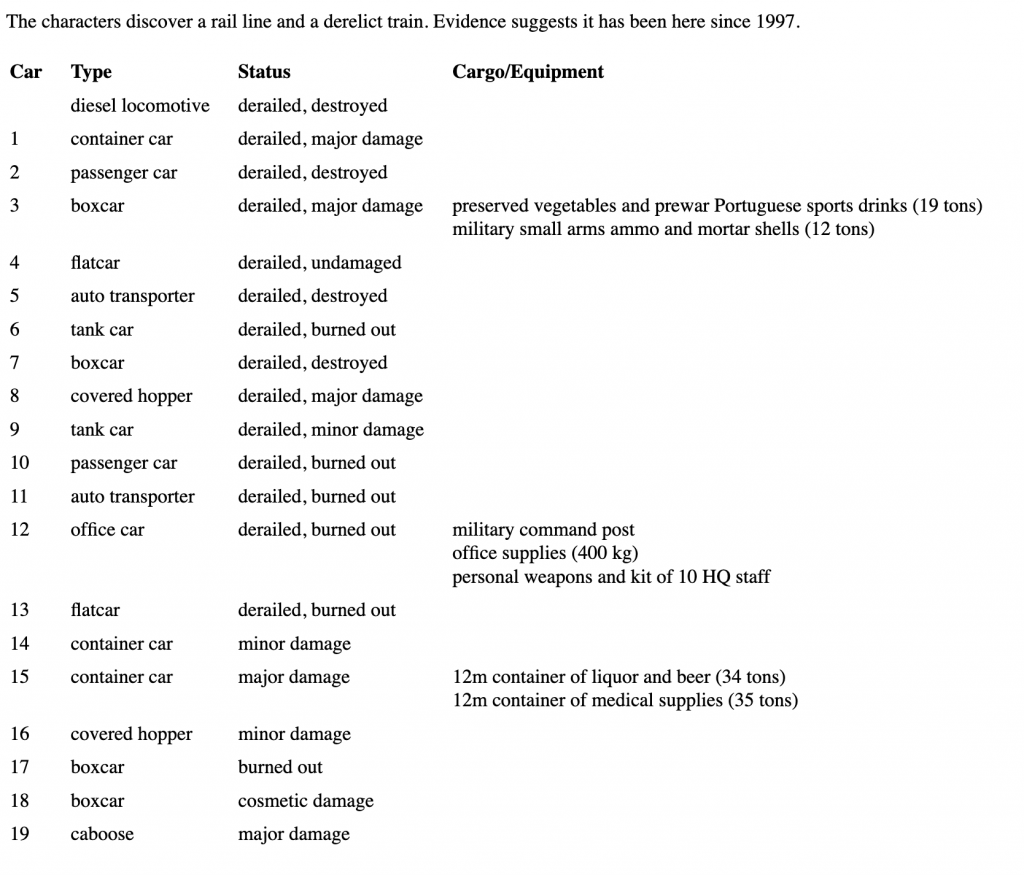
As noted in the last campaign update post, the PCs found a derelict train with some still-salvageable cargo on board:
After some dice-rolling to determine what from this survived the literal train wreck and its subsequent chlorine release, and then after splitting this among the parties involved in the salvage work (Ponikla, the White Eagles, Von Bahr’s Irregulars, and the emerging Opoczno merchant cartel), here’s the PCs’ share of the haul:
Consumables
1900 rations of canned vegetables 1000 rations of Portuguese Gatorade 3 tons beer = 6,000 bottles (500 mL each) 1.2 tons liquor = 1600 bottles (750 mL each)
3 tons shampoo, conditioner, and hair care products (1kg = 3 person-months) 1.2 tons moisturizing soap and hand lotion 6,000 personal medical kits (or equivalent wound care and surgical supplies) 600 kg antidepressants (pill; 1 kg = 1 person-year) 200 kg antihistamine (pill; 1 kg = 1 person-year) 300 kg potassium iodide (pill; 1 kg = 6 person-months) 600 kg chewable children’s vitamins (pill; 1 kg = 1 person-year) 100 kg anti-fungal (cream; 1 kg = 10 doses) 500 kg disposable syringes (1 kg = 500) 200 kg Lidocaine (injected; 1 kg = 100 doses) 200 kg gram-positive antibiotics (pill; 1 kg = 20 doses) 300 kg epinephrine (injected; 1 kg = 100 doses) 300 kg IV saline solution (1 kg = 1 liter)
anesthetic gas regulator 3x bedside medical monitors (blood pressure, heart rate, pulse oximetry, respiratory rate) medical spectrophotometer tabletop centrifuge CT scanner
I don’t think this is campaign-breaking, given how many things the PCs are trying to do that this won’t help with, but it is certainly an interesting, eclectic, and utterly massive haul.
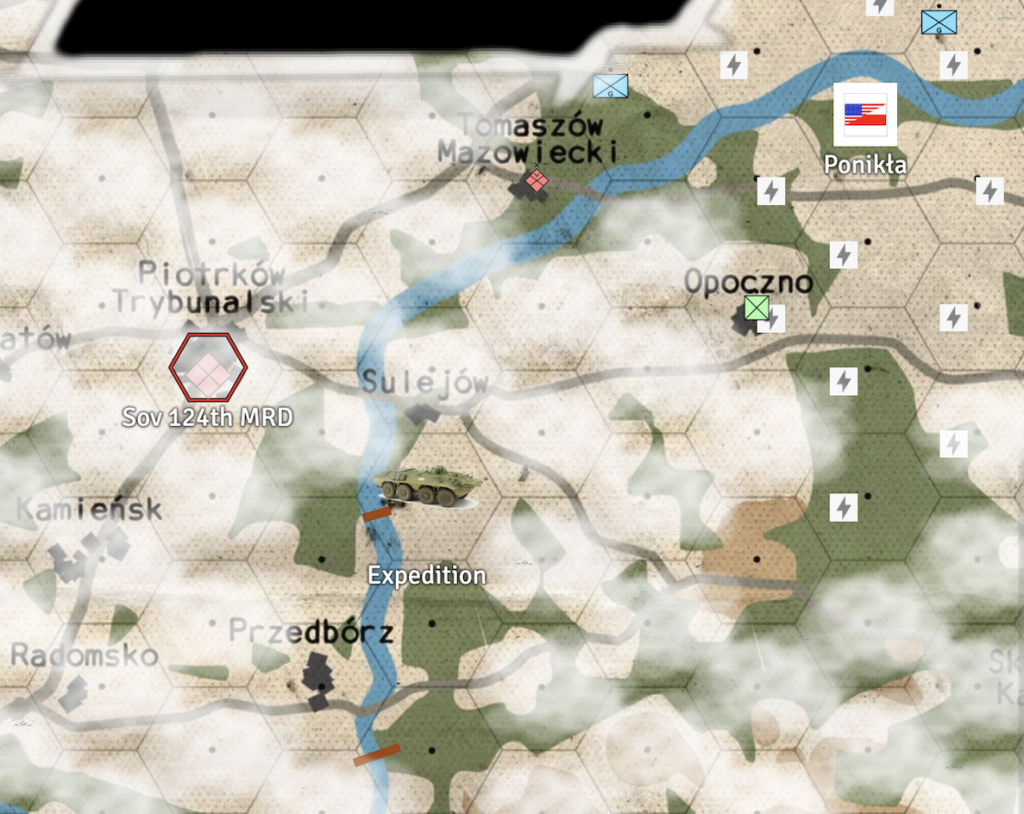
The expedition team says their (hopefully not final) goodbyes and rolls out of Ponikla under a steady rain. The first leg of their journey is through known territory, areas that are, if not entirely friendly, at least not hostile. The plan is to make for the Pilica upriver of Tomaszów Mazowiecki (whose marauders are hopefully constrained in range by the loss of their hovercraft’s fuel supply) and assess two rail bridges as potential crossing points. They know there’s an intact road bridge at Przedbórz, but they also know a marauder band down there has a ZSU-23-4, so that’s definitely a secondary option.
Travel map at the end of the session; no spoilers. “Fog” indicates hexes that the team hasn’t explored yet (keeping in mind the XP award for such activities).
They roll through Opoczno without incident, pick up the highway, and follow it to about ten klicks outside Sulejów. Going farther west would be tempting fate; among other things, Ellis’ interrogations of prisoners from the Battle of Radom reviewed that the heavily-mauled 124th Motor Rifle Division has moved into Piotrków and is running patrols as far as Sulejów. Thus, the team turns south and heads offroad. They’re aiming for the northern of two rail bridges that they believe should be there, based on their knowledge of the railroad network in the area.
It’s not until they hit a familiar stretch of highway across the river from Przedbórz that Cat’s error in navigation becomes apparent. They’re farther south than they intended to be. With dusk falling, it’s not a great idea to backtrack north along the Pilica’s east bank.
Betsy, seated in the bungee sling behind the UAZ’s M2HB, is the first to spot a streamer of smoke rising above the trees about half a kilometer away. The team quickly repositions for a better look and determines that it’s a large-ish occupied farmstead: a big farmhouse, a smaller bunkhouse, two grain bins, two barns, a machine shed, and a scattering of smaller outbuildings. The stone wall around the central compound has been reinforced and there’s a fighting position on the roof of the larger barn. To Betsy’s eye, it looks professionally-done, within the limits of local tools and materials.
The place is occupied by at least a dozen people, most of whom are going about their late-afternoon chores with one eye on the convoy. A couple have taken up weapons and are watching more intently. Erick and Cat dismount, grab the handheld radio from ILM, and walk in to negotiate.
The woman who comes out to meet them is fiftyish, tall, with callused hands and incredible grip and forearm strength [a potter, though this never became relevant during play]. She introduces herself as Greta Nowakowski. Though she doesn’t say as much, it’s evident that she’s the local matriarch. Erick applies the team’s cover as itinerant mercenaries, turns on the charm, and is able to talk Greta into letting the team stay overnight.
One of the armed men slings his Kalashnikov, opens the gate, and ground-guides the convoy’s vehicles into parking positions between the machine shed and the large barn. The more tactically-inclined team members note that the locations shield them from view from most locations outside the perimeter wall – and put them in a crossfire from the most-defensible buildings.
The compound is occupied by a total of 16 people, the remains of three extended families who’ve fallen in on the most-viable of their farms and expanded it for productivity and defensibility. It’s evident to most of the team that the two younger men are Polish deserters, which probably explains the defenses. Greta notes that they’ve had a couple of encounters with the marauders from across the river, but they haven’t come over in force and the farm’s defenses were sufficient to convince them to go the hell away.
The team pitches in on farm work, including taking ILM out and using its cargo-handling crane as additional assistance for setting some fenceposts. After a few hours of labor in the dwindling light, they’ve earned their keep. Dinner is the farm’s usual communal meal, augmented by the PCs’ own rations. As usual, Magda’s plum preserves and cherry jam are welcome morale boosts.
Miko is on watch while most of the team finishes their meals, so he’s the first to spot torches approaching from the south. It’s a party of three men and a women, carrying an AK, two shotguns, and a bow. Their leader not-quite-demands to speak to Greta.
Greta quickly fills in the PCs. This appears to be a delegation from a larger community – about 500 people, including both the core village and the outlying farms – that sits south of the highway. The speaker is Mirion Zawisza, the miller and a member of the governing council. The Nowakowski+ farmstead does business with the community in general and Mirion in particular but isn’t entirely comfortable with them – there’s a nonspecific but definite unease when the subject comes up.
Four people aren’t that much of a threat, but Pettimore takes up position in a hayloft, and a couple of the other team members swiftly gear up as a QRF. The rest accompany Greta as she goes out to speak to Mirion.
Mirion is quite wroth. A month or two ago, a woman came to the village, a foreigner who still spoke pretty good Polish. She claimed to be a healer, so they let her stay with them. She did some good, but she spent a lot of time collecting papers and broken tools that no one could see any use for. She was up at odd hours, asking strange questions. And she’d arrived with a huge black dog and an uncanny cow, neither of which acted quite right either. Then one of the kids took ill, and her response was to say that she wanted to put things in the children’s blood. She must have gotten wind of the village’s imminent response, and now the hunt is on.
“She’s a witch,” Mirion states with fervent certainty. “Will you help us deal with her?”
Greta assures Mirion that her people haven’t seen any witches, nor uncanny familiars. The travelers staying with her are vagabond mercenaries who’ll be moving on in the morning (she says with a sharp look at Erick, who nods in confirmation). But they’ll keep an eye out. With that, Mirion and his accomplices resume their hunt, moving off to the southeast.
The team confers. Erick inserted himself into the conversation, and from the details he elicited in Mirion’s description, he’s fairly certain that what he heard was someone’s description of a scientist or a physician as filtered through a particularly bad case of regressive brain-fog. There’s some disagreement as to whether this actually is the team’s problem to deal with… they can’t save everyone and this is not on-mission…
Octavia Blumsztajn is having a very bad night. From her hilltop vantage point in the fallen ruin of an old water tower, she can see the literal torches and metaphorical pitchforks of the mob that’s searching for her. She has no idea where Mrs. O’Leary, her saddle-trainedPolish Red cow, has gone, but the villagers clearly haven’t captured the creature. Comrade, the immense Black Russian Terrier who’s been following her around Poland for a while, is still with her and is profoundly unhappy with being prey, but he’s also smart enough to avoid picking a fight he can’t win.
Whatever refuge Octavia thought she’d found in the village is clearly no longer an option. The general regression she’s been observing has turned into full-blown crazy. She’d like to go back for her lab, but what hasn’t been smashed is likely to be set on fire soon. At least she has her lab notebooks and a couple other portable instruments she managed to grab on the way out, and a few days’ food and water. Grunting as her knees protest, she rises to a crouch, shoulders her pack, and heads northwest…
Betsy, Erick, Cat, Miko, and Cowboy head out to see if they can do some good in the middle of this “witch hunt,” leaving Ellis, Pettimore, and the NPCs to watch the vehicles. [Ellis and Pettimore’s players were absent; we didn’t arbitrarily split the party to sideline them.] They haven’t gotten far when the sound of shotgun blasts tells them that at least one of the search parties has encountered something.
Moving up quickly, they spot a mob of about a dozen people, Mirion recognizable among them. Two of them are obviously injured, one down with a huge chunk torn out of his calf and another with a mauled hand and forearm. They have a prisoner, though: a fiftyish woman is on her knees, arms bound behind her back and a bruise rising on her face.
The team moves in, weapons not quite readied. Mirion recognizes them and greets them warmly – in his mind, they’re clearly here to assist in whatever he has planned for the witch. “Her hellhound is still out there,” he warns them, indicating his injured party members.
Erick goes to the discarded pack that the woman was carrying, begins rummaging through it. The locals eye him but don’t interfere. He pulls out a stack of spiral-bound notebooks and begins reading the first one. It’s in English, a personal journal of an American Doctors Without Borders scientist who deployed to Poland when the war in Europe began. He frowns, flips pages, reads snippets aloud. The locals don’t react but their prisoner’s eyes flick to him and she nods incrementally.
The team really doesn’t want to massacre a bunch of civilians, but a peaceful removal of the “witch” is looking increasingly unlikely. Erick’s recitation in a strange language is beginning to draw suspicious glances and the team’s readiness to throw down is becoming evident.
Cat breaks the incipient standoff. “Hey, guys, look at this,” she says as she unfolds her painstakingly-hand-drawn copy of the team’s map.
All but one of the locals lock up or go down in convulsions. The only one to not bluescreen is the one with the maimed hand. “Another witch!” he screams, going for a weapon.
Three things happen more or less simultaneously. Octavia rolls over and bites his leg, Cat body-checks him into the mud, and an immense shaggy black canid bolts from the nearby underbrush and begins mauling the guy’s good arm. No one intervenes until they’ve cut Octavia’s bonds, helped her to her feet, and recovered her gear.
[New PC acquired, hooray! Octavia is the second character of Zenobia’s player.]
Back at the farm, Greta is displeased and resigned. She figured something like this would happen. She doesn’t begrudge the rescue, especially once she’s heard Octavia’s story, but she strongly encourages the PCs to move on immediately. If it becomes an issue, she’ll tell Mirion and his people that the witch’s rescuers held her and her people at gunpoint.
The team mounts up and heads north, putting about ten kilometers between themselves and the farmstead. They make camp near one of the rail bridges they’d intended to investigate anyway and settle in to get some delayed rest.
In the morning, Miko and Betsy set out to check out the bridge. From a distance, the damage is apparent. While it’s structurally intact, it looks like a relatively small explosive charge damaged the rails. The effect of this is obvious: a derailed and mostly burned-out westbound train strewn along the tracks and riverbank, with the locomotive and several cars in the river.
Betsy walks out to look at the damage – she’s not a certified structural engineer but she can improvise. It’ll take a couple of days’ work but she thinks she can make the deck safe for vehicle passage.
Meanwhile, Miko checks out the railcars. Most are smashed or burned beyond repair, but a few are very interesting to his acquisitive little scavenger’s heart:
Random generators and emergent story, man. I told myself there was a 5% chance of a derailment here, rolled that, then hit my encounter generator for a derelict train.
They call in the rest of the team to take a look. The reason these cars haven’t already been looted becomes swiftly apparent: one of the tank cars contained chlorine. Anything metal is suffering from some degree of corrosion, and fear of residual contamination would have kept locals away long after the actual hazard dissipated. But, as far as Betsy and Octavia can tell, what remains is safe to loot now.
Erick and Bell fire up the long-range radio in Comms and call back to Ponikla. As far as Red is concerned, this is an all-hands looting job. He begins reaching out to the White Eagles, Von Bahr’s people, and the Opoczno merchant community, organizing labor in exchange for shares of the salvage.
Looting can wait, though. Betsy starts organizing everyone who isn’t on guard – she has an engineering problem to solve. The expedition settles in to brew fuel. Two days’ hard work (and a couple of minor injuries from pushed rolls) later, the bridge is ready to reopen for traffic. The team beds down amid continuing rain, prepared to break camp and move out on the morning of September 23.
This session suffered from exceptionally poor GM preparation, especially in the area of hexbashing mechanics. Still, the main point here was to connect Octavia with the rest of the team in a more-or-less organic fashion, and we pulled that off.
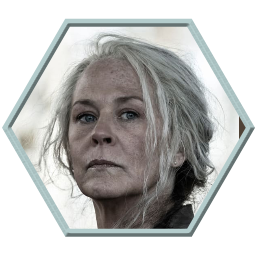
Octavia Blumsztajn
Doctors Without Borders
A Chicago native of Polish/Jewish descent, Octavia Blumsztajn had never been to her ancestral homeland until the war began. She was a doctor, specializing in research and pathology rather than medical practice. When government funding for her position evaporated in the prewar years, she joined Doctors Without Borders. As the European conflict heated up, the need for relief workers skyrocketed, and her language skills made her a natural fit for the organization’s Polish mission.
Since things came apart, she’s been wandering the countryside, avoiding the ruins of major cities, and trying to do as much good as possible while remaining upright and sane. She was fairly settled near a village until recently, when after a child died horribly from lockjaw, she managed to cook up a batch of tetanus antiserum. Which would have been great, but when she explained what she’d done, the brain fog kicked in – her neighbors had tolerated her weirdness (what’s all this paper she keeps hoarding?) for the benefit of having a healer around. But wanting to to inject their kids with stuff whose explanations caused seizures was a fast path to accusations of witchcraft…
Moral Code: The world has fallen to shit, but you can rebuild it–better, faster . . . eh, you get the idea.
Big Dream: Restore the world to some semblance of civilization.
Build: All the science, with a medical focus on public health. She’s also something of an amateur anthropologist. Octavia has a couple of homebrew specializations that I’ll blog later.
Tools: Science and medicine. Octavia started journaling early in the war and kept it up to maintain her sanity. With the brain fog creeping in, it’s been a literal lifesaver. She’s picked up a Steyr Model 72 hunting rifle in .30-06 and a Manurhin MR73 revolver but isn’t really proficient with them – she’s definitely not a fighter.
Alt: Octavia’s player also runs Zenobia.
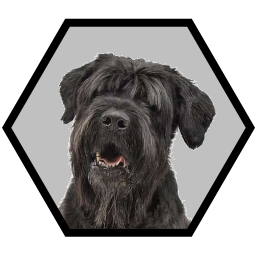
Comrade
very good boy
Octavia is not entirely sure who owned Comrade before he turned up hungry, matted, and very much looking for a human. Given the breed’s history, he was most likely a Soviet Army or KGB military working dog. He definitely has protection training and takes commands in Russian.
The week-plus after the Battle of Radom is a time of consolidation and preparation for Ponikla’s denizens. The immediate security environment isn’t 100% – there’s still the issue of the marauders in Tomaszow Mazowiecki, the harvest isn’t looking great thanks to ongoing steady rain, and the area north of the Pilica is a major unknown – but it’s better than it has been for some time. This gives Ponikla’s defenders time to consider other matters.
Ellis and Pettimore are getting antsy. The Broadstreet Dossier suggested that if Pettimore really is displaced in time, several pivotal events are about to unfold down south. The first step to verifying this seems to be an expedition to where Pettimore’s memories and Broadstreet’s writing both indicate the Black Madonna is hidden: a defunct copper mine west of Czestochowa.
The solution, of course, is to split the party… err, to send a well-equipped expedition, posing as military stragglers/mercenaries. Ellis spends a couple of days organizing this, feeling out who’s interested in hitting the road for a while and who’s putting down roots in Ponikla. In the end, there aren’t many surprises.
A fair amount of logistics work is necessary, though. Red, Ellis, and Léonard put their heads together. The expedition will need a scout vehicle, a support vehicle, some combat power, and enough seats for the ten folks who’ll be heading out.
For recon, the team’s trusty-yet-nameless UAZ-469 gets a light makeover, finally completing the up-armoring job that Minka started when she bolted a gun shield on for Leks. This reduces its cargo capacity, but that’s not its job any more.
The main combat power for the expedition will come from Comms, the BTR-70K (command post variant). With a dedicated logistics vehicle in the offing, the tech team strips out most of its short-lived mobile base functionality, returning it to its original seating configuration with an electronics bay that’s mostly unpopulated… but there’s hope for future salvage.
Finally, the team will need a vehicle for a still, tools, supplies, and other cargo. They have a deuce and a half and a Star 266, but neither of those trucks is in the greatest of shape. Red puts out some feelers to the team’s allies and comes up with a few possibilities. The best option is a MAN KAT1 8×8, roughly the West German equivalent of a HEMTT. It appears to have been stolen by U.S. Marines and used for some time before being abandoned in an empty barn north of the Pilica, where scouts from Von Bahr’s Irregulars found it last month, dry on fuel but with an inexplicable recent oil change. The former USMC crew’s names were neatly hand-painted on the doors, along with custom art and the nickname “Industrial Light and Mayhem.”
ILM also receives some armor work and a mount for the team’s spare M249 SAW (some suppressive fire is better than none). A medium still is semi-permanently mounted in the bed, along with two drums of reserve fuel, a couple of rolling toolchests, a field kitchen, and the skeleton of a mobile medical clinic. There’s also space to tie down Thing One, one of the team’s two BMW K75S touring motorcycles.
The plan is to head southwest to cross the Pilica upriver of Tomaszow Mazowiecki, then pick up surviving highways toward Czestochowa. Once across the river, the team will be in uncharted territory – while they have a map, they have little reliable intel on who might be out there, and the map is not the terrain…
This was one of four necropoli I wrote for The Book of Oblivion (Wraith 20th Anniversary Edition). Sadly, all four were cut for lack of space. That may have been my final freelance work in the World of Darkness… closing the cycle, in a way, since my first work was also for Wraith. Anyway. Here ya go.
Of the four, this is my favorite (admittedly by a narrow margin). This is one of those compelling little bits of Wraith lore that just bubbled up from nowhere good in my head. I chose the location as a too-subtle nod to Jericho, Kansas.
Under a leaden sky, the West Kansas Shadowlands stretch beyond sight. No Sunless Sea kisses this shore; the Great Plains Tempest is an unending swath of tinder-dry grass and mold-blackened grain. Maelstroms here are horizon-to-horizon scythes of dust in the hands of angry Rocky Mountain winds, tornadoes that moan out the Labyrinth’s hunger, or cold wildfires devouring all before them. Every working of humanity reflected in the Underworld is tiny, exposed, isolated, vulnerable beneath the perpetual clouds.
When wraiths speak of Necropoli, they speak of the world’s great cities. But people die in small towns, too. Oakley is archetypal of the rural Necropoli that dot the Hierarchy’s map (when it bothers to put them on the map), a tight-knit and tradition-bound collection of wraiths watching over their mortal legacies and families.
Oakley holds 2,000 living residents, a number that’s held steady for more than a half-century. It sits at the junction of three counties, and 90% of their land is agricultural, making it the local economic and social hub. Where the Quick gather, so do the dead, and the Fick Fossil and History Museum and City Library in Bertrand Park is the occasionally-beating heart of Oakley’s wraithly scene (though Enfants prefer the less-formal atmosphere of Don’s Rainbow Drive-In). The Fick is the town’s nominal Citadel, though it’s neither well-reinforced nor defensible; most wraiths prefer to hunker down in residential storm cellars when the weather turns.
Theoretically, Oakley is a Hierarchy Necropolis. In practice, the only local wraiths who take Hierarchy citizenship seriously are the grizzled “Anakerns” of the governing triumverate: Ora Spellmeyer (d. 1884, complications from a bullet acquired in the War Between the States), Benito Escarrá (d. 1925, drunkenly fell into Gove County’s first self-propelled combine harvester), and Lilac Atteberry (d. 1908, married beneath her station to a husband who poisoned her to inherit her family’s ranch). They hold Citadel meetings on the first Monday night of every month, enforcing Robert’s Rules of Order with a formality that Stygia’s most punctilious parliamentary popinjay could not surpass. No military garrison exists, but the artifact air raid siren atop Logan County Hospital can summon the militia from thirty miles around, and there’s no shortage of relic hunting rifles and wraiths who grew up putting meat on the table with them.
Outside these rusty mechanisms of empire, wraithly existence is a matter of individual interests. The Dictum Mortuum is a dead letter – indeed, many ghosts here don’t actually know what it is, only that the Anakerns pound their fists on it when someone does something they don’t like. Restless think nothing of reaching across the Shroud to counsel their mortal descendants, keep the family farm in the black, or discourage the wrong sort of visitors from staying. This isn’t to say that hauntings are overt; wailing, chain-dragging materializations are Just Not Done. Proper Midwestern Protestant sensibilities require subtlety and discretion. Feuds can stretch on for generations, though, and the smaller the stakes, the more vicious the tactics.
On the mortal side of the equation, this cultural heritage means families simply don’t talk about the ghost in the old farmhouse to outsiders, and even their private conversations are oblique. Consequently, few residents and exactly zero outsiders realize the full extent of local ghostly influence. The second sight runs in the Logan County MacDaniels family, probably from their Wazhazhe (Osage) werelynx blood, but they just nod knowingly and respectfully when they pass a ghost on the street. Dr. Susanna Hogarth is the new minister at Oakley Wesleyan Church, and with the aid of two predecessors who haunt her parsonage, she’s counseling several families through trouble with ghosts who can’t adapt to modern times. The kids in the high school history club have been close to the truth for about a decade, but the most dangerously perceptive seniors always get convenient full-ride scholarships to out-of-state colleges.
Because Oakley’s wraiths have been haunting the city and surrounding plains for so long, they’ve become very, very good at it. Any Hierarchy official worth his mask would have zombie kittens if he saw the practices that have become ubiquitous here. Every Restless is adept in at least one or two Arcanoi that violate the Shroud. Moreover, several arts unique to the region enable wraiths to possess animals, affect plants and weather, and inhabit buildings or tracts of land. Practitioners don’t realize how rare these talents are or how much attention they would attract if word got out.
Outsiders arriving in Oakley find a gracious, if reserved, welcome, provided they don’t bring trouble with them. A lack of local Fetters means few strangers settle down here (most recently the Alchemists who moved into the old grain silos on the north side to experiment with the Underworld ergot that grows on the local Tempest-wheat). Should the Hierarchy take an unkind interest in Oakley, it would find surprisingly aggressive resistance, not least from the Anakerns who won’t take kindly to big-Necropolis bureaucrats telling them how to run their town.
In most fantasy settings, humans are the up-and-coming sapient species, the innovators, the shitdisturbers, the ones who move at high speed compared to the elder dwarven and elven species. They’re usually driving advances in science and engineering (unless gnomes, which have somehow become anonymous with neon-hued steampunk annoyance, have taken than role).
I’d like to tinker with using halflings (or the setting-specific equivalent) to fill that role. Rather than being the tubby, bucolic, barefoot, and socially-conservative species, what if they’re the force of dynamism and social upheaval? Keep them as the setting’s foodies and masters of agriculture – but it’s because they have to be. Their brains and metabolisms are overclocked, resulting in higher overall energy levels and greater intelligence but correspondingly greater caloric demands and shorter lifespans. In fact, they may have been the originators of agriculture because, of all the species, they were the ones with the narrowest margin between survival and starvation.
(Famine would feature prominently in their cultural baggage, probably as the greatest collective fear.)
… huh. As I consider this development, these halflings also owe a fair amount to the betas of Shadow Unit. Stealing further from that source, halfling dynamism may be a result of food security rather than the drive that led to it. Halfling metabolism is adapted to varying levels of food availability. In its default state, assuming a pre-industrial, low-magic level of food production, halflings are sedentary because they need to they conserve energy for survival. If they have calories to spare, though, their brains and bodies can and will use that surplus for bursts of intense activity.
Historically, this gave rise to legendary feats and heroes – and perhaps darker stories of what some of those heroes, pressed by desperate circumstances, didto get the extra food they needed to pull off their miracles. Now, in halfling communities that are edging toward industrial agribusiness models of food production, high levels of productivity and intellectual discovery are the norm.
This was one of four necropoli I wrote for The Book of Oblivion (Wraith 20th Anniversary Edition). Sadly, all four were cut for lack of space. That may have been my final freelance work in the World of Darkness… closing the cycle, in a way, since my first work was also for Wraith. Anyway. Here ya go.
Sailors have always taken music to the sea and brought it back from their travels. Ashore, countless songs memorialize those mariners who the ocean has claimed. But no songs were written for the Piper Alpha oil production platform when it ignited the North Sea in 1988, claiming 167 lives to become the world’s deadliest offshore petroleum disaster.
Piper Alpha’s charred, twisted remains manifested in the Tempest within days. It became a familiar landmark to wraiths putting out from Aberdeen and Bergen, but an ill omen. Ghost ships sailing too close to the platform came under Spectre assault or encountered choking black clouds spitting forth burning rain. Scottish and Norwegian authorities launched several missions to cleanse the site, finally succeeding with Swedish Doomslayer aid in 1994. The Emerald Legion installed a caretaker garrison to ensure the site didn’t become re-infested, whereupon everyone promptly forgot about the problem. The Oslo necromancer incursion of 1998 forced the Legion to recall its troops, after which Piper Alpha lay vacant.
In 2000, Copenhagen Hierarchs exiled goth-rock Chanteur Ragnhild Vinter and her Circle for fomenting anti-Imperial sentiment. The Renegades responded by stealing an Anacreon’s yacht and fleeing into the North Sea, intent on establishing a pirate radio station through which they could continue screaming defiance. Unfortunately, none were sailors, and they headed straight into the teeth of a savage winter Maelstrom. Fortunately, the wind drove them into Piper Alpha before accumulated blood ice capsized their vessel. Finding the platform deserted yet still sufficiently solid to offer shelter, they claimed it as their own and put out the call for like-minded wraiths.
Today, the rechristened Piper Omega is a haven for several hundred Renegade performers and counter-culture Chanteurs and Masquers from across Scandinavia and the United Kingdom. Vinter’s troupe, Gaslight Ritual, runs the makeshift citadel as a commune and performance venue. Residents earn space through Renegade cred or Guild vouchsafing, but they keep it through performance. Monthly on the night of the new moon, the platform lowers its boarding ladders for any wraith brave enough to make the journey and pay the admission fee for a live variety show unlike any other. The main stage stands exposed and flame-lit under the ever-burning gas flare, now fueled on Pathos distilled from Piper Alpha memorials. Between performances, a Rube Goldberg assembly of broadcast equipment fulfills Vinter’s dream of pirate radio broadcasts, reaching relic receivers across northwest Europe with an eclectic mix of entertainment and agitprop.
Piper Omega still stands above the North Sea where its Skinlands prototype went down. Around its legs rests a patchwork accrual of ghost vessels. The largest are semi-permanent components of the Citadel, moored by soulsteel chains. A few small, swift boats are armed for self-defense (or piracy; no one looks closely). Residents are largely self-policing under a well-armed version of Wheaton’s Law, frequent creative differences notwithstanding.
Notable residents include The Voice of the Flame (Renegade Alchemists who run the radio station and keep the platform intact), Näkki (the Finnish Underworld’s premiere shamanic punk band), the infamous ex-Legion of Fate political strategist-turned-information broker known as Icebreaker, and smuggler and arms dealer Søren Amundsen. Ragnhild Vinter herself still heads Gaslight Ritual, which makes her the commune’s de facto leader, though she eschews formal titles. Gaslight Ritual fell away from performing several years ago as the demands of administering the Necropolis grew; lately, they’ve been trying to spread the load among Voice of the Flame and other affiliated groups. Rumor has it that they may soon return to the stage alongside up-and-coming maker/dance troupe Tolerance Stack, bringing forth a new work about which little is known beyond its title: Dance of the Broken-Winged Crane.
With a number of new PCs introduced since we began play in January, it’s probably time for a series of posts to get our hypothetical reader up to speed on who’s who. This post will cover the PCs and NPCs who’ll be going on the road trip, heading south toward Krakow and the mysteries that await there.
Where available, I’m using player-provided character bios and descriptions.
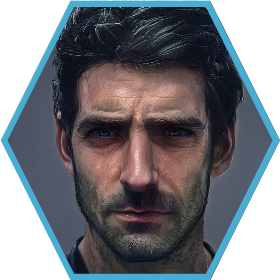
Ellis
U.S. Central Intelligence Agency
Alan Crenshaw spent the years leading up to the war building networks of assets and informants, cultivating relationships through a myriad of different methods serving the interests of the United States. Operating under the cryptonym of ELLIS, he found success in subtly undermining Soviet interests in the region. That is, until the Cold War turned hot.
Moral Code: Deception has kept you alive – it is your armor and your weapon of choice. Never tell the whole truth.
Big Dream: Uncover the conspiracy that actually led to the world being in the awful state that it is today.
Build: Intelligence and investigation initially, bending a bit toward leadership as the campaign has evolved. Ellis isn’t primarily a shooter, but he’s a force multiplier for the shooters if given time to shape the battlespace.
Tools: Disguises, binoculars, and careful rationing of truth. For when things get kinetic, Ellis carries an H&K G3, a Beretta Model 85, and a set of brass knuckles that imprint the name “Manfred” on their victims.
Alt: Ellis’ player also runs Arkadi Sokolov.
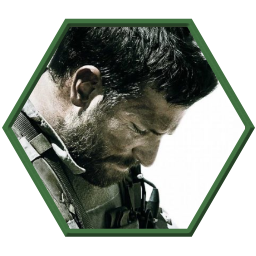
John Lee Pettimore
Staff Sergeant, U.S. Marine Corps
MOS 8541 (Scout Sniper)
Pettimore hails from the mountains of eastern Kentucky. Born in coal-mining country, he saw the Corps as an escape from his home county’s endless cycle of poverty and outside exploitation. For a man who grew up hunting to put food on the table, scout/sniper school was a natural progression.
At some point during the war, Pettimore found himself in the orbit of an intelligence operative who called himself Broadstreet. Broadstreet’s small team bounced around the northwestern Poland area of operations, handling a variety of specialized tasks. When the U.S. Army’s 5th Infantry Division moved out for the summer 2000 offensive, Broadstreet’s unit was attached to it.
As the 5th ID died at Kalisz, Broadstreet, Pettimore, and their associates were behind enemy lines, extracting a U.S. State Department physician from Soviet custody. With no friendly forces to rejoin, the team fled south into a darkening world. His subsequent experiences, recounted in a conversation with Ellis and supported by the Broadstreet Dossier, are not entirely synchronized with the surrounding world’s understanding of linear time…
[Pettimore is a PC from the first iteration of this campaign, carried forward with some unexplained weirdness attached to his presence here-and-now.]
Moral Code: Never leave a man behind. Everybody goes home. God gave you the strength to ensure that.
Big Dream: Home.
Build: Sneaking, seeing, and sniping, as implied by the job title.
Tools: Faith which has so far withstood some unusual challenges, a rigid moral code, and Thoughts and Prayers, a Dragunov which is becoming more than its designer intended.
Alt: Pettimore’s player also runs Alexei Brandt.
Erick Myers
Corporal, U.S. Army
MOS 71M (Chaplain Assistant)
Born and raised in rural Minnesota, Erick, though caucasian, was essentially raised bilingual (Ojibwe) as all the signage in Bemidji was in both languages. Never quite big enough to make it big in hockey, he still played throughout high school, and even into college. He attended Bemidji State University, graduating with a degree in social work in 3 ½ years.
The early days leading up to the conflict perhaps to be known in future history books as WWIII saw him working within the Ojibwe tribal system. He objected to the involvement, and registered as a conscientious objector. As the war escalated, he was drafted and sent into the Army despite his status, and only though persistence managed to work towards the MOS of chaplain’s assistant instead of being thrown into the light infantryman meat grinder.
He was sent overseas, attached to a rotation of units, serving under veteran chaplains of many different denominations. Raised Catholic, he still served with a Methodist, Jewish, and Anglican chaplains, and began to develop an appreciation for each. His own view on religion expanded, and he found himself creating his own hodgepodge system of belief from the best of what he encountered.
Then, as the war raged on, he encountered combat. As chaplain’s assistant, he was required to carry and use arms to protect the chaplain he served. Despite his athleticism and skills, he watched two such superior officers bleed out from wounds that his meager first aid skills were no match for. Instead of shaking his beliefs, this only intensified them. By 1999, he no longer assigned to any particular chaplain, but was merged into whatever mix of units could be cobbled together. Wherever he went, he became the impromptu chaplain for his company, squad, or fire team. His degree in social work made him a skilled and sympathetic shoulder to lean on, and he was a source of morale boost to whomever would listen. Finally, he was part of a ragtag battalion that was enveloped and overrun, and he was taken prisoner. Thinking that his war was over, he resigned to keeping his fellow POW’s spirits up, daring to pray for a release…
And so it seems that his prayers have been answered…
Moral Code: Protect his buddy and any in their flock (“Faith with Firepower”, the chaplain assistant motto).
Big Dream: Expand his religious experiences, taking in whatever he can from whatever he encounters.
Build: Something of a utility infielder, but concentrated in the Agility and Empathy skills. He’ll likely develop more toward a medic concentration over the next campaign arc.
Tools: Erick hasn’t gotten much screen time yet; he’s one of the rescued POWs who started off as an NPC and was adopted as a backup PC. He’s carrying an AK-74, a Walther PPK, and some extra medical supplies, but as the expedition’s primary medic, I expect he’ll be loading up on more medical stuff.
Alt: Erick’s player also runs Leksik “Leks” Müürikivi.
Build: Pretty much what you’d expect for a scout and forward observer.
Tools: Ideally, a good radio and a friendly battery of 155mm. Currently, an M4A1, a Colt Python, and a satchel of grenades.
Alt: Cat’s player also runs Minka.
Kira “Cowboy” Lopez
Private First Class, U.S. Army
MOS 13M (Multiple Launch Rocket System Crewmember)
Kira was raised on a cattle ranch in the Texas panhandle by an impatient, frequently drunk, father and her Hispanic mother. Until her mother died in a car accident in the late ’89. Her father became unbearable and she blamed him for the accident. Their relationship got worse as she got older, and spent as much time away from the ranch as she could get away with. She left Texas for California as soon as she graduated from high school in ’93. She was sick of rural life, sick of her father, and everyone else knowing your business, and wanting to live pretty much anywhere else.
In Los Angeles, she apprenticed to an electrician, thinking it would be a good way to make a living doing gigs for rich people (or something like that) and it was alright for awhile. She worked hard, often being willing to work from before dawn until it was too dark to work safely. On the weekends she partied hard, hanging out with the metalheads and goths, going to concerts and night clubs. On Sundays, once she kicked out anyone she might have come home with the night before, and if she wasn’t too badly hung over, she’d go to church, thinking her mother would be even more disappointed in her if she didn’t.
When the war broke out, she had the misfortune of having an early draft number. Cowboy won out as her nickname in boot camp because she was absolutely willing to throw fists over “Cowgirl” innuendos, and somebody else already got to be “Texas.” She ended up in artillery when her math skills and understanding of trajectories and coordinates indicated she’d be good at it.
Now that the war is effectively over, Madga’s speech has her reconsidering her desire to live anywhere other than some rural shithole, realizing that now…everywhere is a shithole, and it’s going to be mighty hard to find food in an urban shithole. For once, a small, close-knit community might be okay. Besides, if she ends up back in the States, they’d probably send her somewhere else to fight…and she knows she doesn’t want to get involved in a civil war back home.
While she used to think she’d prefer someplace like Valhalla for an afterlife, Kira always remembers to light a candle for her mother and her ancestors on Dias de Muerte, and has included people from her unit who’ve died over the course of the war.
Moral Code: She isn’t a Ranger, but she very much believes in never leave someone behind.
Big Dream: Motivated by Madga & Red, maybe help make at least a small part of the world a better place.
Build: The nature of 4th Edition’s skills means a competent artillerist is also pretty good with squad-level support weapons, and Cowboy is the expedition team’s primary machine-gunner. She’s also a decent technician generalist.
Tools: In the absence of a replacement MLRS, she’s making do on a smaller scale with a PKM. If she weren’t leaving Ponikla on the expedition, she’d probably be taking charge of the village’s newly-acquired mortar.
Alt: Cowboy’s player also runs Dr. William “Red” Greyson.
Elizabeth “Betsy” Reed
Private First Class, U.S. Army
MOS 12C (Bridge Crewmember)
Like Cat, Betsy is a newly-adoped NPC whose history is still shaping up. She’s one of the 5th Infantry Division POWs rescued in transit to the Radom camp. We know she was an M60 AVLB crewer in the 7th Engineer Battalion. She’s something of an adrenaline junkie and her prewar career saw her wheedling her way into as many sapper and combat arms courses as she could manage.
Build: Heavy on technical capabilities, a decent driver, and decent with support weapons.
Tools: As much demo and as large of a hammer as possible. She’s currently toting an HK23, a Browning Hi-Power, and an assortment of grenades and mines.
Alt: Betsy’s player also runs Magda Szymanska.
Mikolaj Krol
Miko is a Polish teenager from Warsaw who spent most of the war just trying to survive and stay out of the way of the armies. History gets a bit hazy during early 2000, but he’s believed to have met Zenobia Slusarski in Warsaw and followed her when made her escape to her hometown of Ponikla.
Miko is mildly-unhinged, adapting to his post-apocalyptic surroundings in ways that the rest of the team finds somewhat concerning. Of all Ponikla’s inhabitants, he may be the one who’s embraced the apparent nanite infection’s benefits the most. His fighting style displays a complete lack of disregard for self-preservation.
Moral Code: The world fell apart around you, you need to keep what little bit of it you can call yours.
Big Dream: Comfort is a dream long dead, as is safety. But I’ve been safer here longer than anywhere else. Can I make it better?
Build: Initially focused on scavenging and stealth, but he’s been developing toward excessive force and skirmish combat.
Tools: A complete disregard for personal safety and a machete. Until recently, Miko also relied on a satchel of grenades, but Cat took those away from him after some injudicious application of white phosphorus. He carries a PM-84 SMG that he may have fired in one battle.
Luis Hernandez grew up in New Hampshire in the shadow of Mount Washington. Being able to see the peak with the reputed worst weather in the country spurred what would become a lifelong interest in meteorology. After completing his undergraduate studies at CU Boulder, he spent a couple of years working for the National Weather Service, but desk-bound work was eating his soul. When a co-worker mentioned that the Air Force had its own meteorologists, Luis skipped lunch to visit the local recruiter’s office. A line on a list of job options leaped out at him: “Special Operations Weather Technician.” It sounded pretty badass…
After the war’s first year, aviation and airborne operations were vanishing, and with them, opportunities for Hernandez to do his real job. He wound up bouncing around a variety of units, using the usual AFSOC cross-training to fill in for specialists in other roles. He was attached to Task Force Cobalt to run communications and was the other survivor of that unit that the team rescued from marauders.
Build: Fieldcraft and technical capabilities foremost, but he can hold his own in a gunfight.
Tools: Science, an M4A1, and an M11.
Henry Bell (NPC)
Specialist/4, U.S. Army
MOS 98G (Signals Intercept Linguist)
Before the war, Henry Bell was a saxophonist in the U.S. Army Band, in it for the G.I. Bill benefits. No one was more surprised than he when he was deployed to perform his original MOS as a signals intelligence voice intercept linguist. He spent most of the war in a SIGINT truck behind the lines, trying to pluck Soviet transmissions out of the air.
Bell was the first of the 5th Infantry Division POWs that the team encountered and liberated. He’s since found himself in the role of Ellis’ aide-de-camp and an occasional backup driver for the team at large.
Build: Social and investigation. He’s not much of a combatant. Bell can speak Russian at native proficiency, is fluent in Korean and Polish, and is working on his pidgin German.
Tools: Good ears and a better voice. He carries an AKM but tries to avoid situations that would require him to use it.
We’re 25 sessions into the campaign, and with the Battle of Radom being a major milestone, it was time for a meta check-in session.
We’ve introduced a number of secondary PCs – currently, six of my eight players have a secondary character. The original intent was to provide backup options for play when the primary PC is down with injuries, or in case of primary PC death (which we’ve managed to avoid… so far). The cast also has grown with the addition of a number of military/ex-military NPCs who provide useful support or combat capabilities and are usable as “rental” backup characters. All of this worked well for the Radom story arc, as a number of characters wound up injured or in the wrong place. In the long term, though, we can see it causing some complexity issues.
We also have a number of story hooks outside the Ponikla area. Because this campaign may or may not exist in the same continuity as its previous iteration, there’s some player interest in investigating the alleged paranormal goings-on around Krakow. Not all of the PCs have this interest, though. A number have put down roots in Ponikla and are invested in the community’s well-being and ongoing recovery/rebuilding operations in the region.
With the buildup of a plot framework, we’re getting away from the campaign’s original design intent of West Marches-style play. We’re seeing a couple of factors driving this. Because there is plot rather than episodic dungeon-crawls, there’s a tendency to push for inclusive scheduling when everyone can make it. Also, I have not done a great job of seeding the map with dungeon-esque points of interest.
As this post’s title telegraphs, our solution for several of these concerns and interests is to split the party. Six PCs and a small number of NPCs will be heading out into the wilds for an extended expedition (which may well lead into adaptations of the rest of the classic Poland modules: The Free City of Krakow, Pirates of the Vistula, and The Ruins of Warsaw). The rest of the cast will remain in Ponikla. We’ll split our sessions between the expedition team and the Ponikla team as player interest dictates.
The guns are silent. With their command post and mortar battery overrun, the ZOMO forces have quit the field. At the now-abandoned patrol base northwest of Radom, our weary and battered collection of protagonists assembles. Also arriving are two more forces…
First, there’s a leadership contingent from the White Eagles, a Skarzysko-Kamienna-based battalion of the Polish Home Army, including:
Major Felicjan Kozlowski, the White Eagles’ commander
Captain Aleksander Grabowski, Kozlowski’s adjutant
Lieutenant Marietta Rabarchak, commander of the White Eagles’ B Platoon and the PCs’ nominal advocate among the White Eagle command staff
There’s also a slightly smaller delegation from Von Bahr’s Irregulars, the band of former East German troops who threw in with NATO when Germany reunified, subsequently found themselves in a Soviet POW camp, escaped, and wound up in loose possession of a small hydroelectric power plant:
Lieutenant Colonel Boris Von Bahr, the East Germans’ commander
Senior Warrant Officer Thekla Adler, Von Bahr’s SNCO and chief advisor
The leaders of the various groups assemble (Red, Ellis, and Leks having jointly assumed the mantle of leadership for Ponikla’s defenders) to share intel and discuss the battle’s outcome. All but a handful of the Soviet advisors are accounted for, either dead or captured. The Soviet QRF is out of action, decisively defeated. The Radom ZOMO still has over a hundred combat-capable troops, but it seems to be in disarray – with its command staff dead or in Ellis’ hands, the more experienced cavalry and mechanized infantry platoons have withdrawn to the east, while the late-war conscripts and recruits of the foot infantry platoons are huddled in their base.
A couple of White Eagle trucks pull up and a handful of partisans begins setting up a field kitchen. Magda wanders over to help and winds up taking over.
A couple of Von Bahr’s troops came in with him and Adler as a security detail. Alexei wanders over to chat with some fellow Ossis. Amid the small talk, he learns that before the ZOMO started pushing them, the Irregulars were running patrols north of the river. They’d found the remains of several marauder (or presumed marauder) groups – cleanly and professionally killed, their remains marked with signs indicating their alleged crimes. Someone out there is cleaning up the neighborhood…
Ellis has been busy in the battle’s aftermath. After wrapping up “interviews” of the higher-ranking prisoners taken from the QRF, the ambushed convoy, the Soviet advisors, and the ZOMO command staff, he’s starting to develop a clearer picture of what threats remain in and around Radom. He also has a few new radios to play with, so as he organizes his notes, he and Bell sit down with headsets and begin scanning.
It isn’t long before Ellis and Bell hit paydirt. They intercept a transmission from the Soviet engineer unit in Radom giving a SITREP and requesting orders. The ZOMO have lost cohesion and the Soviet plan for stabilization in the Radom AO appears unsalvageable. The response – presumably from Reserve Front HQ in Lublin – is noncommittal. The engineers are ordered to stand by for orders in two hours.
Ellis notes the time… he’ll be back for the next episode of this show.
The joint command group has some things to work out. Chief among them is how much latitude Von Bahr’s Irregulars will be allowed. They’ve been good neighbors thus far, but the Home Army is leery of letting Germans on Polish soil have too much free rein.
After some negotiation, a joint security agreement exists between the Ponikla defense force, the Irregulars, and the White Eagles. The Irregulars will retain possession of the hydroelectric plant and its surroundings, including the adjacent village of Bialobrzegi, but they’ll allow the other parties access to the plant and will cooperate with infrastructure restoration efforts. The White Eagles will take the lead in securing Radom, including dealing with the elements of the ZOMO garrison who may be salvageable – mainly the post-1997 recruits who weren’t part of the prewar regime protection force.
With the social aspects out of the way, the groups begin dividing the spoils of war. Our protagonists come away with the UAZ-452A ambulance (everyone agrees that Red, as the only qualified doctor in the region, needs that), the ZOMO transport unit’s Star 266 heavy truck, and the Soviets’ Toyota Hilux technical and its AGS-17. Ellis requests the Mercedes S-Class from the convoy, as well… “I have a disguise in mind,” he says.
On the topic of armament, Ellis is adamant that his team keep the AT-5 launcher after the amount of blood they shed to get it. Kozlowski is fine with this, so long as it doesn’t wind up in Von Bahr’s hands. The team also gets an SPG-9 and one of the three 82mm mortars. It’s a significant boost to their anti-armor firepower after months of relying on rifle grenades and disposable rocket tubes.
As that discussion is winding up, Ellis gathers everyone around the radio. On schedule, the Soviet engineer detachment receives orders to negotiate with the local partisans for the return of captured personnel…
Pettimore, out on the perimeter, sees two sets of headlights approaching. He crawls over to the White Eagle RTO who’s been assigned to him and calls in the alert. One of the vehicles halts a couple of kilometers out; the other keeps coming. As it approaches, Pettimore can see that it’s a HMMWV with Soviet identification markings sprayed on the doors. The gun ring is empty. The occupants are a young man with junior enlisted rank insignia and a woman with captain’s rank tabs. Pettimore puts the reticle of his captured Dragunov on the driver and waits…
At the camp, there’s a brief stir, but this isn’t entirely unexpected. Ellis, Red, Leks, and Kozlowski go forward, with Von Bahr hanging back as the joint command group’s designated survivor in case this is some kind of ruse.
The HMMWV stops a few hundred meters away. Both occupants emerge. The driver slings his AKM and leans on the hood. The passenger unbuckles her pistol belt, drops it on her seat, and begins walking forward, waving a white flag.
The command group waves her forward. When she’s within conversational distance, she introduces herself as Captain Danila Marchenko. She’s a whipcord-thin, hard-worn thirtysomething with a bad case of thousand-yard stare.
Out in the darkness, Pettimore is too disciplined to allow his finger to tighten on the trigger.
Marchenko asks about the state of the Soviet POWs. A little of the tension cranks out of her posture when she hears that Major Maksim Volkov, the QRF commander, is alive. (Ellis’ interrogation of Volkov revealed that he and Marchenko are close friends and related by marriage.) “I’ll need proof of that,” she holds out.
Kozlowski gives the necessary orders. About twenty minutes pass before a truck arrives from the nearby farm where the prisoners are being held. A handcuffed Volkov emerges and takes in the scene.
Marchenko asks what it will take to get the prisoners released into her custody – just the Soviets, she has no orders regarding the ZOMO and doesn’t really want them back. The command group presents the demands they worked out while waiting for her to show up: withdrawal of all Soviet forces from Radom, withdrawal of support for the Radom ZOMO, and halting the planned demolition of the half-completed Soviet base adjacent to the FB Radom weapons plant.
Marchenko frowns slightly at the last point – the demolition orders came as part of her conversation with Lublin. “You’ve been listening,” she says, unsurprised. “I can do that. I have better uses for that Semtex anyway.” She turns and waves her white flag in a semaphore-like move. Through his scope, Pettimore sees Marchenko’s driver reach into the HMMWV and pick up a radio handset. The farther vehicle’s lights come on again and it begins crawling in slowly. It’s a 5-ton truck, two crew in the cab and an empty bed – presumably the vehicle that’ll take the prisoners away once the exchange occurs.
Volkov has been watching and listening with an expression of intense concentration. As the conversation pauses and the process of bringing the Soviet prisoners forward begins, he speaks at last. “Mister Broadstreet. You’re not like the ZOMO, like these.” He gestures at Kozlowski. “You’re awake.”
Ellis nods. “Yeah, that’s a thing.”
Volkov looks around the group. Looks at Ellis speculatively. Narrows his eyes. “Library.”
“Huh. Map,” Ellis responds acerbically.
Volkov nods slightly, exhales. “You’ve seen it, then.” He gestures with his cuffed hands, encompassing the world with an abortive, jingling sweep.
“We’ve seen some things,” Leks puts in.
Volkov cocks his head at the accent and looks up at the big Estonian. “Let me guess. You didn’t wait to be captured before going over to NATO.”
Leks grins.
“We could have handled the Baltics better,” Volkov admits.
“What have you seen?” Red asks, still turning over in his head the implication that Volkov has access to, or at least knows of, an intact library.
The Soviet officer shrugs. “We’re reconnaissance. They send us to find things. We… find things.”
“The training and drills you were running. That wasn’t just to keep their edge, was it?” Ellis asks rhetorically.
“No. Routine is the mind-killer. Days blur into days and people… lose time.”
“What else?” Leks prompts.
Volkov inhales sharply. “The first sign I couldn’t ignore? There was a village. They were friendly, but something took three of my men on three nights. We found what was left. No one would talk to us except one old woman, the one everyone else pretended wasn’t there.” His eyes meet Minka’s and he quickly looks away. “She told us enough. So on the fourth night… I had three female soldiers with me. I put them on guard duty. It couldn’t blind them, couldn’t lead them away. They caught it. It had a woman’s face. What was underneath…” he flinches. “Green, wet, and all teeth.”
Volkov looks at him sharply. Nods. His eyes track back to Ellis. He stands silent for a long moment, then something inside him breaks loose. “Damn you! We were trying to help here. We were here to stabilize this. Something’s happening up north, something in Warsaw.” His expression tightens as he sees the recognition in the Americans’ and Poles’ eyes. “Radom was supposed to be a bulwark, a shield against whatever’s coming from there. Establish some kind of order here, get the ZOMO under control and civilized again. Deal with the bandits, the anarchy. Be ready.” He makes a throwing-away gesture, frowns as the cuffs pull one hand after the other. “It’s your problem now, Mister Broadstreet.”
Ellis and Red look at each other. We could have worked with these guys passes unspoken between them.
Air brakes hiss, breaking the tension as a truck pulls up behind the group. White Eagle troops begin unloading Soviet prisoners. Marchenko crosses to stand next to Volkov, who’s mentally ticking off names and faces.
“If we see any of you back here,” Ellis says conversationally, “we’ll shoot you.”
Volkov snorts. “Don’t worry. If you see me back here again, you’ll probably have bigger concerns than shooting me.”
There’s a long silence. “Yeah. I get that,” Ellis admits.
Volkov holds up his wrists, jangles the cuffs again, raises an eyebrow. Leks waits just long enough to inject some doubt before grunting and producing a key.
Volkov rubs his wrists, as if reassuring himself he’s actually free. He doesn’t offer his hand before he turns to leave.