So today, I found out about H.R. 6869 from 2022’s legislative circus. I’m certain it’s pure coincidence that it was introduced four days after Russia’s invasion of Ukraine began…
A BILL
To authorize the President of the United States to issue letters of marque and reprisal for the purpose of seizing the assets of certain Russian citizens, and for other purposes.
Be it enacted by the Senate and House of Representatives of the United States of America in Congress assembled,
SECTION 1. Issuance of letters of marque and reprisal for purpose of seizing assets of certain Russian citizens.
(a) Authority of President.—The President of the United States is authorized and requested to commission, under officially issued letters of marque and reprisal, so many of privately armed and equipped persons and entities as, in the judgment of the President, the service may require, with suitable instructions to the leaders thereof, to employ all means reasonably necessary to seize outside the geographic boundaries of the United States and its territories any yacht, plane, or other asset of any Russian citizen who is on the List of Specially Designated Nationals and Blocked Persons maintained by the Office of Foreign Assets Control of the Department of the Treasury.
Kinda makes me want to run “you are a team of privateers in the business of stealing Russian kleptocrats’ high-value toys” as a Spycraft campaign.
What’s Russian for “heave to and prepare to be boarded?”
This was one of four necropoli I wrote for The Book of Oblivion (Wraith 20th Anniversary Edition). Sadly, all four were cut for lack of space. That may have been my final freelance work in the World of Darkness… closing the cycle, in a way, since my first work was also for Wraith. Anyway. Here ya go.
In its heyday, Route 66 was a peerless transportation artery, running from Chicago to Santa Monica. Threaded through Joplin, Tulsa, Albuquerque, Flagstaff, San Bernardino, and Los Angeles, it showed American motorists a vibrant cross-section of the Midwest and Southwest until the interstate highway system supplanted it in the 1950s and ’60s. Without federal maintenance funds, Route 66 withered, subsumed by state roads or vanishing entirely.
In the Underworld, derelict highways may resurface as byways or ghost roads. Not so for Route 66. Sometime in the early 1970s, its entire 2,448 miles manifested in the Shadowlands. Wraiths in Riverton, Kansas were the first to report that even as Maelstrom tornadoes ravaged the surrounding region, the highway was untouched. In mid-1976, an Anemographer/Ghostrider expedition out of California met a band of Legion of Paupers explorers from Illinois at the highway’s Adrian, Texas midpoint. The Empire’s Bureau of Trade soon proclaimed that Route 66 appeared to be a safe and stable route through the American Underworld.
What troubled early explorers remains a concern today: Route 66 defies all conventional wisdom on Shadowlands geography. Although plenty of blood soaked into its asphalt, it never approached the body count of deadlier highways like Interstate 95 or Camino a Los Yungas. The Artificers and the Harbingers would like to claim credit, but there’s no evidence that Route 66 is a cultivated byway or an unprecedented working of Inhabit. The popular and comforting theory is that its modern status is a result of its cultural iconicity, a rare example of a non-living construct accruing Memoriam. A less benevolent explanation is that popular culture has imbued Route 66 with a myth-driven form of quasi-sentience. No one wants to hear the fringe belief that the “highway” is really a charmingly useful and friendly-faced manifestation of some Labyrinthine elder horror.
Route 66 earned recognition as a Necropolis, albeit a very long and narrow one, by virtue of its permanent population. In most places, its protection from Maelstroms extends five to ten yards from the asphalt. This so-called Black Ribbon Citadel is home to perhaps a thousand wraiths, many of whom form small Circles to offer travelers’ services. Most such groups have colonized the ghost towns that crumbled along the route after the interstates diverted travel and commerce. Other citizens include the Night Mail (ghost truckers and bus drivers who serve connected conventional Necropoli), Wings for Wheels (a Chanteur troupe famous for its repertoire of travel-themed songs), and Detroit West (a large nomadic Circle immersed obsessively in the imagery and culture around classic muscle cars and drag racing).
The Hierarchy’s hand rests lightly upon Route 66. The Legion of Paupers first re-mapped the highway’s full length and was quick to lay claim to authority here, but its duties are largely ceremonial. The ghost road needs no maintenance; indeed, it rejects all attempts to patch its cracks and potholes. With the population so widely-distributed, there’s little call for bureaucracy. Under the command of Anacreon Robert “Pony Bob” Haslam, the Legion’s 7th Cavalry Squadron provides what law enforcement is needed here. The 7th, more commonly known as the Black Ribbon Patrol, spends most of its time assisting travelers and investigating the occasional mysterious disappearance or reappearance.
This was one of four necropoli I wrote for The Book of Oblivion (Wraith 20th Anniversary Edition). Sadly, all four were cut for lack of space. That may have been my final freelance work in the World of Darkness… closing the cycle, in a way, since my first work was also for Wraith. Anyway. Here ya go.
Alas! Alas, that great city Babylon, that mighty city! For in one hour is thy judgment come.
Once, Baghdad was the mightiest Necropolis in the Mantaqat Khayal, the Middle Eastern Shadowlands. 250 leagues from Mecca, it was far enough from the source of the Keening that the perpetual sand-Maelstrom engulfing the region was sometimes passable. Here, ghosts of the Abbasid Caliphate traded relics and lore with Ottoman Restless and the British Empire’s wraiths. Beholden to no Dark Kingdom, a council of ancient merchant princes opened Baghdad’s gates to anyone who didn’t disrupt business. Even Oblivion’s saner scions were welcome as long as they behaved.
On April 2, 2003, as American troops approached, an unprecedented Maelstrom broke over Baghdad. The city had endured countless prior sieges and sacks, but none televised before the eyes of all the world’s Quick. As bombs fell on the living city, soulsteel hail and shark-toothed lightning battered the Underworld. Wraiths caught in the storm succumbed to their Shadows’ basest urges, falling upon one another in a frenzy of mutual annihilation.
Trust died in Baghdad that night. In the storm’s aftermath, remaining wraiths learned the hard way that Arcanoi no longer reliably identified Spectres or the Shadowridden. For a Necropolitan culture whose overriding ethos was the sanctity of deals and contracts, this was a deathblow.
Then the war’s dead began to arrive in the Underworld, and they showed no interest in ceasing their war. American troops and their Coalition allies spurned a millennium of traditional hospitality and coexistence in pursuit of their Iraqi adversaries while Oblivion gleefully infiltrated all sides to further the conflict. The Shadowlands shook to the renascent detonations of relic IEDs. An ambush lurked around every corner; a nihil glimmered at the bottom of every bomb crater.
In the Skinlands, scavengers followed on the soldiers’ heels. The sack of Baghdad’s wealth was nothing compared to the feeding frenzy for its knowledge. The city’s museums and libraries held countless arcane relics and keys to forbidden history. Supernatural beings from every corner of the world collided while rushing to stake claims amidst the chaos. Battles spilled into the Shadowlands as sorcerers and shapeshifters maneuvered through every accessible plane of existence. For every priceless artifact destroyed while saving it, wraiths fought to ensure it re-formed across the Shroud and in their hands.
The battle for Baghdad’s lore burned itself out within a season, giving way to a simmering asymmetrical war. Across the Shroud, the Middle East’s traditional denizens regrouped and drove out most foreign intruders in a brutal years-long campaign. Among the dead, the Grim Legion and Penitent Legion attempted to establish a peacekeeping presence as a precursor to long-denied Imperial expansion, but found themselves drawn into the conflict too.
Today, Baghdad is a city of wraiths trapped by Fetters, the resurgent perpetual Maelstrom, or their own Passions and Shadows, all amidst a war without end. The major factions, as best they can be defined, are Stygian forces seeking to claim a city long denied them; an alliance of outsider Mantaqat Khayal inhabitants with a similar agenda; newly-dead Coalition and Ba’ath Loyalist troops and politicians who can’t let go of their respective sides of the Quick’s war; and pre-war Baghdadis who want everyone else to stop destroying their homes. Beneath it all, Oblivion bargains, manipulates, and carries out false-flag attacks to stoke the conflict, and its agents still can’t be identified until they act.
Leaked reports from the Legions have brought belated Doomslayer attention. They’ve enjoyed some success recruiting here when they’ve been able to point out the real enemy. Their primary mission, however, has been intelligence-gathering, and what they’ve learned may have ramifications across the Underworld. The Shadow-Eaten have been watching and learning from mortal combatants, and now they’re versed in the skills of terrorist and special operator alike. They’re smart and patient in ways the Void hasn’t allowed until now, and they’re willing to play long games. If this spreads beyond Baghdad, the struggle against Oblivion will change forever.
PDF’d and posted because I’m too lazy to fight with reformatting it for here. This rolls up the team’s status and that of their allies and opponents, as well as the major captured items of interest. It’s not exactly an in-character document but it’ll probably drive a lot of discussion during the next session of play.
[I’m blogging this separately for readability, but this scene ran in parallel to the mortar battery raid, with focus shifting back and forth at appropriate moments and at the end of each combat round. This scene had Ellis and Miko being played by their regular players; Cat being run by her player, whose primary is Minka; and Scott being driven as a rental by the player behind Red and Cowboy. Quinn stayed an NPC, as all she was doing was driving.]
It’s been a long afternoon of light rain, high humidity, and fruitless searching. The UAZ-469 with Ellis’ detachment aboard is crawling through the Polish countryside, staying in concealment and off main roads as much as possible. Patience is in short supply as the team rolls up from the south side of another little cluster of buildings at another nameless crossroads. Leaving the UAZ in a scattering of trees, Ellis, Miko, and Cat ease forward to scan with their binoculars…
Jackpot. On a rooftop on the north side of the not-even-large-enough-to-be-a-village are two men in Soviet uniforms with something Ellis hasn’t seen in a long while: the thick tripod-mounted tube of an ATGM launcher. About fifty meters closer to the team, near the actual crossing of the roads, two more men are hunkered down in a rubbled building. Cat picks out the wavering line of a radio antenna next to them, and the angular shape of a parked GAZ-66 light truck nearby.
The team crawls back to the UAZ to discuss tactics. The enemy forces are all on the north side of the settlement and oriented northward. Ellis’ quick analysis is that they’re waiting for Von Bahr to try a breakout to the west so they can neutralize his T-72… but they don’t appear to be watching their backs yet. So Ellis, Cat, and Miko will sneak forward to take up positions in buildings on the south side of the road. As soon as the firefight kicks off, Quinn will floor it out of cover, allowing Scott to bring the UAZ’s mounted M2HB (a recent replacement for the PK appropriated by Cowboy) into action.
At least, that’s the plan.
As Ellis, Miko, and Cat approach their selected buildings, they hear the faint rumble of a vehicle approaching the crossroads from the east. Ellis sees it first – it’s a battered BTR-70, one he recognizes after spending a good number of hours around it listening to its radio.
[With Magda strapped into one of the litters and unable to do her usual navigation job, Bell and Erick got a little turned around on the way out of the battle area…]
The Soviets aren’t unaware of this either. The launcher crew begins reorienting to the east and the duo in the rubble also swing around. It’s the latter group who catches sight of Miko and shouts the alarm, and the fight is on. As the first shots ring out and Ellis ducks into the nearest building, he catches sight of the BTR hitting the brakes and beginning to reverse into a J-turn.
Miko opens with a fragmentation grenade, stunning both of the troops in the rubble pile. Ellis and Cat exchange inconclusive fire with the duo atop the building. This attracts the attention of a third pair of Soviet troops, previously unseen by the team, who were stationed in another rubbled building on the north side of the village. Fortunately for our protagonists, they go for their rifles rather than engaging with the RPG-7 they’re carrying.
Both lightly injured, the two men in the southernmost position begin pulling back north toward the GAZ-66. Scott and Quinn arrive in a screech of tires, but Scott’s initial burst of .50 goes wide. One of the Soviets pulls himself into the GAZ and mans the PK mounted in the cab’s gun ring. His return fire tears through the UAZ’s cargo compartment and sends Scott and Quinn bailing out of the vehicle.
Miko dashes across the street and into another partially-collapsed building to hurl another grenade. This one goes wide, its only function to attract attention. Four AK-74s chatter and Miko goes down, bleeding out from a brachial artery wound [bleeding shoulder crit]. The RPG team starts running south, bypassing Miko and maneuvering to flank the team.
Cat continues trading fire with the Soviets on the rooftop as Ellis sneaks out the back of their building. He sets up just as they come into view. A burst from his G3 drops one Soviet in his tracks and sends the other scurrying back to cover. The two men trade fire and injuries for a few moments, Ellis finally resorting to his sidearm to drive off his opponent.
Cat moves up and boards the UAZ as Scott and Quinn resume their positions. The little jeep-analogue rolls out again, screeching to a stop between the GAZ-66’s machine gun and Miko’s prone form. Cat bails out and drags Miko to cover as Scott and the GAZ gunner trade fire, an exchange that leaves the GAZ with a leaking radiator and Scott with an injury that forces him and Quinn out of the UAZ again. Scott props his RPK across the UAZ’s hood and continues firing, managing to keep the ATGM team on the roof from making the situation any worse.
Cat gets Miko back in action, for certain values of “action.” With his functional arm, the teenager preps and tosses a grenade toward the GAZ. It flies true…
… and explodes in a shower of hellfire. Miko wanted to see what his recently-looted white phosphorus grenade would do. The two Soviets aboard the GAZ die screaming. Enraged, the ATGM team pops up and hammers Miko flat with another volley.
Horrified, Cat slams Miko down to the sidewalk and strips him of any more grenades before trying to resume treatment.
This is the point at which Ellis’ opponent returns to the main fight, appearing behind the pinned-down quartet and lobbing a frag of his own into their midst. Cat and Scott both catch fragments and are knocked prone. As the man levels his AK to finish the job, Ellis emerges behind him and casually empties his Beretta 85 into the soldier’s back.
Cat picks herself and her M4 up and blasts one of the ATGM team off the roof. His partner, realizing he’s the lone survivor, finally surrenders. As Cat resumes trying to save Miko, Ellis shakes his head, reloads, and walks over to see if the radio survived.
Running this in parallel with the mortar fight was a study in contrasts. I was genuinely afraid I might wipe this party. The dice just did not go in their favor until the last few rounds. The final damage was:
Ellis: Health 1/4, Stress 5/6
Miko: Health 0/5, bleeding shoulder crit
Cat: Health 4/5, Kevlar vest destroyed
Scott: Health 1/5
Quinn: somehow uninjured, but also two-dimensional
This effectively concludes the Battle of Radom series. I’ll try to get some informational posts up so readers can keep track of all the secondary PCs and NPCs who’ve been introduced, and I also am considering a referee’s perspective post about the overall story arc here. There will be one more game session dealing with the battle’s aftermath, but due to scheduling and wanting everyone at the table for that, it’s about a week out at best.
At a crossroads near the former ZOMO command post, the team and a few of their allies link up. Using the radio aboard the captured UAZ-469, Leks established contact with Zenobia while she was delivering ammunition to Von Bahr’s troops, and the two groups were able to reunite. Ellis’ raiding party, lacking a radio of their own, remains out of contact, its whereabouts and status unknown.
The raid on the command post was costly. Magda and Cowboy both went down, the latter with a critical arm injury, and Pettimore also is leaking. An immediate medical evacuation and the addition of some reinforcements are necessary before the team goes after the ZOMO mortar battery. Erick, re-added to the group after he and Red finished with the last round of surgery, will command the medevac, with Bell, Ortiz, and Ross rounding out his crew. His job is to get the worst-injured team members – Magda, Cowboy, and Pettimore – out of harm’s way in the BTR-70K.
Von Bahr’s RPG team has stuck with the irregulars from Ponikla thus far, but their task now is to watch the ZOMO command post and maintain custody of the prisoners and material taken there. If enemy reinforcements show up in force, they’re to bug out.
This leaves Leks, Novotny, Turner, and Minka to go after the mortars with the OT-64. Joining them are Zenobia, back from the supply run, and Betsy, newly arrived with Erick.
[Nudging my players to build backup PCs a few sessions ago is paying off now. Betsy hasn’t been on screen until this session, but she’s the ex-POW AVLB crewwoman, the backup PC for Magda’s player.]
The team cross-loads their APCs, spends a few last moments with wounded comrades, and splits up – one group going toward safety, the other heading back into the line of fire.
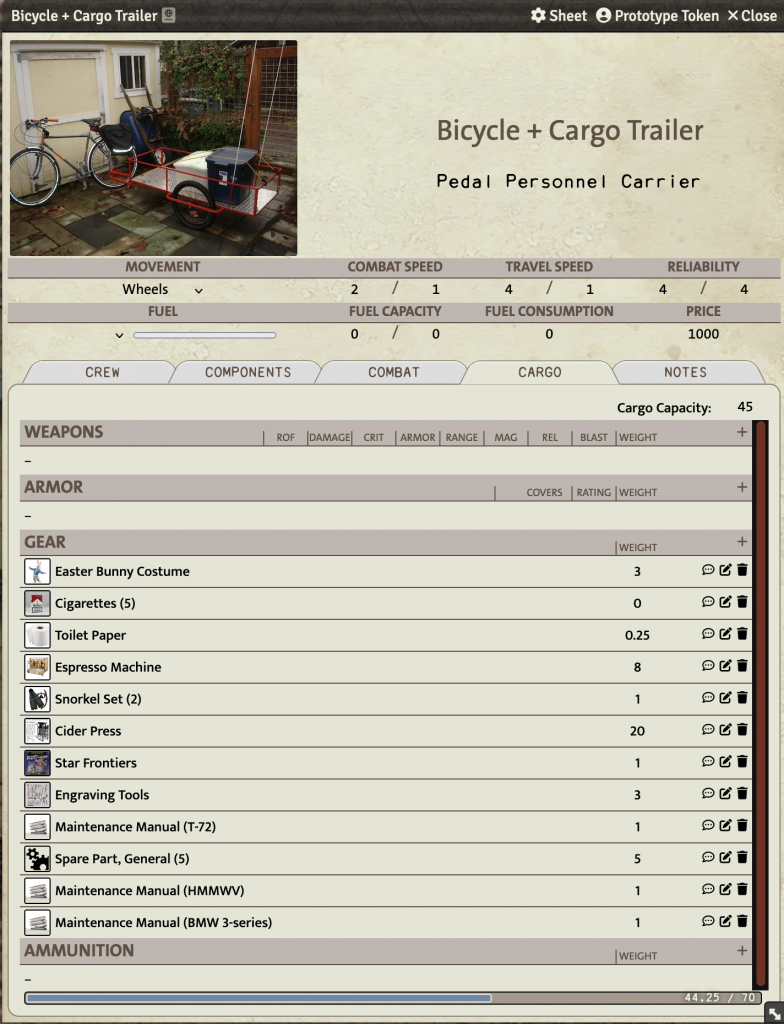
Somewhere nearby, Alexei Brandt pedals his bicycle and its attached cargo trailer down a mostly-paved two-lane road. The light rain that’s been falling all day hasn’t been able to mask the sporadic sounds of fighting in the area, and the East German teenager hopes he doesn’t get caught up in it. His luck runs out, though, as he rounds a bend and sees a farm whose field is sprouting three hastily-dug pits, each tenanted by trio of Polish militia and the long tube of a mortar.
[Alexei is the backup PC for Pettimore’s player. I hadn’t planned to bring him in for another couple of sessions, but Pettimore’s injuries and this scene gave me the opening I needed to get him into play.]
Alexei tries to ride by casually, but as he passes the turnoff to the farm, three sentries – two more Poles and a third in Soviet uniform – yell at him to halt. They move away from their vehicle, a battered pickup truck with some sort of heavy weapon mounted in the bed, and approach him, ordering him off his bike. Alexei complies, raising his hands.
“What are you doing here? This is a restricted military area!”
Alexei shrugs. “I’m sorry, man. I didn’t see any signs.” He gestures to his bike’s trailer. “I’ve just got stuff, you know? Like, salvage.”
[This is not a verbatim transcript but it’s pretty much how the conversation went.]
The two Poles exchange a look. “What do you have?”
“Ah.” Alexei starts pulling things out of the trailer to display them. A set of engraving tools. A technical manual for BMW 3-Series automobiles. A snorkel and a set of swim fins. “Just stuff I’ve found, y’know?”
“You, uh, got any smokes?”
The Soviet, much more alert and hanging back a few meters, shakes his head in resignation.
Alexei grins and produces a half-carton of Marlboros. “Sure do! What do you have for trade?”
I may have had a bit too much fun setting up Alexei’s initial trade goods from my random loot generator. On the other hand, I’m very curious to see what shenanigans my players get up to with an adult-size Easter Bunny fur suit.
At this point, the trade deal is interrupted by the bellow of an engine and the squeal of tires as an OT-64 bearing extensive but superficial combat damage charges into view from the south and makes a skidding, swaying turn onto the farm’s driveway. Alexei and the sentries scatter, diving for cover.
Aboard the OT-64, Minka’s eyes widen as she recognizes the East German boy who worked the last prewar summer for her as an exchange student farmhand. “Don’t shoot the kid!” she yells as she, Betsy, and Novotny open fire. The broadside volley drops the ZOMO troopers where they stand and drives the Soviet toward the cover of the nearby trees.
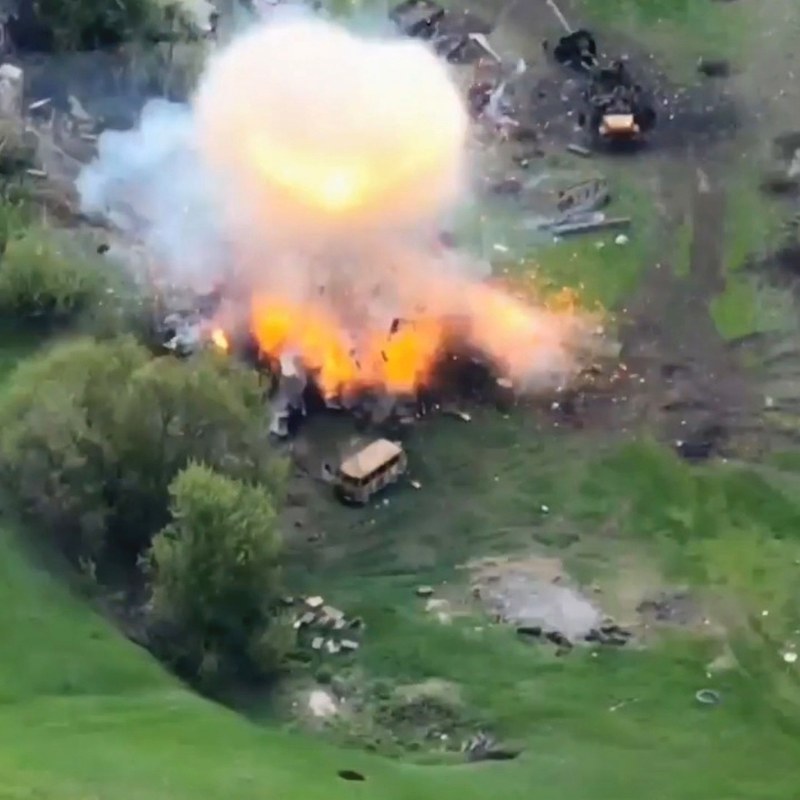
Turner hits the brakes as the APC barrels toward the technical parked in the driveway. There’s a horrifying screech as the vehicles trade paint but neither one sustains serious damage. In the turret, Leks brings the KPV into line with the nearest transport vehicle, a Tarpan Honker with ZOMO markings and an attached cargo trailer, and mashes the trigger –
[Penetrating damage, 1d10 table… a 5 is… cargo.
Oh boy.]
Pretty much exactly like this.
The OT-64 rocks in the blast wave as seventy 82mm mortar shells detonate. The blast half-flattens the nearby command tent, smashes the front of the adjacent farmhouse, and stuns the battery crew into inaction just as they were beginning to react to the sudden appearance of a very hostile APC.
The 40mm grenade that Minka sends toward the command tent is almost anticlimactic. In its wake, she bails out of the APC, Betsy hot on her heels. Both women sprint toward the abandoned technical and its automatic grenade launcher.
“Minka!?” Alexei hauls himself to his feet and starts running in that direction. As he passes his bike, he grabs one of the items that he didn’t intend to offer for sale.
The Soviet advisor who was on sentry duty folds as Alexei swings en passant and dives into the pickup’s driver’s seat. Betsy wins the race by a stride and leaps behind the AGS-17 while Minka clambers aboard. The engine cranks and the tires fling gravel.
Sporadic return fire begins to crackle from the farmhouse windows. Leks ignores it to put his sights on the Star 266 heavy truck visible beyond the building. His salvo tears the fuel tank to shreds, sending a couple hundred liters of flammable alcohol gushing onto the fallow fields. The lone crewman there decides he isn’t being paid enough for this and begins running as fast as his legs can carry him.
Now alone in the OT-64’s passenger compartment, Novotny [piloted by Miko’s player] grins and puts a 40mm tear gas round through one of the farmhouse’s open windows.
Turner steers the APC around the farmhouse, surprising a trio of ZOMO who staggered back there after escaping the command tent. Their AKM volley does little more than chip more of the OT-64’s paint. Leks saves ammo and lets Novotny return fire, dropping one and convincing the other two to behave themselves.
The mortar crews are starting to get organized, grabbing their personal weapons and firing from their positions. Betsy’s freshly-appropriated AGS-17 thunkathunkathunks out a volley at one of the mortar pits, suppressing the trio of ZOMO there.
The OT-64 swings around the parked Star and the farmhouse to put all three of the mortar pits under its guns. This is about all the survivors can take and weapons begin to fly out of the pits.
This was designed as an easy fight if the players could neutralize the AGS-17 and the machine guns on the trucks, which they did rather swiftly. However, I ran this in parallel with the hunt for the Soviet advisors’ commando team, switching back and forth at dramatically-appropriate moments and at the end of every combat round. That fight… did not go as dramatically in the PCs’ favor.
After consolidating and reorganizing, Leks is leading Bell, Cowboy, Pettimore, Magda, Minka, and Novotny in a headhunting raid against the ZOMO command post. This is their best chance to disrupt the ZOMO assault against Von Bahr’s unit to ensure that their allies retain control of the derelict-but-repairable hydroelectric power plant.
Ellis wasn’t able to extract an exact location for the command post during his interrogation of captured Soviet QRF leaders – they legitimately didn’t know – but the team has a general idea. They’re looking for an elevated position a few kilometers southeast of the battle, close enough that the Soviet-supplied radios will enable the ZOMO commander to control his maneuver elements and mortar battery. Magda takes a look at the map that Zenobia recovered from the QRF HQ and points to a string of low hills. “There.”
In a small dot of woods a few hundred meters south of the position Magda indicated, Magda, Pettimore, and Cowboy slip out of the idling OT-64 and head north. As the stealthiest characters on this operation, they’re charged with pinpointing the CP’s location and calling in the rest of the raiding force. Because they have good Recon rolls and it’s no fun to play out hours of aimless searching, they find it, creeping in from the east amid light woods.
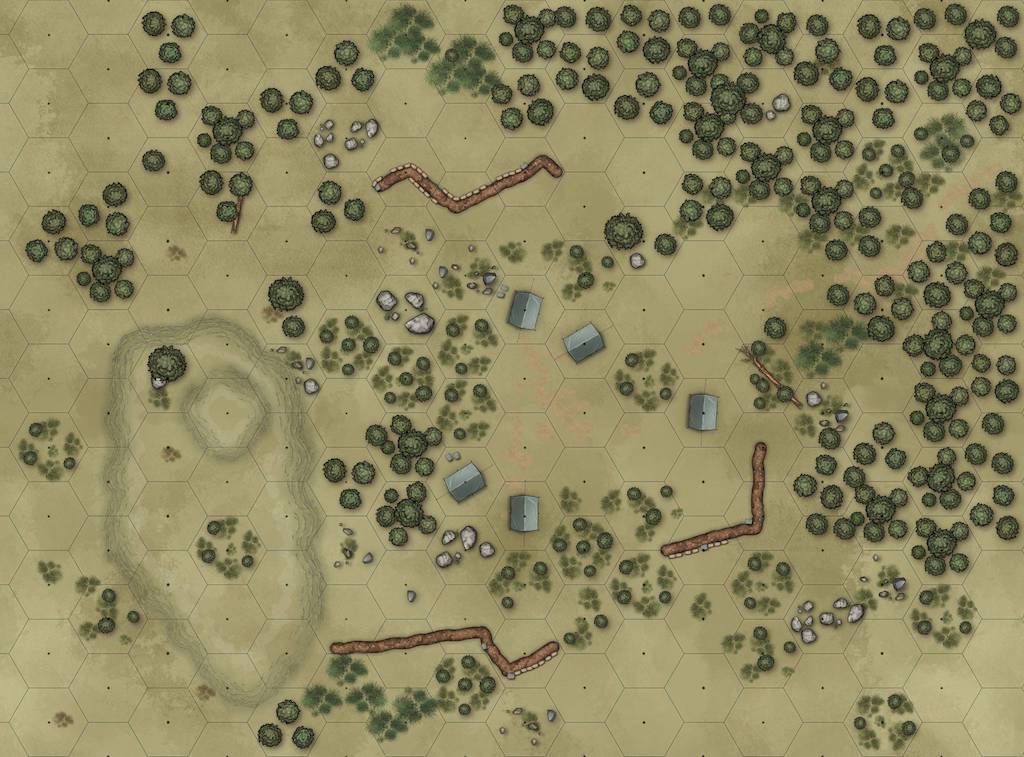
It looks like the ZOMO field force used this as a base camp before the cavalry and mechanized infantry moved out for the assault. A large number of tents are scattered around a clearing atop the hill, but none of them appear occupied at the moment. Trench lines to the north and south host a quartet of disinterested sentries. The hill’s crest to the west provides a natural barrier there. In the center of the camp are parked a Land Rover 110, with spray-painted camouflage over its original British paint scheme, and a UAZ-469, wearing ZOMO markings and sporting a large radio antenna. A half-dozen people in mixed ZOMO and Soviet uniforms are clustered around the rear of the latter vehicle.
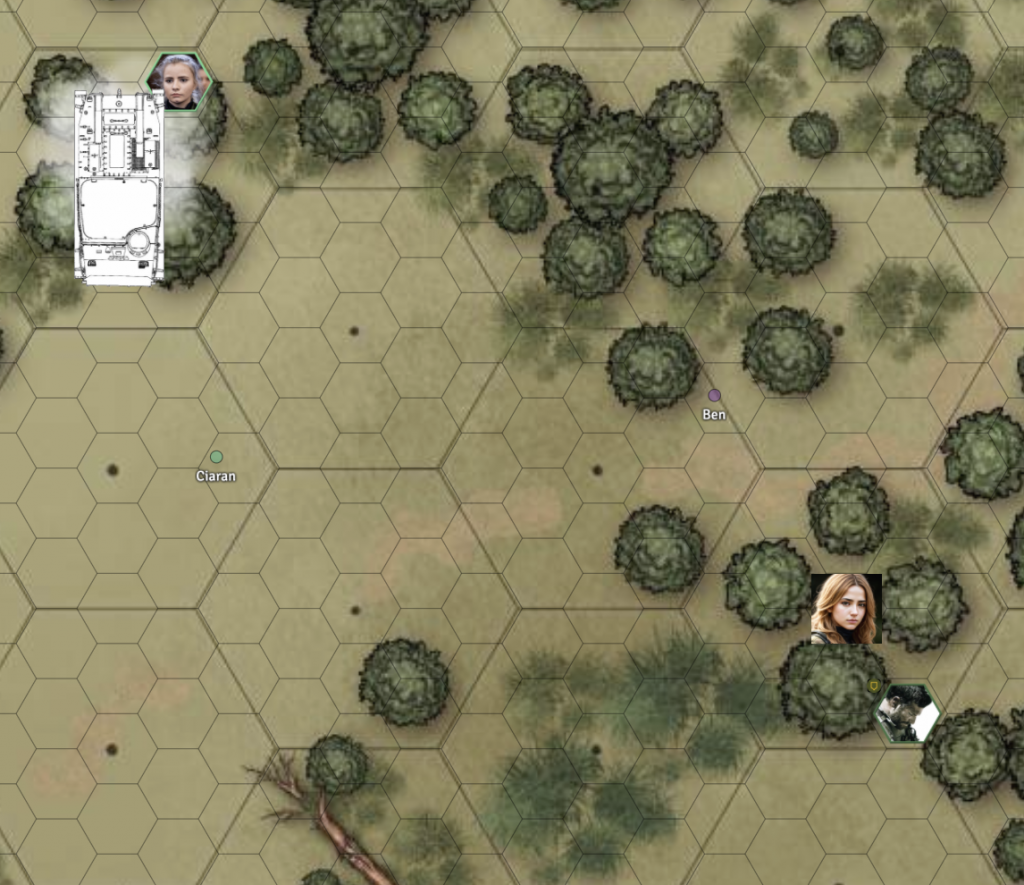
No tokens because I once again failed to get a screen shot before the scene began. The map is yet another of Pulpscape’s fine creations from the eponymous Patreon account.
Without radios, the team is back to more primitive methods of signaling. Cowboy tosses a red smoke grenade out of the treeline to the south. There’s an immediate reaction from the command post. Shouted orders send the nearest sentry climbing out of his trench to investigate. He’s almost to the source of the billowing crimson cloud when he sees and hears the OT-64 bellowing its way up the slope toward him. He turns to shout and run.
Cowboy opens fire on the cluster of officers. She’s carrying a PK and the heavy 7.62mm rounds tear into the group, dropping one of the ZOMO officers and suppressing the rest. The two Soviet advisors are faster to react, ducking for cover and moving to the rear of their Land Rover.
The roar of a large engine turning over alerts the recon team that they’ve overlooked a major and potentially fatal detail. On the north side of the camp, the crew of a BTR-50P is cranking their ride. From the factory, such a vehicle wouldn’t have been much of a threat to the oncoming OT-64, but it’s been up-gunned. A DShK heavy machine gun is pintle-mounted at the commander’s hatch. Of greater concern, though, is the SPG-9 recoilless rifle whose long tube sits atop the roof.
Magda sprints toward the BTR. She’s not much of a mechanic but she knows that most engines stop if you punch enough holes in them. The crew is focused on getting their weapons into action against the OT-64 and doesn’t see her until the muzzle of her Tantal is jammed into the engine’s cooling louvers.
[Does a BTR-50’s engine bay even have cooling louvers? I don’t know. Nor do I care. It was an awesome maneuver in play.]
No one was expecting this shit.
Magda dumps an entire magazine into the BTR-50P’s engine compartment [bypassing the armor]. A cloud of dense white smoke erupts as thirty extra 5.45mm holes exceed the engine’s designed tolerances. Magda has just forcibly parked the ZOMO’s greatest anti-armor asset… but its guns are still in play.
Bell pulls the OT-64 onto the map just in time for an SPG-9 round to sail over his head. He begins driving evasively, throwing off the gunner’s aim for a follow-up shot but also giving Leks, Minka, and Novotny a horribly unstable firing platform.
Despite the swerving and bouncing, Leks’ hand on the KPV is steady. His return fire tears into the BTR’s glacis. The loader slams a round home, though, readying the SPG-9 for a second shot.
Fire begins reaching out from the trenches as the sentries react. Rounds ping off the OT-64’s hull and further damage the coaxial PK. Leks, undeterred, keeps hammering the BTR. Minka returns fire from the overhead hatches while Novotny dismounts and charges a trench.
[We really need to have a chat with Miko’s player about these tactics…]
Cowboy shifts fire to the Land Rover, tearing its suspension to shreds. The Soviets continue pulling gear from the back of the disabled vehicle. Pettimore sees one of them loading an RPG-16 and puts a round close enough to suppress him, but the anti-armor rocket launcher is still in play.
Magda, isolated at the camp’s northeast corner, comes under fire from the north trench’s sentries. She pulls back around the BTR’s corner, reloads, and begins trying to suppress the vehicle’s crew to keep them off their weapons.
Minka reloads her GP-25 and puts a 40mm round into one of the trenches. The ZOMO officer and sentry there are hurt [which the explosives in enclosed spaces rule from Urban Operations definitely facilitated], but neither man goes down.
A heavy rifle round slams into Cowboy from a heretofore-unrevealed sniper team atop the western hill crest. Pettimore reciprocates with a headshot, demonstrating why he’s the superior sniper, but the spotter is still in action. He’s nestled in behind a G3 and he flips the selector to full auto and continues firing on Cowboy. She goes down with a shattered elbow, bleeding out. Pettimore adjusts fire and coolly puts a round into the spotter too.
[The sniper team was up there observing the battle with a spotting scope. It took them a couple of turns to reorient on the unexpected fight and pick the best target. They should’ve gone for Pettimore first]
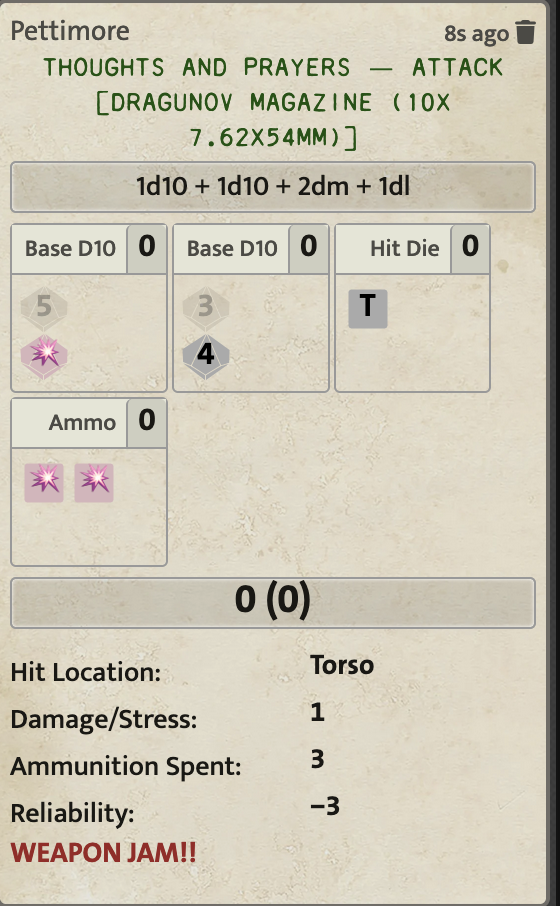
One of the northern sentries exits his trench and rushes Magda. There’s a close-range exchange of fire which ends both both parties injured and out of ammo. Enraged and desperate, Magda pulls her gardening knife and charges her adversary, but the initial exchange of blows shows she’s outmatched. Pettimore attempts to intervene in the melee, but his rifle finally fails him, going down to 0 Reliability:
A rifle butt smashes Magda in the face and she falls. The ZOMO trooper’s triumph is short-lived, as Pettimore swaps weapons and drops him around an arrow in the stomach.
Leks continues trading 14.5mm volleys against SPG-9 shells. The ZOMO gunner can’t seem to hit. Leks isn’t so handicapped. His KPV finally chews through the BTR’s front armor, killing the commander and sending the driver (who’s been hiding in his seat with nothing to do) into headlong flight.
Novotny overruns the southeast trench in a point-blank exchange of fire that ends with him standing atop two dead ZOMO.
Pettimore drags Cowboy into cover and begins applying immediate aid to keep her from bleeding out.
A final volley of fire from the ZOMO survivors disables the OT-64’s coxial PK. Leks curses, turns over the turret to Minka, and dismounts to press the assault with his MG3. The Soviets go down in a barrage of fire, having never gotten a shot off with their RPG-16. This is enough to force the three surviving officers, the BTR’s driver and gunner, and the one remaining sentry to surrender.
This was an ugly fight, ending with two PCs down, one with a crit. The dice made the BTR-50 tougher than the numbers say it should have been, but its crew passed a surprising number of Coolness Under Fire checks to avoid forced bailouts. For all that, they got like four or five SPG-9 shots off and never actually scored a hit.
It’s approaching noon when the team is reunited. A haze of burning truck and UAZ hangs over the ambush site. Red and Erick, their own wounds barely bandaged, are hard at work in their improvised field surgical ward. Minka goes to check on and help them, in that order. The rest of the team begins reloading, reorganizing, and trading stories with one another and the White Eagles.
Ellis and Leks take a few of the higher-ranking prisoners aside for interrogations. The news isn’t great. It gets worse when the White Eagles’ RTO comes to Ellis with a radio message from Von Bahr (with the loss of the BTR-70K’s radio, the team has no working comms themselves). Ellis pulls the team and the White Eagle command element together and summarizes the take:
As suspected, the Soviets have been following their Afghanistan counter-insurgency template: protecting their own assets, trying to build up local forces to handle regional security in the rural areas, and preparing to move more Soviet forces into Radom to control the city.
The greatest perceived security threat is Von Bahr’s loosely-NATO-aligned East Germans at the power plant on the Pilica. The PCs’/White Eagles’ strike against the Soviet QRF happened to coincide with the Soviet-backed ZOMO move against Von Bahr. The majority of ZOMO forces are in the field for this assault now.
The Soviet advisor team is in a different chain of command than the QRF was. They both report up to commanders in Lublin, and they’re coordinating and communicating locally, but neither group answers to the other.
There are about a dozen advisors. A few of them are embedded with the ZOMO forces but the majority are using the ZOMO action to mask their own unspecified commando action against Von Bahr.
There are four main ZOMO elements in the field: a command post, a mortar battery with three 82mm tubes, a cavalry “company” of about 20 troops, and a mechanized infantry “company” with about 25 troops, an OT-64, and two BTR-60s. The remaining two foot infantry “companies” (in reality, platoons) are back in Radom for local security – presumably, one of these was the reinforcements that the team saw arriving at the QRF base.
Ellis does some quick map sketching. Von Bahr’s back is to the Pilica River, north of him. The ZOMO cavalry are moving in from the south as skirmishers while the mechanized infantry’s main assault comes in from the east. The mortars and command post are both southeast. This leaves Von Bahr’s western flank open, and that’s where Ellis suspects the Soviet advisors are operating.
Ellis, Red, and Leks confer with Rabarchak, the White Eagle commander on scene. As agreed, the White Eagles will support, but Rabarchak’s orders don’t allow her to move her troops forward and no one expected to have to ride to Von Bahr’s rescue today. But the team is behind the ZOMO’s lines and has an opportunity to disrupt this offensive without engaging another large force.
The team has to split up. It’s the only way they can do enough damage.
Ellis grabs Miko, Cat, Quinn, and Scott and the team’s own UAZ-469. They’re going hunting for the Soviet advisors.
Zenobia takes the BTR-70K with Turner, Ortiz, and Ross. They’ll accompany Ellis’ group as far as possible, then split off to make a special deliver to Von Bahr. The Soviets had done some surgery on their captured FV-101 Scorpion, replacing its standard 76mm gun with a 73mm gun from a BMP-1. Presumably, this was to simplify their supply chain for the vehicle. For the team, this means that they’ve liberated a decent supply of 73mm ammo that Von Bahr’s troops can use in their own BMP-1, for which they previously had no main gun ammo.
[No new faces here, but reminders. Turner, Ortiz, and Ross are all NPCs rescued from the POW column. Turner is an MP, Ortiz is an infantrywoman SAW gunner, and Ross is an artillerist. Ortiz and Ross are both carrying moderate injuries from the convoy/QRF ambush but are still fit to fight.]
Finally, Leks will take Bell, Cowboy, Pettimore, Magda, Minka, and Novotny in the OT-64. They’re hunting for the ZOMO command post with the intent of performing a decapitation strike.
[And a few more reminders. Bell, Cowboy, and Novotny are all rescued POWs. Bell is the NPC linguist, still trapped in the OT-64’s driver’s seat. Cowboy is the MLRS crewwoman who’s now the secondary PC for Red’s player. Novotny is a Czechslovakian defector, an infantry grenadier who’s usually an NPC but will temporarily be under the control of Miko’s player.]
It’s not a perfect plan, but there’s only time for an adequate plan executed violently. The team rolls out.
Context-free handwritten notes from 2017 for a Changeling campaign that never launched:
The net is a realm of dream too. How can you tell where its Hedge begins? Is it the same Hedge? Or is it the border of another Arcadia, one whose inhabitants hold no Contracts binding them to the material world? Ancient sleepers stirring in the starless cyberspace. Under neon skies, Bobby Newmark’s loa are coming. Korea was first. Addicted gamers in cybercafes never come back, not entirely. Online, no one can tell if you’re a dog – or if you just have the head of one.
The hit on the Soviet QRF base west of Radom will rely on a successful convoy ambush to draw off enemy forces. Without dividing the Soviets’ strength, the raid team will be severely outgunned. But they do have a plan…
The team splits up into four elements. Pettimore and Zenobia move in first, creeping up before dawn to take position in an abandoned house southeast of the base.
The main assault will come from two teams, each approaching on the main road in an APC. The team coming from the north will be Bell (driver), Cowboy (gunner), and Miko (dismount) in the BTR-70K. The heavier south assault will be Turner (driver), Leks (gunner), Magda, Minka, and Novotny (all dismounts) in the OT-64. Finally, a three-person RPG team on loan from Von Bahr will approach on foot from the southwest in case any QRF elements try to break out through their compund’s back gate. All three of these teams spend a couple of agonizing hours easing into position. If they’re seen or heard, the whole operation will be blown.
[Bell, as readers may recall, is the trombonist and SIGINT linguist rescued from the POW column in mid-August. Turner is the MP from the same group. Both of them are still NPCs. Cowboy is also a liberated POW, a former MLRS crewwoman who’s now the secondary PC for Red’s player. Finally, Notovny is a fourth ex-POW and NPC, a Czechoslovakian defector who’d subsequently been a grenadier in the 5th ID.
I probably need to do a roll-up post for all the characters we’ve introduced who haven’t yet gotten much screen time here.]
Everyone reaches their starting position without apparent detection. They’re committed now – without radios, they have no coordination between the four elements. On paper, the numbers still suck for our protagonists. Even with the planned diversion drawing off enemy strength, they’re still going to be outnumbered by veteran troops who are equipped at least as well as they are and who are in their home. On the other hand, they actually have done some pre-fight management for this assault, and they should have the additional advantage of…
Leks needs this t-shirt.
Pettimore and Zenobia have been hunkered down in their hide for hours. It’s now mid-morning. Without a radio (the team’s only unit is in the BTR-70K), they don’t have direct communication to tell them when the convoy ambush goes off, but they can tell anyway. There’s a boil of action around the QRF base’s radio room. Within minutes, engines are cranking and hatches are slamming shut. The initial counter-assault package rolls out: the Scorpion, followed by the OT-64 with an infantry squad on board and the UAZ-469 gun truck with its AGS-17.
The rest of the QRF doesn’t rest. The other vehicles pull around to the front of the compound, ready to move once the ambush scene is secure. With the departure of the first package, this leaves a BTR-80, a HMMWV with a DShK, and the unarmed bukhanka ambulance and the Zil-131 recovery truck – plus, of course, the remainder of the infantry, the command element, and the mechanics and medics.
The sniper team waits. At a hundred meters out, they can’t hear the enemy radio, but their rifle optics give them a window into the command element’s body language. They can tell exactly when the counter-assault package hits the White Eagle ambush.
Pettimore sights in. Thoughts and Prayers cracks once. The QRF’s tower guard falls.
A kilometer to the north, Bell hears the distant shot. “I guess it’s that time,” he sighs, and cranks the BTR-70K’s engine. An equal distance to the south, Leks clanks the OT-64’s hatch shut and nudges Turner with his boot.
Pettimore and Zenobia move back into the shadows, watch, and begin marking targets. The Soviets are scrambling for cover, shouting back and forth as they try to determine where the shot came from and who was hit. They’re just getting organized when the bellow of engines heralds the arrival of both APCs.
From the previous week’s reconnaissance, the team determined that the Soviets’ initial reaction package should usually by the Scorpion, one of the APCs, and one of the gun trucks. Their plan calls for removing the biggest threat first: whichever APC remains at the base. Cowboy and Leks swing their KPVs onto the BTR-80 and cut loose. The Soviet APC’s hatches fly open and it shudders in a cascade of internal explosions as the 14.5mm deluge finds its ammunition feed.
From the OT-64’s air guard hatches, Magda and Minka open up on the workshop at the compound’s southeastern corner, suppressing the mechanics before they can get organized. The HMMWV’s gunner starts to swing his weapon in their direction, but Zenobia has been waiting for this. A single round from her M21 takes the gunner’s head off and sends the rest of the HMMWV’s crew scurrying for cover.
Miko jumps out of the BTR-70K and advances through the junked cars on the compound’s north side. He lobs a tear gas grenade into the former restaurant/tavern that now serves as the QRF barracks, then hunkers down as that attracts the attention and fire of the troops who’d already made it out of the building.
To the south, Leks turns his attention to an RPG team that’s trying to set up for a shot on the OT-64. Magda and Minka continue trading fire with the mechanics. Novotny dismounts but heavy fire forces him into cover before he can execute his assigned task of tear gassing the workshop.
Despite Cowboy and Miko’s best efforts, there isn’t enough weight of fire on the north side to pin all of the enemy troops in the barracks and headquarters building. One of the troopers manages to get an RPG-18 into play. The rocket hisses toward the BTR-70K and slams into its flank. The HEAT jet tears through the rear compartment, striking the priceless radio. Miko retaliates with more tear gas.
Heavy fire from the headquarters rattles off the OT-64’s armor. None of it penetrates but it forces Minka and Magda under cover and damages the APC’s coaxial PK.
Pettimore finds the source of the heaviest fire, a Soviet with an ancient Degtyaryov DP-27 propped on a window of the HQ. He sights in, breathes, and puts a round through the man’s heart.
Leks puts PK fire into the remaining members of the HMMWV’s crew, permanently deterring them from re-boarding their vehicle and getting their DShK into operation. Minka and Magda stay in the air guard hatches, sending short bursts toward targets of opportunity.
The Soviet RPG team sends a round toward the OT-64 but it goes high. Pettimore, Leks, and Zenobia focus fire on them.
There’s a momentary lull in the action as both sides maneuver and take stock. Miko, closest to the HQ, is the first to hear the call for surrender. With all his heavy weapons out of action, the Soviet commander seems to have realized the futility of continued resistance. The team moves in cautiously, but there’s no treachery afoot here. Under the guns of the APCs, the survivors lay down their weapons and have a seat on the pavement.
Aware that they’re on a clock, the team begins looting everything they can get. Zenobia goes for the HQ first and finds that the Soviet commander’s last action before surrendering was to toss a thermite grenade onto his radio and codebooks. There’s still at least one major intelligence win, though: a large wall map of Radom and its surroundings (which has some interesting implications about the Soviet commander’s headspace).
Miko and Magda head into the recently-fumigated barracks, working in quick bursts before ducking out to get fresh air. Minka makes a beeline for the workshop. Leks, Cowboy, and Novotny, aided by the East German RPG team (who are suitably impressed with the carnage), supervise the Soviet medics’ treatment of their wounded and herd the prisoners into the back of the Zil-131.
The team is about halfway through a good thorough looting when Pettimore, who’s remained on security, spots two heavy trucks approaching from the north. They halt about a kilometer away and an infantry platoon begins deploying. Through his rifle scope, Pettimore can see the ZOMO armbands.
The team drops what they’re doing and scrambles for their vehicles. Miko tosses a Molotov into the barracks; Leks drops the HMMWV into gear, aims it at the workshop, and leaves another Molotov in the driver’s seat. The impromptu convoy turns south, heading for a rendezvous with the White Eagles at the ambush site and hoping that side of the fight turned out as well as this one did…
We had an entire game session devoted to planning this fight before actually executing it, and that really showed the difference between randomly running into enemies and taking the time to think through and coordinate actions. Surprise and suppression played huge parts in the players’ success. The Soviets actually had a fair amount of anti-armor firepower that could have splattered the team’s APCs, but they didn’t have a chance to get much of it into play. At the end, the PCs killed 12 and captured 19 in exchange for minor injuries and stress. They also got away with the UAZ-452A ambulance, the Zil-131, and about half the Soviets’ gear and supplies.