It’s an hour before dawn. Ellis’ face is lit by the glow of the BTR-70K’s remaining radio set. He occasionally blinks. Otherwise, his only movement is a turn of the wrist to adjust a dial.
He’s about to scan away from the frequency that, in the decrypted dossier from Broadstreet, was labeled “DIA liaison,” when:
“Any unit on this net, this is Gunstar Two-Two requesting assistance.”
It’s a male voice with a New England American English accent. Ellis blinks, frowns, adjusts his mic. “Go ahead, Gunstar Two Two.”
“Gunstar Two-Two to last unit, please identify. Over.”
“Gunstar Two-Two, this is Ops. Verify you are aware this is an unsecured transmission.”
“Ops, Gunstar Two-Two is aware I am transmitting in the clear. My crypto is down. I am requesting any available assistance, over.” The voice sounds exhausted.
“Gunstar Two-Two, Ops copies. Stand by for response.” Ellis removes his headset and strides the twelve meters to where Bell is sleeping. “Bell. I need your ears.”
The SIGINT linguist rolls awake, reaching for something before he processes his surroundings. “What? Yeah. Ugh. Gimme a second.” But he throws back his blanket, shoves his feet into his boots, and follows Ellis back to the BTR.
Ellis re-dons the headset and hands the spare set to Bell. “”Gunstar Two-Two, Ops. State your situation and location.”
There’s a distinct pause before the other guy keys up again. “Ops, Gunstar Two-Two is west of the Pilica River and south of the reservoir. No grid reference available. This unit has four personnel, all wounded, two trauma red. Our vehicle is disabled. We’re separated from our parent unit and have been unable to re-establish contact. Be advised, there is a heavy hostile presence in this area, presumed Soviet deserters. How copy, over.”
Ellis and Bell confer quickly. The speaker mispronounced “Pilica” the way a native English speaker would who’s seen the name written but not heard it spoken by a Pole. Speech and diction are giving both men the impression that this guy is either a legitimate Anglophone or as good a linguist as they are, and is also proficient with radio comms. Bell thinks he’s probably from Vermont or New Hampshire. It’s seeming less likely that this is a Soviet or Pole playing games.
“Gunstar Two-Two, Ops copies all. Hold it together. Help is on the way.”
“Ops, Gunstar Two-Two copies. Be aware, I have limited battery. Please advise time for next check-in, over.”
Ellis checks his watch, does some mental math. “Two-Two, Ops copies. Keep your heads down and your powder dry. Talk to you in an hour. Ops out.”
“Two-Two out.”
Ellis looks at Bell. “I’m going to need you on the radio. Get your stuff. Wake up that MP and the infantry chick. They’re going to be driving and gunning. We’re rolling out in thirty.”
One of the many background elements I track on the logistics spreadsheet for my Kaserne on the Borderlands campaign is weather. The Twilight: 2000 4th Edition rules as written are pretty simple: it’s either fair, cloudy, or precipitation, with a 1d6 roll moving along that sliding scale. I wanted a bit more detail, as I do appreciate me some fine-grained worldbuilding. While looking around my bookmarks, I was reminded of hex flowers.
As that linked post says (you really should RTWT):
Basically you arrange your 19 possible outcomes into the 19 hexes of the Hex Flower i.e. you populate the Hex Flower. The (general) idea is to group the 19 outcomes in a way that makes sense. Often this means grouping similar things together. In play, you roll dice and the rules of the Hex Flower dictate which Hex you move to next. That is, you move from the current hex to one of the 6 adjacent hexes. In that way the last outcome limits the next outcome … a sort of ‘memory’ of a kind.
Early stages. The creases in the jeans do a nice job of showing off the auto-shading from Army Painter’s Speedpaints (specifically the Tidal Wave light blue).
Completed paint work. I could touch up some ragged edges, especially the red banding on the camera lenses, but that’s approaching the limits of my brush control and might not yield a net gain.
This completes my paint work on all six of the covert/overt pairs. I need to seal this one, base her and the U.K. agent, and then there’ll be some better and more-contextual photography in the Flickr gallery. I may throw a spot of black wash on her shoes; as it is, they’re a bit too monocolor for the “women’s casual hiking shoes” look I was seeking.
I’ve seen some complaints levied against Spectre’s newer sculpts – some consumers feel that the computer-rendered figures are too “samey-samey,” and I certainly can see how the sculptor might feel a temptation to reuse elements. However, in terms of paintability, the consistently clean lines of a CAD-derived figure coming out of a new mold are a joy to work with, especially when I contemplate some of the melty-edged 30-year-old Ral Partha minis that are still in the stack of to-be-painted boxes in the basement.
The reconnaissance mission to Radom ended with the ZOMO and Soviet garrisons on alert. The team decides that further provocations may not go in their favor until they’ve had more time to prepare. Instead of keeping their focus east, they head south, intending to survey and map more of the area past Opoczno (and perhaps see if the ZOMO are probing westward).
After their last encounter with the ZOMO, there was some discussion about having a stealthier point element. Minka is the one trained horsewoman on the team, but Miko is a decent natural rider. Minka selects Kinga for her own mount and puts Miko on Tobi. The rest of the PCs going on this op – Magda, Leks, Red, Pettimore, and Zenobia – load into the UAZ-469.
[ A note here because I’ve failed to introduce some not-quite-NPCs. When the PCs captured their initial five horses, I rolled their appearances and qualities on my vehicle generator. The player behind Minka fleshed out their descriptions and personalities for us. I’ll post her work later, but for now:
Kinga is a black-and-white pinto mare. She’s loyal, fearless, and calm – good qualities in a scout mount.
Tobi is a dark bay gelding with white socks. He’s moody but intelligent, strong (+5 encumbrance units of cargo capacity), and trained to ignore gunfire if prepared or prompted. ]
The team heads out, moving cautiously once they cross the highway and head into unknown territory. The forest here is dense, and despite the lack of clouds in the sky, little sunlight penetrates to the twisting, unpaved road they’re using. Magda, navigating from the UAZ’s front passenger seat, is having trouble keeping her bearings. Miko, ostensibly the point man, is very out of his comfort zone – he’s on horseback for his first real ride, he can’t see more than twenty meters through the foliage, and this is about as far from his familiar urban environment as one can get in Poland. The wolf howls in the distance aren’t helping his composure, either. So it’s a surprise even to him when the road widens out into a cleared area.
At least, it’s a formerly-cleared area. The old-growth forest (which Zenobia does not remember being this dense before the war) was, at one point, cut back in an area about 500 to 600 meters across. In that area stand the remains of a small village – a lumber town, judging from the decrepit sawmill. The place looks like it’s been abandoned for a half-century: new trees sprout in the former fields, roofs have collapsed, rusted-out trucks sit on flat tires, birds nest in exposed structural members. There’s no sign of human habitation.
Most of the team dismounts, with Leks staying on the UAZ’s PK for overwatch. Minka, more attuned to spiritual elements than most of her companions, gets the sense that the place wants to be hospitable… but it’s forgotten how. She mentions this to Magda, who wonders if whatever effect is making people forget things is also making places forget things.
[ At this point, I may or may not have PM’d Magda’s player to award bonus XP for this insight. ]
The team pokes around in the ruins a bit. Miko unearths a chainsaw, broken and badly rusted but probably repairable. Zenobia takes a closer look at the vehicles parked along the village’s single paved street and realizes that while they’re in advanced states of decay, most of them are 1970s to 1990s production. Minka finds the village’s cemetery, which has nearly 40 grave markers with dates in January and February of 1998 – presumably victims of the first winter after the nuclear exchanges.
Pettimore walks a bit away from the rest of the group. One of the POWs who elected not to stay with the team was a fellow Kentuckian, and he offered to take a message to Pettimore’s family if he got home first. Thoughts of home have been weighing on the scout-sniper even since. He heads to the village’s church (Catholic, as it happens). Its condition is just as bad as that of the other buildings, with the steeple collapsed onto the roof and the roof more holes than wood. The doors protest a little, but yield to Pettimore’s arm. He steps inside, finds a box of candles, lights one, and kneels to pray for his brothers – and for the inhabitants of this village, wherever they may be.
A pair of songbirds flutter in through the holes in the roof and alight on the altar. A sense of peace suffuses Pettimore. He rises and turns to leave.
“We found one of your people, Bearkiller,” says a voice next to him.
Very slowly, Pettimore turns. Filip gives him a slow nod.
“Someone from the Fifth? Where?” Pettimore asks.
“West of here. She wandered into our territory, badly wounded. We have her at a mining village we use as a waystation sometimes. I was going to come north to find you, but since you’re here…” The Bracia Wilkow leader kneels and sketches a quick map in the dirt on the floor. “I’ll meet you there.”
“Thank you.” Pettimore runs for the door, yelling to the team to get ready to move.
The road climbs out of the old-growth forest and into wooded hill country. The town they’re approaching is eerily familiar to Pettimore – but for the language on the signs, this could be any one of a hundred Appalachian mining towns he’s seen over the years. The mine here extracts iron rather than coal, but it’s still the same rows of simple houses, the same general store, the same tool supply store, the same heavy bunkers for storing mining charges… the same story, the dark earth willing to exchange a ton of stone for a pound of flesh.
Three more Bracia Wilkow are waiting outside the small infirmary. Filip steps forward, meets Pettimore’s eyes, and shakes his head. He steps aside and gestures to the door.
Pettimore looks to Red. “Doc?” he says hoarsely.
An awkward silence descends over the rest of the group as Pettimore and Red push into the clinic. On the bed nearest the door is the body of a dark-haired woman wearing the remains of an olive drab flight suit. It doesn’t take Red much effort to determine what killed her: slow internal bleeding from a deep shrapnel wound in her lower back. Her dog tags – one around her neck, the other laced into one of her boots – identify her as First Lieutenant Danielle Flores, US Air Force. Pettimore recognizes an insignia on her flight suit: she flew for AFSOC.
(No one has seen an operational helicopter for two years. When Pettimore was doing Broadstreet’s work alongside the 5th Infantry Division, though, he heard rumors that U.S. XI Corps still had a small force somewhere for exceptionally high-priority special operations work. If Flores was part of that, someone back west had a strong interest in something in this patch of Poland…)
Flores’ personal effects are piled on a table across the room. There’s an aviator’s survival vest containing a couple of signal flares, a VS-17 marker panel, an M11 and a couple of spare magazines… and a knee board. One side is covered in math that Pettimore doesn’t immediately recognize.
The other side is a clear acetate sleeve containing an aviation sectional map for the area west of the team’s current location. Grease pencil markings point out two sites.
The revealed world map so far. The portions around Kalisz/Lodz are the result of Ellis’ interviews with the 5th ID POWs. The rectangular portion in the center is the aviation sectional chart’s reveal. The area the team has actually explored to date is the un-clouded bubble in the center right…
Outside, Filip’s two followers are not quite trying to stare down the rest of the team. Filip notices this behavior and says something that sends them slinking away.
A few minutes later, another of the Bracia Wilkow emerges from the nearby residential area with two freshly-snared rabbits. He presents them to Minka and Magda, then stares at them as if he’s trying to figure something out. Eventually, he finds his words, haltingly welcoming them and inviting them to prepare a meal.
Magda checks out the kitchen, such as it is. The Bracia Wilkow seem to be ignoring any kitchens in the houses around them, preferring to use an open-air fire pit with a rudimentary camp kitchen. While Magda is looking through the team’s travel rations to find something to make the meal more palatable, the rabbit hunter comes back with an ancient, battered leather case, which he proudly displays to her. “We use this. For… feast nights,” he explains. Inside, in padded compartments, are a dozen glass vials of seasonings.
This breaks the ice. Three more Bracia Wilkow arrive, including the first woman the team has seen among the partisans. They’re bearing hand-woven baskets full of mushrooms, nuts, and berries from the forest. With the aid of a couple of laconic helpers, Magda sets to work.
Leks has been standing back, observing the proceedings in his self-assigned role as security (and playing staredown games with the younger Bracia Wilkow). As he watches, something half history lesson and half cultural memory is simmering in the back of his brain. “Forest Brothers?” he muses in Estonian.
Filip looks up and raises an eyebrow. Leks repeats himself in his fragmentary Polish.
“We know the name,” Filip acknowledges. “The legacy.” He scrutinizes Leks. “I think you would have done well among them.”
Red and Pettimore emerge from the clinic, Pettimore bearing Flores’ remains wrapped in a sheet. They brief the rest of the team on what they learned from their examination.
Filip nods. “We found her unconscious. Blood trail from the west. Not our territory. If you’re going there… the one who claims that place won’t care, so long as you respect the land.” He looks sidelong at the UAZ. “No vehicles. But his followers are more territorial.”
The team discusses plans while they eat. The Bracia Wilkow are attentive but have little more to say. As things conclude, Filip clears his throat. “Bearkiller. I see you taking her back for your rites. Would she object if we sang for her?”
Pettimore, who’s been silent since reporting out on his and Red’s findings, manages, “I think she’d be honored.”
Filip nods. Gestures to the Bracia Wilkow. As one, they stand, pull the hoods of their cloaks over their heads, raise their faces to the sky… and howl a dirge.
As the team prepares to pull out, Filip pulls Leks aside and claps a hand to his shoulder. “If you grow tired of fighting for the world that was – the world that is dying – find me.”
It’s after dark by the time the team rolls back into Ponikla. Wilhelm and Leonard are waiting for them. Wilhelm goes stiff upon seeing the shrouded body in the back of the UAZ. He does a quick count, sees that all the PCs are accounted for, and asks, “who?”
Pettimore grits out a summary. “Can you find Father Maciej?”
Leonard nods and slips away to locate the priest. Red takes over and works out the details of storing Flores’ remains until the team can arrange a proper funeral. They have more pressing business to attend to.
As word spreads, a growing crowd (such as it is for a village Ponikla’s size) is gathering. Staff Sergeant Scott, still trying to function as the village’s most-senior NCO, pulls Red aside to get a briefing. When Red is done, Scott frowns and asks to see Flores’ knee board. “These are fuel calculations.” He traces it out. “They were planning to burn more fuel on the way out than on the way in. Could’ve been expecting a headwind but I think they were supposed to pick up a fair amount of cargo.” He scratches his head. “Big bird with long legs, too. I was a Blackhawk crew chief but this was something with a lot more fuel load. Maybe a Chinook or an Osprey.” He looks at Red. “If you’re going back out in the morning, I’d like to tag along.”
After a short night’s rest, the team turns right around and heads out. With five trained riding horses and a sixth who’s wagon-trained, there’s enough literal horsepower that no one has to walk – though Minka has her hands full keeping the less-experienced riders in their saddles.
Retracing yesterday’s steps is uneventful. They return to the mining town, which is now deserted – the Bracia Wilkow have discharged their obligations there and moved on. Distant wolf howls make it clear that someone’s keeping an eye on them, though. With the aviation sectional chart and Magda’s navigational skills, they’re able to make good time westward, heading for the nearer of what they presume are two marked LZs. There’s a paved highway which the partisans indicated should be safe.
About ten kilometers past the mining town, as the team approaches a crossroads, a figure detaches itself from the overgrown field to one side of the road. It’s the woman from yesterday. In a voice rusty from disuse, she advises them that the way ahead is clear as far as the river, but the Bracia Wilkow can’t say what lies off the road. Message delivered, she disappears into the terrain as effortlessly as she arrived.
The team moves on. As the afternoon winds down, they’ve gone as far west as they can reasonably travel on the highway. Magda turns them south, heading off the road about a kilometer short of the Pilica River.
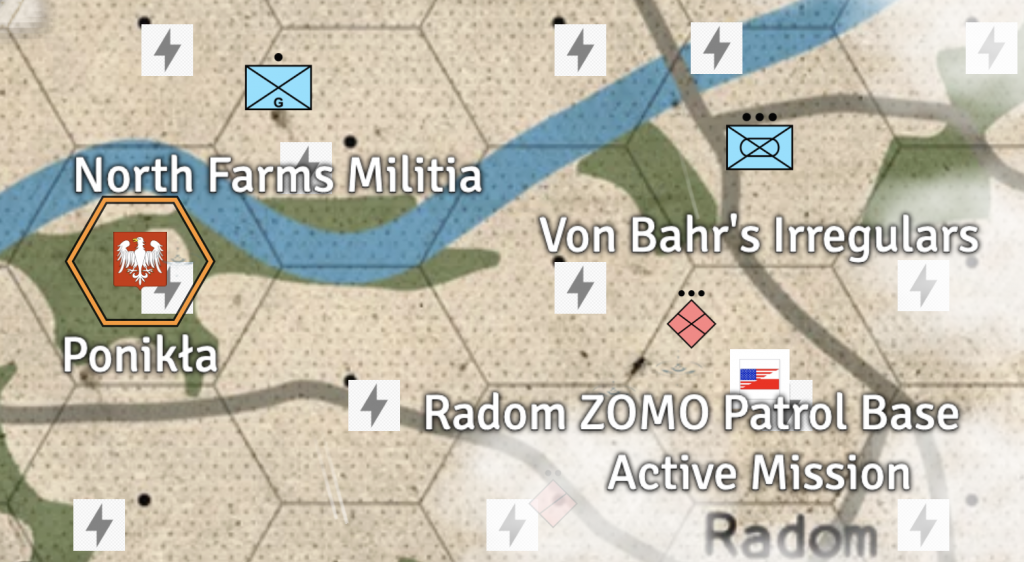
This is as far from Ponikla as the team has traveled to date. The circled “1” by the Active Mission marker is the first LZ; the circled “2” southwest of Sulejow is the second.
Miko smells the smoke first. It’s harsh and acrid: burnt metal and petroleum fuel. The team spreads out, dismounts, and moves forward cautiously.
In a small clearing lie the crushed-dragonfly remains of a large helicopter. Red, Pettimore, and Scott recognize it as a Pave Low, shot to hell and almost certainly a total hull loss now.
The team moves in cautiously. Up close, the damage appears to be from a mix of small arms and light autocannon fire. The pilot is still strapped into the right seat. It looks like he was killed instantly by the autocannon hits; there’s no way he was involved in this landing. The starboard M2HB is trashed, with blood spray all around the gunner’s station. The ammo box at the rear ramp suggests a minigun was there, but the gun mount is sheared off. There’s a second M2HB on the portside mount, this one damaged but intact. From the amount of empty brass still strewn around the rear compartment, the aircrew gave a good accounting of themselves.
Miko and Pettimore begin a spiraling search pattern, working outward from the wreckage. At the edge of the treeline, Miko finds the body of an enlisted airman. He has a few shrapnel and bullet wounds, but his death was probably from a fall. Broken tree branches indicate that the MH-53 didn’t quite clear the canopy as it came down.
The ground is dry and the light is fading, but Pettimore finds tracks leading northwest. As best he can tell, four survivors left the crash site.
Scott finishes his survey and shakes his head. “You’re not gonna get anything out of the avionics but parts. Everything’s trashed. Both engines are fire hazards and all the fuel tanks have leaks. There’s a hole through the tail rotor drive shaft – I guess a fuse malfunctioned and a shell went all the way through. I don’t know how this girl didn’t burn. I dipped the tanks with a washer on a string and there’s like thirteen hundred gallons still on board.”
The team quickly strips the wreck of salvageable parts, including the remaining M2HB and all the ammo. Leks spends a moment cooing appreciatively to the battlebox next to the minigun mount, which contains close to 700 rounds of belted 7.62x51mm that his MG3 will happily digest. Miko claims the pilot’s bloody helmet and the miraculously-functional night-vision goggles clipped to them. There’s a brief discussion of tossing a thermite grenade into an engine and letting the whole wreck burn. Scott doesn’t say anything but his expression makes it clear that this is somewhere between cannibalism and desecration of a corpse to him. Greed wins out and the team decides to leave it for now and come back with a hand pump and a bunch of empty drums.
The final thing the team removes from the helicopter is a small red wooden box with a Plexiglas front, which was screwed to the forward bulkhead next to the flight engineer’s station. Inside is a bottle of Jack Daniels. In careful hand-lettering, a sign reads, “Break Glass In Case Of Peace.” Pettimore chuckles grimly, extracts the bottle, and passes it around.
In the last light, the team wraps the bodies of Major Gary Allen and Airman Alex Harris and loads them into the wagon. With Pettimore tracking on foot, they head off on the trail of the missing crew.
The trail ends at the eastern abutment of the bridge over the Pilica. There’s evidence of a lopsided but intense firefight. Whoever had the light autocannon must have brought it along, because the trees here show ample evidence of hits from it. It’s impossible to reconstruct details, but the team infers that the survivors ran into whoever shot them down, and this is probably where Flores started heading east. Pettimore can’t find any blood trails – but it is full dark by now.
While the team is halted, Minka has a crawly feeling of presence. Out in the darkness by the edge of the trees, about a hundred meters away, she can just make out a tall, spindly shape. It appears vaguely-humanoid, but it’s tall – well in excess of two meters – and the proportions are all wrong, too slim and with horribly-elongated limbs. She avoids looking directly at it, but as the team heads back south to make a cold camp at the crash site, she quietly leaves an offering: a jar of fresh plum preserves (Magda’s been supervising the harvest).
As the team sets watches, Minka pulls Magda aside. “Please don’t think I’m crazy…” she begins. She explains the barest details of what she saw, concluding with, “please, whatever you do, if it comes back, don’t let anyone shoot at it.” The two women agree to each take a watch… just in case.
Click. Click. Click. Click. Click... Miko is taking the first watch with Pettimore and Magda. It’s really an excuse to play with his new toy.
Click, the NVGs switch back on – and something is standing there, maybe a hundred meters away, well inside the clearing. It’s close to three meters tall, horribly thin and elongated, and it has antlers, a huge, branching rack reaching for the sky.
Miko freezes. Click. He can’t see anything – the green phosphors have trashed his night vision.
Click. And the tubes power on again to reveal… nothing. Whatever he saw is gone.
“Hey. Hey, Pettimore. I just saw the weirdest deer…”
The not-so-whispered conversation quickly rouses the whole team. Minka and Magda firmly admonish Miko not to mess with what he saw. Pettimore and Red forcibly remove the flight helmet and NVGs from his possession.
The rest of the night passes uneventfully.
Dawn comes far too early, and yet takes far too long to arrive. Amid silver-blue fog, Magda arises and heads to the wagon to prep the camp kitchen for breakfast. On a nearby flat rock, she finds an empty jam jar.
This session had a couple of obscure references which only those deeply-marinated in Twilight: 2000 fandom will get. One is a nod to the long-lost Black Winter.
This was a wholly non-combat session but, as is evident from the account above, contained a whole hell of a lot of plot. Pettimore got the lion’s share of coverage here but all of my players were heavily engaged. This group is an absolute joy to run for because they will lean into just about anything I throw at them and their characters are far more than the sum of the numbers on their sheets.
As proof, I offer the sketch Minka’s player drew of what she thinks she and Miko saw (and, yes, she did get bonus XP for this!):
The team really wants to continue messing with the Radom ZOMO, but they haven’t actually probed Radom yet. They decide to conduct an extended reconnaissance in the hope of identifying one or more of their desired targets. Of course, not all of the PCs are particularly suited to recon work, so this looks like something to be done during downtime rather than an in-play session.
Because this is a lot higher-risk than the typical downtime activity, here’s how I handled it:
The garrison has an Alert stat ranging from 0 to 5, representing how aggressively they are hunting suspected infiltrators/saboteurs. 0 is absolute complacency; 5 is full counterinsurgency. Pact-aligned forces in Radom are currently at a 2 because of White Eagle activity along the MSR and encounters to the northwest with the PCs and Von Bahr’s East Germans.
Each day of downtime has two Recon checks. The first is for observation of the city, using the best observation-focused Recon in the team (Scout applies). Each success provides a roll on the list of locations. If the result is a new location, it’s revealed. If the result is a revealed location, the PCs gain additional detail on it.
The second Recon check is for avoiding notice, using the worst stealth-focused Recon in the team (Infiltrator applies). This is opposed by a Recon roll for the opposing forces. If the PCs have more net successes, Alert stays the same. If the PCs and enemies have equal successes, Alert stays the same but each PC takes 1 Stress from the close call. If the enemies have more net successes, Alert increases by 1 per success and one randomly-selected PC receives one long-range attack as they’re spotted. If Alert reaches 5, the garrison mobilizes for an all-hands hunt and the recon team is forced to withdraw.
Stealth will also take a -1 penalty on clear, sunny days and a +1 bonus on rainy days (+2 for exceptionally heavy precipitation).
PCs do not regain Stress during this operation because of the constant lower-case stress of conducting close reconnaissance in enemy territory.
The best observation in the team is Magda/Miko, both with an A+B roll after Scout is applied.
The worst Stealth in the team is Miko, with an A+C.
Day 1 (August 21): The team drives to the vicinity of Radom and caches the UAZ-469 (they don’t want to have to run away on foot if their mission is blown). Their initial hide site is near the Rafil paint factory, which appears to be untouched – including a string of ten tank cars parked on a siding. However, a close call with a ZOMO patrol forces them to pull back. Alert 2, +1 Stress.
Day 2 (August 22): Not a great night. As the team is moving into position for the evening’s work, Miko finds a tripwire-triggered flare. Caught in the open, he narrowly avoids a snap shot from an unseen sniper. Patrols are out in force and the team pulls back to avoid detection. Alert 3.
Day 3 (August 23): Swinging south to avoid the area of the previous night’s incident, the team pauses at the grumble of engines. They’re able to creep forward and identify what appears to be the base for the Soviet QRF that’s covering the highway! It’s a few kilometers [1 hex] southwest of Radom, in a scrapyard. Avoiding it seems to be the best course of action, so the team continues on into Radom’s southern industrial sector. They move into the paint factory, confirming that it’s undamaged and was shut down in good order. Tons of organic solvents, resin, and powdered pigments are on site. From there, they’re able to check out the stockyards, which are a total loss from fire. The area is profoundly unsettling and, by unspoken accord, the team pulls back. Alert 3, +1 Stress.
Day 4 (August 24): The north side of Radom is tonight’s area of operations. The team passes through the mostly-intact rail yard, which was a major freight hub for the local industries. There’s probably some enticing salvage here, but there isn’t time to tarry. Pressing east, the team approaches what their collective memories say should be an airbase (formerly used for training Polish Air Force pilots). The base is shattered, apparently from conventional (non-nuclear) bombing… but between it and Radom’s silent shadows lies a moderate-sized compound with a double fenceline and guard towers. The guard force – and their dogs – are sufficiently alert that the team can’t get close enough for details, but this must be the prison camp! Alert 3, +1 Stress.
Day 5 (August 25): Probing the west side of Radom tonight, the team locates an unexpected resource: an abandoned warehouse containing the logo of Fabryka Broni Radom. It’s nowhere near the FB Radom factory, the world-renowned arms manufacturer. Curious, Zenobia slips the lock on a fire door and the team eases inside The building is full of industrial machinery, but not for manufacturing guns. No.. this is the mothballed production line for a side business of license-built Facit 1620 manual typewriters! Invigorated by this discovery, they press on. At the northern edge of the industrial sector, a blaze of light clearly marks the main ZOMO barracks. A passing patrol forces them back into the shadows before they’re able to gather too many details, but they now have a location for it. Alert 3, +1 Stress.
At this point, all of the involved PCs are at 4/5 Stress. They haven’t gathered much in the way of details on the enemy forces here, but they have three key locations for further investigation, as well as information on some valuable future salvage.
Meanwhile, back in Ponikla, the rest of the team is keeping busy:
Red, Arkadi, and assistants fortify another 19 hexes of the village’s perimeter with earthworks/floodwall
Ongoing fuel production ensures the net supply stays roughly stable despite the bulldozer’s thirst
Ellis interviews all of the new recruits and is fairly certain that none of them are plants or major liabilities
Minka completes one cycle of horse training, allowing her to add a positive trait or remove a negative one on one horse
Minka finishes machining the necessary parts to repair the fuel pump on Von Bahr’s T-72
Red and Arkadi deliver the fuel pump and provide medical and technical assistance
Pettimore and Leks finish harvesting their assigned wheat fields
Minka fabricates a gun shield (Armor 3) for the UAZ-469’s gun mount
The recon team returns and spends a day resting off their Stress and being interviewed by Ellis, who’s compiling all of the data he’s collecting into a comprehensive picture of the local threat environment.
One of the PCs in this campaign has the Cook specialization. With the campaign centering on a farming village with adequate food production, the party hasn’t yet had to subsist on its own in the wilderness, so foraging and hunting are more supplements to the local food reserves. This makes Cook something less of a good investment.
The community currently has 71 residents (including PCs), so it burns through 71 rations of food a day under normal circumstances. The PC in question has assumed a discussed-but-not-seen-on-screen role as the village’s head chef. Up until now, it’s been solely a roleplaying factor, but we recently negotiated a means for giving it some mechanical effect.
Each day that the PC spends a shift supervising food production, the player makes a Survival check. Each success reduces the community’s total food consumption for that day by 5%. This represents increased efficiency in the communal kitchens – basically, the same effect as the specialization’s as-written function, but scaled up.
I agonized quite a bit over the paint scheme. I knew I wanted to do the masks in white, both for a cyberpunk vibe and as a nod to Legend of the Five Rings‘ porcelain-masked zombies. Everything else hinged on making that color choice stand out. The Speedpaints Tyrian Navy may be just a tad too dark to show detail, but I think any lighter blue would have looked too cartoonish. It also sets off the Ashen Stone of the nylon gear pretty well.
Still need to add a bit of detailing to the weapons, paint the bases, and maybe risk a bit of white touch-up on the masks, but they’re 95% done. I was going to do the masks in gloss white but I think it’ll work just as well to leave them in the white primer.
The team continues to probe the area surrounding Radom, trying to develop a better profile of the ZOMO and Soviet forces there. Magda, Miko, Leks, Minka, Ellis, and Pettimore deploy, taking the UAZ-469. They leave Red, Zenobia, and Arkadi in Ponikla to continue infrastructure work and to serve as the core of a defense force.
I realized I hadn’t posted a world map in a while. This is what the PCs now know, based on the electrical infrastructure map they found in the hydroelectric power plant’s control room. Hexes with a gray lightning bolt icon can theoretically have electrical service restored from the hydro plant. Hexes with white cloud/smoke overlay are those which the PCs haven’t actually explored yet (recall that under the book’s XP rules, they get 1 XP for every session in which they explore a new hex.)
The patrol heads southeast, picking up the highway at the abandoned town where they once fought some rather unusual dogs and subsequently acquired a large amount of agricultural equipment. Miko notices signs of recent travel through the area. The team dismounts to take a closer look. Magda and Minka put their heads together and determine that it’s probably a few people on horseback, a few pack mules, and an indeterminate number of people on foot. The footprints and animal dung are fresh – this group passed through within the last couple of hours.
The team’s initial assumption is that it’s another ZOMO patrol. They decide to follow cautiously, with Miko and Magda periodically swapping out on point and ranging ahead to check the road. The unidentified group is following the highway east toward Radom. As the team tracks them, the picture becomes clearer: six horses, three mules, and about twelve to twenty people on foot. The team begins to suspect [correctly] that they’ve found one of those POW convoys that their White Eagle contact mentioned.
With the superior mobility that the UAZ affords, the team has to be careful to not catch up to their quarry in an unplanned manner. They decide to loop around north of the road and try to find a point where they can set up for stealthy observation.
Magda is out on point, leading the UAZ through a small woods, when she hears muffled shouting. She sinks into cover on the north bank of a small creek. A few moments later, a man in tattered American woodland camouflage BDUs bursts out of the woods on the far bank. As he splashes into the creek, a burst of AKM fire cuts the leaves above his head and he dives for cover!
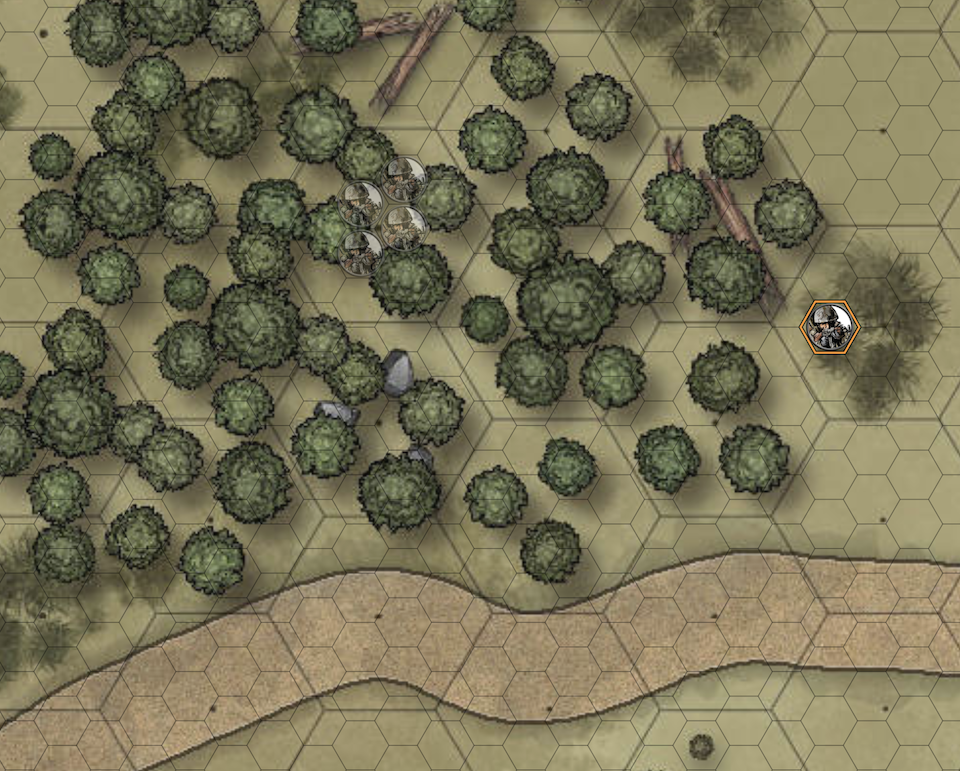
Dramatic re-creation because I never remember to get screen shots during play.
Two Soviet soldiers emerge from the woods, shouting at their quarry in broken and heavily-accented English. The rest of the team moves up quickly. They’re trying to be stealthy but someone [probably Miko] makes a bit too much noise in their haste. The Russians begin to react but the team is faster. Leks cuts down one with a burst from his MG3; the other falls to Ellis’ G3 and Magda’s Tantal.
The escapee scrambles out of the line of fire, taking cover in the woods. As the gunfire ends, Ellis calls out, “Hey! What unit?”
“U.S. Army Concert Band!” is the response.
“Oh, you poor bastard,” Pettimore sighs.
The team convinces their new acquaintance that they’re not going to shoot him [immediately] and brings him in for a chat. Ellis takes charge of the interview. The escapee introduces himself as Spec/4 Henry Bell. He’s a signals intelligence linguist (and formerly, in happier times, trombonist), a survivor of the U.S. 5th Infantry Division’s last stand who was captured after the encirclement at Kalisz. His brief account of the battle matches the intel Ellis has gathered – and Pettimore’s own memories.
Bell explains that he’s one of sixteen POWs from Kalisz who are being taken to the camp in Radom. The column had six guards – “four, now,” he observes, watching Miko loot and hide the bodies. His captors didn’t know he speaks fluent Russian, so he was able to gather a fair amount of information, though not much of is useful intelligence.
Suddenly, a signal flare rises above the treetops to the south.
The team doesn’t want to precipitate a massacre, but they’re unified in their desire to free these prisoners before reinforcements arrive from Radom. Magda leads off again, finding a route that arcs to the north and puts the team on the road just in time to lay a hasty ambush. The gunfight is quick and almost anticlimactic: four more guards down, no injuries among the team or the prisoners. One of the guards does launch a second signal flare, though.
The senior NCO among the prisoners, Staff Sergeant Andre Scott, comes forward. Ellis gives him a quick interview as well while the rest of the team pulls security, checks over the prisoners for injuries, and rounds up the horses and mules. The POWs are all basically healthy, though several are missing digits or hands, heavily scarred, or, in one case, wearing an eyepatch. They’re ragged and on short rations, but they report that they weren’t mistreated once this group of guards took charge of them. SSG Scott explains that the Soviets separated the officers and senior NCOs, interrogated them, and sent them on to Lublin.
Further conversation will have to wait. The team doesn’t want to stick around for what they expect will be a large and well-equipped QRF. Between the UAZ and doubling up riders on the horses, they have enough transport to get out of the immediate area. They head for an abandoned farm that Magda identified on the way in. About half an hour after they vacate the ambush site, Miko, who’s on rear guard, hears multiple engines and at least one set of treads from the direction of the highway. There’s no immediate pursuit, though.
After a brief rest, a more thorough medical assessment, and some polite but probing questions, the team decides to bring the POWs back to Ponikla, at least for the short term. They arrive back at town late in the afternoon. The expanded group assembles in the hostel’s common room and awkwardly begins to socialize while Magda ducks into the kitchen to check on dinner.
Ellis pulls Scott aside and asks what his intentions are. Is Scott still fighting the war? Scott… isn’t sure. “I left New York fifteen years ago,” he says, “and going back there didn’t much matter until it suddenly wasn’t possible any more. Now it’s on my mind a lot.”
Ellis probes a little more. Ponikla isn’t home, but it could be. It’s stable, the community’s agricultural capacity could probably support a few more mouths, and there’s a chance of getting more infrastructure back online and maybe even a regional defense coalition.
Scott scratches his stubble. “You got a point. Let’s circle up the troops and you can make your pitch to them.”
The team members present their respective cases for throwing in with Ponikla. Some are more effective than others. Magda pulls the five female POWs into the kitchen and makes the point that Ponikla is a place where it’s safe to be a woman – something that isn’t guaranteed in many places these days. Miko bumbles his way through a speech about Ponikla, unlike his hometown of Warsaw, being not-irradiated. Ellis is his usual silver-tongued self, expanding on his previous comments to Scott.
In the end, eleven of the POWs decide to throw in their lot with Ponikla and the PCs. The other five regretfully part ways with their fellow soldiers, but they’re set on trying to get back to friendly lines – and, from there, home. They’ll rest up a couple of days, then make for the Baltic coast. The team wishes them well and gives them the equipment captured from their former guards [thus neatly resolving the accounting for that].
This session felt somewhat rushed and disjointed to me because I had to make some hasty plot adjustments when I realized I’d mis-read my own map. The players seemed happy with it, though, and the PCs are counting the successful hit on the POW column as a win (as they should).
The recruiting scene at the end was fun to run. I had a list of the POWs and their MOSes. Each player got to make their character’s pitch, then roll Persuasion. Each success was one NPC recruited.
One of the things I wanted to do with this session was open up the opportunity for players to pick up secondary/alternate PCs by “adopting” a POW. I provided a limited amount of detail on all of the POWs, and some of it may get retconned if necessary to fit what a given player needs or wants, but right now, the recruiting pool is:
Staff Sergeant Andre Scott (m) – MOS 67U helicopter repairer
Spec/4 Henry Bell (m) – MOS 98G signals intercept linguist
MOS 13B cannon crewmember (m)
MOS 13M multiple launch rocket system crewmember (f)
MOS 11B infantry (f)
MOS 95B military police (m)
MOS 45B small arms repairer (m)
MOS 71M chaplain assistant (m)
MOS 12C bridge crewmember (f)
parachute rigger (British Royal Air Force, f)
plumber (British Army, m)
(All are E-4 or below except SSG Scott. The five who left were an infantry sergeant, two more artillerists, another helicopter maintainer, and an Abrams mechanic. We wish them safe travels…)
With Pact forces in Radom stepping up their operational tempo, the team decides to get back in the field as soon as everyone is healed up. A single day of downtime and two nights’ rest will be enough to accomplish that.
Miko takes the UAZ-469 and heads out on the long counterclockwise loop that will take him to the area of Tomaszow. It’s time to pull Ellis out – the team needs their spook focused on the more immediate problem.
Arkadi breaks in the welding torch. It’s a miserable job in the summer heat, but he’s able to patch the armor breaches on both the BTR-70K and the OT-64. Even more importantly, the latter vehicle is now watertight again – or close enough that its bilge pump can keep it afloat for river crossings.
Red and Zenobia grab the few available villagers who aren’t committed to the harvest or other support tasks. With the fuel situation somewhat stable, there’s an opportunity for infrastructure work. They break ground on a berm that will serve double duty as fortification and flood wall. They figure they’ll need one or the other before the year is out…
It’s time to get back to work. Red organizes Zenobia, Magda, Minka, Miko, and Leks for another trip east. With the recently-obtained intel about presumed American prisoners headed into Radom, two hostile contacts with the Radom ZOMO, the presence of a recoverable hydroelectric power plant, and recent overtures to the forces who hold that site (Von Bahr and his Ossis), the team’s strategic focus is shifting in that direction. Today’s op is reconnaissance in the vicinity of Radom.
The drive out to the dam is uneventful. The team has radioed ahead to let the East Germans know they’re coming, and they’re waved inside the perimeter once their identities are confirmed. Von Bahr, Adler, and a couple of other former NCOs are waiting to meet them.
Von Bahr informs the team that the Radom ZOMO is definitely patrolling more in his direction. His own patrols have sighted them several times along the river. They haven’t shown up at the power plant yet (as far as he knows). Yesterday, though, a cavalry squad approached Bialobrzegi, the village just east of his compound (and under his protection – or “protection,” it’s hard to tell with him). The squad of East Germans who were in the town exchanged inconclusive fire at long range, with neither side taking casualties. The East Germans’ impression is that the ZOMO was testing their vigilance and probing their defenses.
The captured BTR-60 is up and running but Von Bahr’s people haven’t yet ramped up fuel production, and they’re still working on putting the recovered BMP-1 and T-72 back into service. Their BTR-70 isn’t good for much more than a parts donor, but they’ve towed the hulk back to their compound to prevent anyone else from scavenging it. Von Bahr promises to have the -60 prepped and a QRF on standby if he hears a gunfight, but since the PCs’ only radio is in their own BTR-70K, they won’t be calling for help from beyond audible range.
With that, the PCs head south on foot, leaving the deuce and a half under guard. They decide to move toward Radom more-or-less parallel to the main highway, but off it a hundred meters or so in case they need to seek cover.
A couple of kilometers in, Miko, on point, spots a dirt road joining the paved highway. At the intersection sits a long-since-burned-out structure, some sort of shop. Around it are scattered bodies and a dead horse. Miko calls a halt and carefully probes the scene before calling in the rest of the team.
The four bodies are all military-aged men dressed in scraps of civilian attire and three different nations’ uniforms – one Soviet, two Poles, and one Hungarian, if the clothing actually matches the owners. All were killed by gunfire one to two days ago and subsequently stripped of all equipment (including, in two cases, their boots). The Soviet and Hungarian both bear prison tattoos. A search of the area turns up a number of spent shell casings in 7.62x39mm and 7.62x54mm, as well as a damaged segment of PK machinegun belt. The team’s conclusion is that these guys did something to piss off the Radom ZOMO.
[This was a bit of world flavor seeded from my random encounter generator and adapted to fit the plot. The original was:
The characters arrive at the scene of a recent firefight.
The bodies of 1 slain horses are strewn around the battlefield.
A total of 4 fallen combatants remain at the scene. Evidence on the bodies and in the vicinity suggests the combat occurred between marauders and marauders. The body/bodies have been stripped of any usable or valuable equipment.
Careful searching will reveal a total of 128 spent shell casings and 50 disintegrating links for belted ammo.
The combatants have left behind a small amount of sheet and billet metal.]
The team decides to see where the intersecting dirt road goes. They move out, now heading west. The better part of an hour’s worth of careful movement brings them in sight of a village. Most of the place looks abandoned, with maybe two-thirds of the buildings burned or shattered by combat. However, nearer the PCs is a small roadside park, carefully tended. The flowerbeds are blooming, the grass is trimmed, and there’s some sort of recently-cleaned bronze statue on a stone plinth. Near the treeline sits a small travel trailer, its tires flat but its surroundings clean and showing signs of occupancy. Beyond the trailer, on the far slope of the small rise on which the park sits, the top of a large pile of brush and tree limbs is visible.
This is not what the team expected. They settle in to observe for a bit. After a few minutes, the trailer’s door opens and a middle-aged man emerges. His hair looks like a bunch of cats taped together, and he’s wearing work-stained blue coveralls and carrying a pair of gardening shears. He walks over to one of the flowerbeds, kneels, and begins weeding.
It’s too bizarre to be a trap. The team decides that Magda and Minka have the best combination of “non-threatening” and “well-socialized.” [They’re female, they’re native Poles, and they didn’t take Empathy as a dump stat.] With the other four remaining on overwatch, the ambassadors move forward.
The caretaker doesn’t notice the women until they’re standing over him. He blinks, smiles, and introduces himself as Albert Pokorny. He used to be the village’s handyman, he explains, until everyone else left [or “left”]. When he was alone, he couldn’t take care of the entire village, but he decided to keep up his favorite place, the park. He moved the trailer in here and has been living on his own ever since.
As Magda and Minka talk to Albert, it becomes increasingly clear that he’s not entirely sane. He’s lucid, coherent, and polite, but he appears to simply have decided to ignore most of the world and events beyond his park. His only regular contact is with the Radom ZOMO, who apparently check on him during their patrols to make sure he’s okay.
Zenobia, scanning the surrounding area in case it really is a trap, spots a large angular shape in or beyond the brush pile. She tells Red, Miko, and Leks and eels out of the team’s hide. While the conversation continues, she works her way around to the back side of the park, undetected. Yep, something is definitely concealed under the brush pile. I ping Zenobia’s player with a private message:
Referee: Worn-out, lots of superficial damage, but intact.
Zenobia: F ME
Meanwhile, Magda and Minka move with their host to a set of folding lawn chairs under an awning by the trailer. Albert offers them tea, but their caution prevents them from accepting. He doesn’t seem too put out.
Minka realizes that she’s feeling a sense of presence and safety that she’s not accustomed to experiencing outside Ponikla. Looking around a bit more closely, notices a large number of carved wooden statuettes around the park’s perimeter. A few more are under and around the trailer. Looking closer, they fit a description that’s all too familiar to her. She asks Albert about them; he’s happy to explain that they’re his “friends.” He carves them himself as a way to stay occupied on rainy days. They usually help keep him safe.
Usually?
Well, yes. Yesterday, four men showed up at the park. Mostly, this type of wanderer doesn’t bother him because he doesn’t anything to steal, but these guys beat him up and took his tools. (At this, Minka and Magda realize that there are fresh bruises and minor cuts under Albert’s layers of grime.) The Radom ZOMO visited a couple of hours after that incident and, upon learning what had happened, rode off in pursuit. They came back a while later to return his belongings.
[Don’t look at me in that tone of voice. The ZOMO are the opposition, and probably under heavy Soviet influence, but they aren’t total monsters. Albert is a totally non-threatening and inoffensive civilian in their AO, clearly too insane to be useful as forced labor, and it doesn’t cost them anything to check up on him, so he’s under their protection (not even with ironic airquotes). If someone messes with him, of course they’re gonna exercise their authority – and chase down obvious marauders in their patrol area.]
Magda and Minka eventually say their goodbyes and head back to the rest of the team. Minka is carrying a carved statuette that Albert gifted to her. She takes a moment to check the plaque on the bronze statue: it’s “Saint” Urszula Pokorny, a mid-19th-century local folk heroine. She was a midwife and herbalist responsible for saving a large number of lives when plague struck the local area.
Minka smiles and observes sotto voce to Magda that that’s about as close as a Catholic country will ever come to publicly honoring a witch.
The team links back up and syncs their intel. There’s some discussion of whether Albert has any idea of the value of that Biber or whether he knows it’s possible to restore it to operational status. That’s a tomorrow problem, though. The team sets off again, skirting the village and noting in passing the large number of headstones in the cemetery with dates between autumn ’97 and summer ’98.
[This also spun out of a random encounter roll:
The characters arrive at a prewar monument which memorializes a local folk hero. During the war, it was kept up by a dedicated and quixotic caretaker. It now serves as trading ground for local civilians and traveling merchants.
A derelict but salvageable armored vehicle-launched bridge (Wear 8) is parked here amid mud and weeds.
Any other Twilight: 2000 party would be looking for a way to recover that Biber chassis and make it into an improvised AFV. My players are looking for a way to recover it and actually use it as a bridgelayer.]
With Miko on point and Magda navigating, the team makes a large counter-clockwise loop through the sector [hex]. As they’re heading back east toward the highway, the dirt track passes through a small valley which contains a crossroads and a small, shattered cinder-block building. An old radio tower occupies the bluff north of the road. Miko sees movement through the trees at the valley’s east end. A moment later, it resolves into mounted men in ZOMO uniforms.
The team begins setting up for a hasty ambush. Miko decides to dart across the road – and tumbles as a bullet slams into his body armor. The crack of the shot arrives a moment later. That didn’t come from the men on horseback, though, but rather from the vicinity of the radio tower! Miko staggers to his feet and dashes for cover as an RPK opens up, flailing the landscape around him.
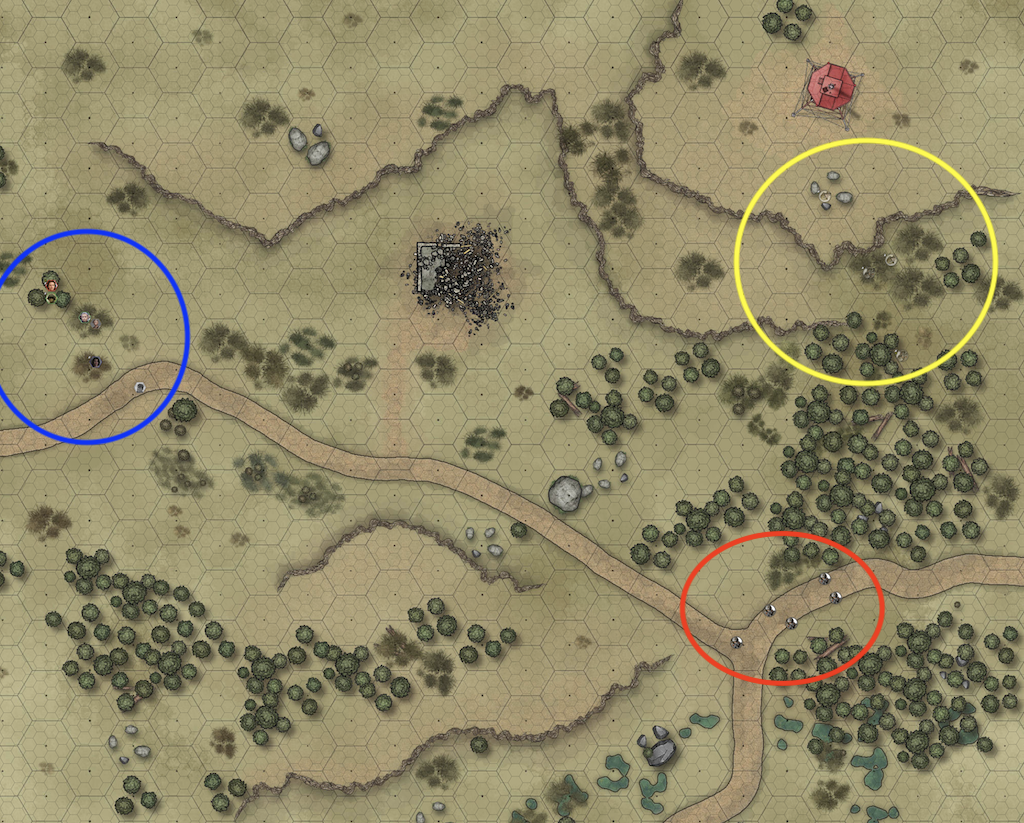
The map at the beginning of the fight. Blue is the PCs’ location, with Miko hanging out in the open. Red is the cavalry team that Miko initially sighted. Yellow is the patrol’s second team, which Miko didn’t spot, set up in overwatch with one man back holding their horses.
Leks moves forward as the cavalrymen bunch up. He unleashes a burst that injures three of them, but they keep their saddles and their heads. They begin pulling back while the sniper and RPK gunner keep up their fire. Leks tosses out a smoke grenade to screen the team.
Zenobia takes a round as she attempts to duel with the sniper, but he’s dug in too well for her return fire to deter him. Red, Leks, and Magda start maneuvering north, using the bluff for cover, while Magda and Zenobia continue returning fire. Miko regains his feet and moves forward in the trees on the southern hill. He’s trying to maintain visual contact with the cavalrymen, but when he regains sight of them, he sees one man holding the reins of five horses.
What Miko didn’t see, but correctly inferred, was that the rest of this dude’s fire team had moved back into the woods and was moving up under cover and concealment to take the PCs under fire if they attempted to pursue – or to press an assault on the element on the bluff.
Minka and Zenobia see Miko suddenly dash out of the trees on the south side of the road. He’s screaming something they can’t hear, but the sight of Miko running away from a fight is an immediate indication that it’s time to leave. They displace north, joining up with Red, Leks, and Magda under cover of the bluff… just as a mortar round lands by the building toward which they were about to move up.
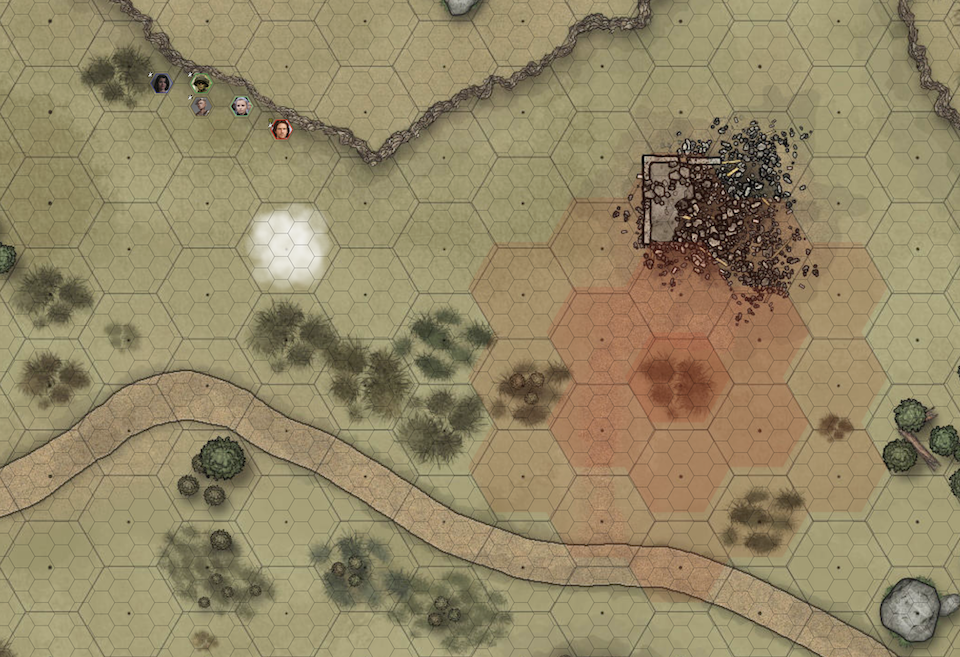
The spotter failed his Recon check, so deviation was automatic here. I wouldn’t have done serious injury to any of the PCs with this if they had pushed east as they intended, but suppression and automatically being knocked prone could have been ugly, especially with the RPK gunner still in play.
That’s enough to convince them to break contact. They withdraw west. The cavalry don’t seem interested in pursuing. [After all, they do have three men with severe (albeit not critical) injuries from Leks’ initial volley.]
Once they’re reasonably sure they aren’t being followed, the team circles up in good cover. Red dresses Miko and Zenobia’s injuries. Everyone is interested in the radio tower – is it still in use, and if so, for what? With Miko and Zenobia injured, Magda will scout the area. Despite her wounds, Zenobia volunteers to back her up, counting on her ghillie suit, her M21’s range, and her general sneakiness to avoid further insult.
Some careful maneuvering leads the team back to the area of the fight. The tower is structurally intact but doesn’t appear to be in use. It seems to just have been a convenient nav and lookout point for the ZOMO. However, the horse tracks are easy to follow… and with the limited range of a mortar, the team suspects there’s something else out here.
Very cautious movement is called for. The team creeps east. As they approach the highway again, they spot a small travel plaza with bustling activity. The scouts advance. Some careful reconnaissance reveals a contingent of 20 to 30 ZOMO troops with a BTR, a UAZ-469 with a DShK, and a technical mounting a SPG-9 recoilless rifle, as well as about a dozen horses. A dug-in and sandbagged mortar pit is in the center of the camp, and several spools of razor wire are ready to be strung. Magda also spots three uniforms that aren’t ZOMO: Soviet officers.
This session likely marks a turning point in the campaign. The players were interested in clearing out the marauders in Tomaszow, but Ellis has been doing long-term recon in that area and they’ve been avoiding confrontation. The Radom ZOMO are more of an immediate concern, especially if the now have direct support from Soviet forces – possibly even Reserve Front HQ in Lublin. The next set of downtimes will see Ellis recalled from his spook activities as the team starts really building a regional coalition to target Radom.