Aside from a tiny bit of detailing (black on rifle muzzles, metallic red and silver on rifle optics and lights, ivory and black for the dog’s eyes, fluorescent yellow on chemlights), this was all one-coat work with Army Painter’s Speedpaint range. No wash, drybrushing, or other technique. They aren’t gonna win any contests, but about three hours’ total work yielded nine table-ready minis.
I’m particularly happy with the green on the pants of the two guys at left-front (Algae Green), the blue for the denim in back (Tidal Wave), and the tan/khaki that I used for the armor, war belts, helmets, and face protection (Bony Matter). All three colors showcase the automagical shading that Speedpaint provides on well-textured sculpts.
After tramping around in the mud all day, the team is less enthusiastic about conserving fuel. They’ve been brewing with a pair of small stills, which have a combined maximum yield of 40 liters per day if operated around the clock [and if everyone makes successful Tech rolls]. Having a larger, more reliable source of alcohol is a priority on which everyone can agree. The entire team piles into the 2.5-ton truck and trundles down to the railyard to spend a day sifting through parts suitable for a larger still.
With the help of the village’s brewer and the former high school chemistry teacher, Red, Minka, Zenobia, and Arkadi spend the next two days banging together a larger still. Pettimore, Leks, Miko, and Magda focus on the harvest and other food supply-related tasks.
Not much of note happens during this time, but at the end of those three days, the tech crew proudly hoists glasses of mead over their new fuel still.
Most of the team (less Arkadi and, of course, Ellis) heads out on another mapping and reconnaissance mission. This time, they’re southbound, exploring the region beyond the railyard and Opoczno. Fuel production is still barely keeping up with consumption, so they decide to march rather than piling into a vehicle.
The sky has been threatening rain all morning. The first raindrops are falling as they take a break at the highway south of Ponikla. Magda and Pettimore, out on point, are the first to hear the howling. Somewhere south of their position, wolves are agitated about something.
Another set of howls starts up from the southwest. They sound like wolves, but the cadence is off. It almost feels more like a conversation.
The team finds a defensible position and hunkers down, but there’s no sign of lupine aggression. After a few minutes, they move out, albeit with a bit more caution than before. The drizzle becomes a downpour as they pass the railyard, checking in with Arkadi, who’s there with the teenagers on a salvage run.
The team continues south into more of the mostly-abandoned farmland that’s the region’s prevalent terrain. Beyond the fields, a scraggly forest offers to mitigate at least some of the downpour. The dirt track the team is following intersects with another muddy road – this one revealing recent footprints. Pettimore hunkers down to inspect the tracks. It looks like about a dozen people, mainly in civilian footwear and including a few kids; a few of them are carrying heavy loads.
The team decides to follow. The tracks lead to a derelict house, half-collapsed and in the process of being reclaimed by nature. Pettimore, Zenobia, and Magda move in to take a closer look. Sure enough, the group they’ve been following is about a dozen refugees, who are currently engaged in an attempt to cook what meager rations they have. A few of them have hand tools that could serve as improvised weapons and one appears to be carrying a firearm under his coat, but they’re not a serious threat.
Pettimore takes up his bow,and slinks off in search of wildlife. Magda and and Red [who were not built with Empathy as a dump stat] move in to initiate conversation while the rest of the team holds position in case something goes sideways.
The refugees are standoffish, as expected, but the team’s negotiators win them over. Pettimore certainly doesn’t hurt the process when he returns and donates a deer to the stewpot. The refugees’ nominal leader, Roman Sobol [a good random Polish name], indicates that the group is traveling from Radom to Opoczno.
The team perks up at this. Radom is on their radar as the source of the ZOMO detachment that was threatening their farmer friends to the north of Ponikla, and, more recently, as the intended destination of the slavers who abducted Bianka, Tamara, and Pawel from the railyard.
Roman fills them in on recent events. The Radom ZOMO, which functions as the ruined city’s military government, is under increasing pressure from the Polish puppet government at Lublin (which Roman believes is, in turn, under pressure from Soviet Reserve Front HQ there). The new capital wants Radom’s arms factory restored to some level of function, despite the heavy damage it took during NATO forces’ withdrawal at the end of Operation Advent Crown in late ’97. The Radom ZOMO is responding by increasing labor quotas, diverting workers from the fields at the most critical point in the harvest, and demanding more work from the inmates at the POW camp.
Beyond that, Radom has seen a significant amount of westward Soviet troop movement over the past month, with couriers going both east and west with increased regularity and urgency. There are rumors that a NATO offensive somewhere around Lodz destroyed the units that were sent west.
The conversation is interrupted by more wolf howls – this time from the north. There’s another brief exchange, immediately followed by two explosions.
The team hastily gives Roman directions for reaching Opoczno without exposing themselves on the main road. They then gear up and move out, heading toward the noise of what now sounds like an intense gunfight. A couple more explosions shake the forest.
Smoke is rising over the trees as the team approaches the highway. They spread out and approach cautiously. Around a bend, armed figures are moving around a Soviet convoy that’s seen better days. The lead vehicle of the eastbound unit was a BTR-70, which is now on its side courtesy of what appears to have been a massive IED. Behind it, a Ural-375 with some sort of communications shelter on the back is fully engulfed in flames. Another Ural-375, this one the standard cargo model, appears intact, as does a UAZ-469 towing a trailered generator. At the rear of the convoy, a UAZ-469 gun jeep is leaking fluids around its four flat tires.
The Poles in the team are the first to recognize the insignia on the arms of the figures who are picking through the debris. It’s the white eagle on red of the Polish Home Army, the anti-Soviet movement that aligned with NATO at the war’s onset. Magda, herself a former Home Army fighter, has recently resumed wearing her own insignia, so she takes point as the team heads down to meet presumed allies.
The woman in charge of the ambushers comes out to meet Magda. She’s tall, with brilliant green eyes, delicate hands that look more suited to surgery or a piano than the AKM she’s holding, and an old knife scar across the side and back of her neck. She introduces herself as Marietta Rabarchak, a lieutenant with the White Eagle Battalion operating out of Skarzysko-Kamienna, a city about 40 kilometers southeast of their current location. She wasn’t aware any other Home Army forces were in the area; Magda has to quickly explain that while she’s Home Army, her companions are something of a grab bag.
(Red and Pettimore identify the convoy as a Soviet signals intelligence unit, probably returning to Lublin after doing unpleasant things in support of the forces that crushed the U.S. 5th Infantry Division. Unfortunately, the vehicles that might have contained the items that the team is most interested in – maps and radios – are on fire. Such is war.)
Rabarchak gives the team a quick summary of her group’s situation. The White Eagle Battalion holds Skarzysko-Kamienna and is focusing its efforts on the Soviet presence in the region. They’ve been hitting couriers and convoys along the main line of communications between Lublin and the forces in the west. They knew someone else was in the area after finding the remains of a GRU unit that they themselves hadn’t hit. They expect that the Soviets will start stationing quick reaction forces along the route; Pettimore infers that they’re about to change up their tactics in the hope that they can lure the QRFs into larger or secondary ambushes.
Before the team can get too far into the details, a trio of men emerges from the woods. These guys aren’t wearing Home Army colors; they’re dressed in ragged civilian attire under wolfskin cloaks. All are carrying scoped bolt-action rifles that probably saw service in the 1940s. Their leader, a dude with a pierced eyebrow and a beard that would do ZZ Top proud, walks up to the conversation and eyes the team warily. In monosyllables, he asks Rabarchak who the newcomers are. She explains and introduces him as Filip, an individual of some importance within an allied partisan group, the Bracia Wilkow.
(The PCs don’t recognize the name but the Poles in the party immediately parse it: the Wolf-Brothers.)
Filip gives the team some more stink-eye. He’s obviously assessing them as a potential problem. He locks onto Pettimore, steps into the sniper’s personal space, and sniffs. “Mm. Bearkiller. You’ll do.”
[Exposition at this point for the home audience: Pettimore is a legacy PC from a previous iteration of this campaign world. Early in that campaign, he was out hunting when a bear attacked him. He killed the beast with his sidearm, skinned and dressed it, and took one of its claws as a trophy necklace. All of the carcass except that claw subsequently vanished from the team’s HMMWV, with tracks and blood smears strongly suggesting that it got up and walked the hell away.
Pettimore still has the necklace, but he wears it under his shirt and no one in this campaign has ever seen it.]
While Pettimore is studiously not reacting to this, Filip shifts his attention to Minka and does the same thing. “You smell of the forge and old things. Good.”
And then he just walks away, gathering his two associates and disappearing back into the forest.
Rabarchak doesn’t have much explanation to offer. Apparently, the Bracia Wilkow are like that. They operate out of the forest somewhere south of here and west of Skarzysko-Kamienna, and they occasionally show up to support the White Eagle Battalion with reconnaissance and the odd sniper shot. And there are standing orders to not piss them off.
She checks her watch and realizes that she’s spent about as much time next to a burning Soviet convoy as she wants to. Her platoon wraps up the looting and begins loading up the usable UAZ and Ural. Red negotiates a communication dropoff at Opoczno; apparently, one of the merchants there is part of the White Eagles’ network. With that, the partisans head south and the PCs circle back to pick up Roman’s refugees and escort them into Opoczno.
This was a remarkably tense session despite the complete lack of combat. All of the players from that previous iteration are in this campaign, and they have unpleasant memories of men who associate themselves closely with wolves. Pettimore is the only PC who continued (or sideslipped) into this campaign, and my players are pretty good at not metagaming, but the paranoia was contagious.
I haven’t posted miniatures photos for a while. I stopped painting for the fall and most of the winter, and when I resumed in February, it was too cold to get outside and spray matte sealant. My usual workflow is paint > seal > flock > photograph, so I had a growing project tray of painted but fragile figures waiting for things to warm up.
The girl and I carved out some time over the weekend to set up the Battle Systems terrain that she gave me for Christmas. It makes an excellent backdrop for this sort of thing, though some of the flocking was drastically inappropriate for an urban landscape. In the long term, I’ll add “build terrain boards for photography in different biomes” to my list of projects I’ll realistically never accomplish, but we made do with some other terrain bits, a towel or two, and the remnants of a nontraditional desk planter that I gave her a few tax seasons ago.
I’m quite pleased with the results. In the spirit of full disclosure, I should say that she did all the actual photography – she has both a better eye for composition and a newer phone (and we didn’t dig out the household’s actual cameras for this).
I like this one because it has a cinematic action shot vibe. The pallets are hiding the base flocking, which is Huge Miniatures’ sakura scatter. I have a vague thought of using that for a bunch of ultramoderns and building a Japanese cyberpunk terrain board.While I haven’t previously blogged about it before, I’m a huge fan of Ubisoft’s The Division franchise, especially the first game. Spectre has a couple of lines of figures that absolutely nail the aesthetic of Division 1’s player characters. These four are from their Deniable Operators line.Spectre also has a line of paired “covert” and “overt” figures. These are four of the “just minding my own business…” covert versions…… and here are the versions for those times when subtlety is no longer appropriate.
With Miko badly injured, the team pulls in their horns and focuses on agriculture and infrastructure for the nine days it’ll take that shattered elbow to heal.
Pettimore, Leks, and Magda throw themselves into the harvest. July’s bounty includes black and red currants, cherries, potatoes, and barley. The month’s total yield from all fields harvested is an impressive 6,100 rations of food. On rainy days when working the fields is impractical, the team supplements this with foraging and hunting.
The more mechanically-inclined team members get to work on infrastructure tasks. The drilling rig enables them to sink another well (actually, two, but the first one came up dry – literally). Minka gets her forge set up, and her trial efforts produce a couple of the boar spears that Pettimore had requested a while ago. The team also puts some effort into assembling a welding torch, though they still lack a supply of acetylene.
Arkadi was always a hobbyist mechanic and he’s familiar with Volgas. Against Zenobia’s recommendations, he puts a few shifts into patching tires and body panels and reconditioning other components that caught Leks’ wrath. With the Volga restored to driveable condition, the village’s entire vehicle fleet is repaired. A week-plus of no travel also sees the available fuel increase as both stills are in constant use, though they still have a ways to go before reaching their goal of full fuel tanks and a reserve.
Finally, there’s some discussion of long-term infrastructure improvements. Zenobia and Red both want to restore electrical power to the community. Minka has recently come into possession of a stack of technical documentation for the region’s electrical grid, and there seems to be a small hydroelectric generating facility about 30km downriver (east) of Ponikla…
This was prompted by a summer birding walk a couple of years ago, in which my wife and I spotted and identified our first grasshopper sparrow:
The sparrow grasshopper‘s name derives from its mottled brown-tan coloration and prodigious size – typically 14-18cm long at full growth. Genetic analysis reveals it to be an Awakened subspecies of the differential grasshopper (Melanoplus differentialis). It is believed to reach this size through consumption of Awakened plant life, which is its preferred (but not exclusive) diet. Its size makes it a target for predators that do not normally eat grasshoppers, including domestic cats and dogs, several species of raptor, and hoop snakes.
The sparrow grasshopper is generally harmless to humans. However, when startled, it takes flight briefly, and swarms along highways have been responsible for several major traffic accidents as they have obscured drivers’ vision and confused vehicular sensors. As a dual-natured creature, the sparrow grasshopper has an astral presence, and swarms are vivid on the astral plane.
It should come as no surprise by now that the tinkering with rules continues in my Kaserne on the Borderlands campaign.
Improving Coolness Under Fire
I’m not a fan of the rules as written because of the chance to lose Empathy on increasing CUF. As there’s no way to improve attributes during play, that’s a permanent hit to any EMP-reliant character. We’re currently assessing the effects of the following house rule:
At the end of each session, roll your base Coolness Under Fire die.
If the die comes up its maximum value and you were in combat during that session, increase your CUF by one step, to a maximum of A (d12).
If the die comes up a natural 1 and you took a critical hit or were incapacitated from stress during that session, decrease your CUF by 1, to a minimum of D (d6).
Initiative
I’m definitely not a fan of a random initiative system that doesn’t reflect character proficiency (leaving aside the poorly-named Combat Awareness specialty). Our current initiative system, which we’ve been using since the first session, is:
At the beginning of each round, each player rolls Coolness Under Fire (adding Unit Morale if the PC is within voice or visual contact of a teammate). With success, they act in the fast phase, before all NPCs. With failure, they act in the slow phase, after all NPCs. Characters in each phase may act in any sequence and players may (briefly) discuss tactics and order of operations before declaring actions.
As a play aid, I’ll watch the dice log and drop a brief summary of the rolls into the chat. A typical turn sequence may look like:
Fast phase: Red, Leks, Magda, Arkadi, Pettimore (in any order)
NPCs
Slow phase: Minka, Zenobia, Miko (in any order)
This incentivizes keeping the team close (no lone-wolfing), rewards both individual proficiency (Coolness Under Fire) and team cohesion (Unit Morale), and allows the sort of coordinated action that we see in both documentary and cinematic examinations of small unit tactics.
With obvious Warsaw Pact military activity south of them, the team is interested in getting eyes on more of the map in that direction. They load up the UAZ-469 for a reconnaissance push in that direction, heading south or southeast from the railyard.
While they’re prepping their gear, Malvina and Jacob approach them. Jacob’s eye socket has finally healed under Red and Minka’s care, and the two teenagers would like to get back to the railyard to check on their friends. They’ve been exchanging written communication (with a primitive duress/wellness code that Ellis figured out before he left on his mission) but they haven’t actually been back since the team brought Jacob in for surgery.
Arkadi, Zenobia, Leks, Minka, Red, and Miko squeeze into the UAZ along with the two teens. It’s a tight fit but the trip down is uneventful.
Arriving at the railyard, it’s… quiet. The other four teenagers have had semi-regular contact with the team and should recognize the UAZ, but no one comes out to greet them. The team fans out to search.
Miko heads into the woods south of the railyard and immediately picks up on signs that someone’s been here [4 successes on a Survival check… okay, we’ll go with it]. He finds an observation point or sniper hide, apparently occupied last night. About thirty meters back, there’s sign of a larger campsite with horses, dogs, and a horse-drawn cart. As best he’s able to reconstruct, about a half-dozen men with five horses came here yesterday, observed the railyard overnight, and departed a few hours ago.
He also finds signs of a fight. There’s no evidence of gunfire, but blood splatters, trampled undergrowth, and broken branches all indicate that something went down. He also locates the remains of a hand-woven wicker basket that was crushed in the melee along with its cargo of mushrooms and herbs.
Minka is accosted by the tabby cat who gave her and Magda a brief jumpscare on their first trip here. She follows the cat to a damaged and derailed baggage car across the yard. Seeing a gleam of metal in the car’s depths, she squeezes herself through the jammed, half-open door.
The rest of the team sees Minka disappear into the baggage car. A moment later, screaming and the sounds of a ferocious melee erupt! The team dashes in that direction, Arkadi in the lead.
Inside the baggage car, Minka finds herself fending off a panicked, frantic teenager with a knife who seems intent on stabbing her in the kidneys. Fortunately, her tool roll is in the way, and a couple of wrenches take the brunt of the assault. In between the stabs and the screams of “you’re not taking me!” Minka manages to disarm and pin her assailant. It’s Irena, one of the other teenagers.
Arkadi lowers his AK as Minka emerges from the baggage car, followed by a 16-year-old girl with wide eyes and a broken knife. Irena provides the pieces of the story that connect to Miko’s findings. Early this morning, slavers raided the railyard. She recognized two of the same crew that had tried to capture the kids a couple of months ago in the raid that cost Jacob his eye. She was scrounging for parts on the north end of the yard and escaped notice, but the slavers made off with the other three teenagers – Bianka, Tamara, and Pawel.
The team instructs Irena, Malvina, and Jacob to fort up in the railyard and head for Ponikla if they aren’t back after dark. Jacob assures them that they have some hiding places they haven’t shown the team yet (earning a fistbump from Miko, who appreciates teenage paranoia). Malvina hefts Zenobia’s old Glock 17 (which she semi-inherited when Zenobia upgraded to a Glock 18).
The team heads out on the trail. The slavers aren’t hard to track – light rain over the last few days has made the ground soft but not muddy, and they’re using farm roads through largely-abandoned countryside.
Zenobia, riding shotgun while Arkadi drives, spots a couple of large, angular shapes about a kilometer away. They look like tanks. There’s a general swearing and readying of weapons. Leks grabs the one RPG-22 he packed along (after the GRU fight, he’s less inclined to leave home without something that can handle at least light armor).
Binoculars are passed around. Leks, Red, and Arkadi, all with formal military training, are able to recognize the shapes of self-propelled artillery. They also pick out the signs of severe battle damage – these are derelicts, not actively-crewed vehicles.
The team approaches cautiously, Miko out in front on foot to watch for mines or UXO. The tracks they’re following do indicate that the slavers halted to check out the wrecks, but didn’t stay for long. The wreckage is old, several years of rust visible on torn steel. Overgrown craters tell the story: an American artillery battery stayed too long in its firing position and was wiped out with counterbattery fire. The three M109s are hopelessly beyond repair, as are the remains of two 5-ton trucks. The trio of M992 ammunition carriers is only slightly less damaged, but Minka, Zenobia, and Arkadi confer. If they took detailed measurements, fabricated a few drivetrain parts, and camped out here for a week with a good selection of tools, they might be able to strip two of the M992s to get the third back to operating condition.
That’s a tomorrow problem, though. The team has much higher priorities right now.
After another hour of driving, the road begins winding downward into a low, swampy area. On a bluff overlooking the road, a bombed-out building looms. It looks worth checking out. Arkadi slows the UAZ as it passes a stand of trees and Miko and Zenobia roll out into the scrub at the side of the road. As they collect themselves, they spot a sniper atop the ridgeline, tracking the UAZ with his rifle as it passes.
The UAZ rolls on to the north, holding the sniper’s attention. Zenobia settles herself into position and waits under her ghillie suit while Miko circles wide and ascends the west end of the bluff to come up behind the sniper. As he does so, he spots two more men in another patch of woods to his east.
Miko applies his hard-won patience and settles in to watch. After about five minutes, the sniper returns to scanning the road and the other armed men head back to a small campsite in a clearing. Miko resumes his stalk, slowly closing on the sniper’s rear with machete in hand.
About 400 meters north of the bluff, Arkadi pulls the UAZ behind a ramshackle abandoned barn. He, Leks, Red, and Minka dismount and begin moving back south. They’re trying for stealth but this isn’t the team’s sneakiest subset…
Miko is about 30 meters from the sniper when he sees the man tense and swing his rifle to the north. He can’t see his approaching teammates but he’s fairly certain what’s captured the sniper’s attention. He dashes in and swings down in a vicious attack, slashing both of the man’s Achilles tendons. The sniper loses his rifle down the bluff as he rolls away screaming, incapacitated with pain.
Distant screaming is the cue for the group to the north to move in. They abandon their stealthy approach and begin dashing south toward the bluff. Red and Leks curve around to a western approach while Minka and Arkadi head due south, hoping to scale the sheer rocks and flank whoever’s in the decrepit building.
Red takes the lead. As he approaches the dirt track that leads up to the building, he sees another armed man emerge with three large dogs. He flattens himself against the bluff to break line of sight, as does Leks – but a moment later, a grenade comes sailing over the edge of the cliff. Shrapnel strikes Red’s chest and the blast knocks both men down. Through the smoke, two of the dogs charge. One tears into Red’s side just below his armor.
Minka scales the bluff like a spider monkey and dashes for the armed man. Arkadi tries to follow her but pulls a hamstring [three total 1s on two successive pushed Mobility checks]. Minka gets in the man’s face – and gets her hammer in his face, too.
Leks dumps a magazine from his Saiga-12 into the dogs that are on Red, tearing them both apart. Before Red can regain his feet, though, the third dog makes it to the fight and latches onto his leg, doing enough damage to incapacitate him.
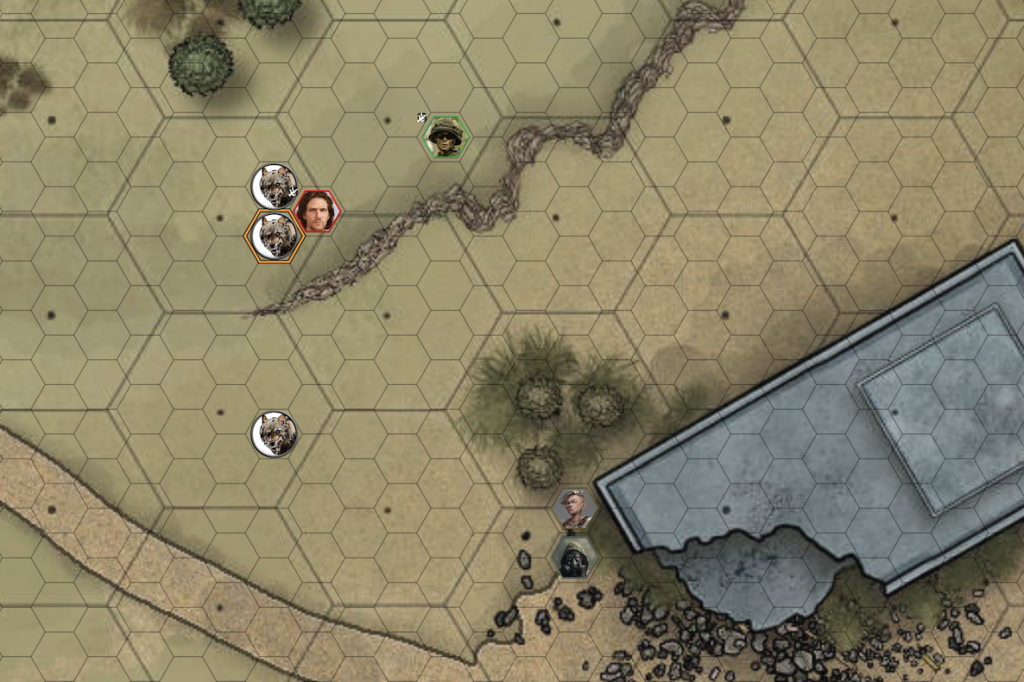
The man facing Minka flips his AK-74 to full auto and dumps most of a magazine at her. Amazingly, nothing connects. Minka’s reciprocal attack misses too.
Arkadi finally makes it to the top of the cliff and circles around the far end of the building. Coming up behind Minka’s fight, he hurls his tomahawk into the man’s back. The slaver crumples.
Leks picks himself up and moves in, bludgeoning the last dog with his empty Saiga [and reminding us again that he wants Minka to give the shotgun a bayonet attachment]. Minka turns from her fallen foe and leaps off the bluff, landing hammer-first on the dog.
Back on the west side of the fight, Miko sees three men running toward him from the camp. He pulls the pin on a grenade of his own and lobs it into their midst. All three drop prone from the blast.
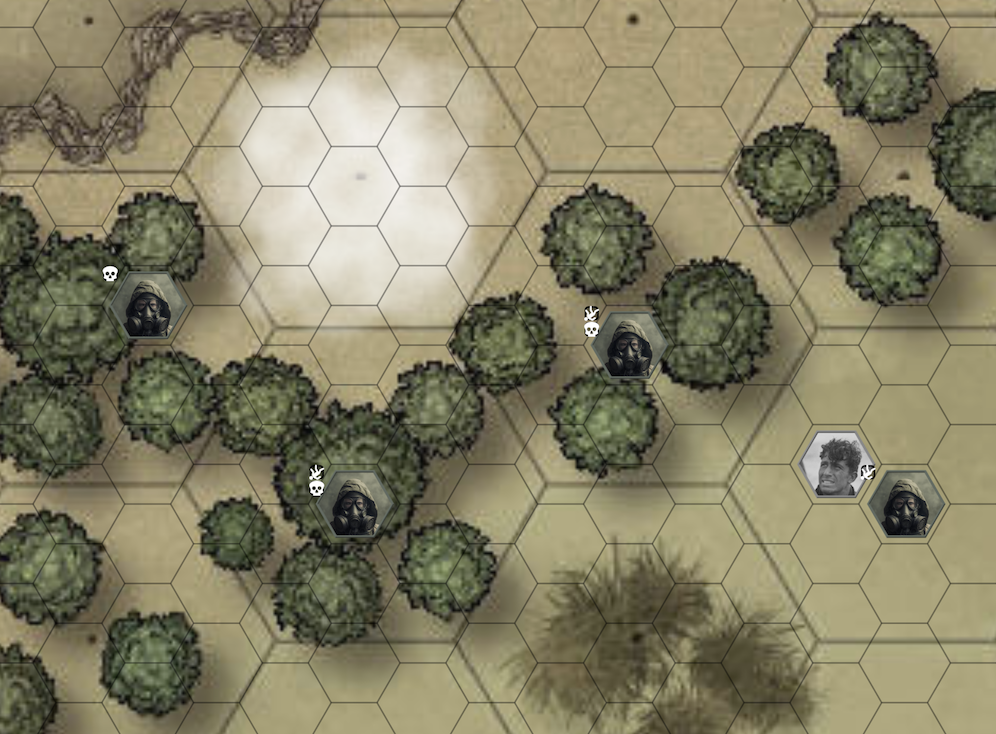
With Zenobia providing covering fire (and not all that impressed with the M21 she’s recent substituted for her bolt-action Sako), Miko moves in for more machete work. He lops off a hand, lays open a chest, narrowly dodges a tear gas grenade, and closes on the grenadier. He’s about to cut that man down, too, when he sees another adversary at the campsite – this one holding a shotgun on the three missing teenagers.
Miko’s trail of mayhem.
Whatever the guy was expecting, it wasn’t Miko covering 40 meters through dense woods [in a single move action, thanks to ridiculous Mobility rolls] and tackling him to the ground. He recovers quickly, though, fending off the machete-wielding maniac with the barrel of his Benelli and firing a blast that nearly tears of half of Miko’s arm [shattered elbow crit]. Arkadi sprints into the thicket and puts a tight, professional burst into the man’s back before he can finish off Miko.
Miko pushes himself to his feet and goes back after the grenadier. The man tries to bring up his submachine gun but Miko steps in and tears out his throat with a backhand swipe before collapsing in pain.
Minka and Leks get Red back on his feet. He’s bleeding and wobbly but still fit to practice medicine. He hobbles over to Miko. Field surgery without anesthesia is no one’s idea of fun, but the team is able to stabilize Miko before blood loss becomes life-threatening.
Red and Minka check on the kids next. They’re shaken but physically unharmed.
Zenobia and Arkadi wander over to the one survivor, the man who Miko hamstrung. He knows he’s dead and isn’t particularly cooperative. Zenobia shrugs; she’s happy to leave him out here to be eaten by wolves. Arkadi, joined by Red once the surgery is done, eventually pries a little bit of information out of him. The slavers were taking the teens to a prison camp in the ruins of Radom. The camp commissar there has turned to human trafficking and pays well for young, healthy workers. When the conversation is done, Leks asks the others to walk away and quietly disposes of the slaver.
The team gathers the weapons and equipment of the fallen. The most notable items are an HK-69 with an assortment of smoke, paraflare, and CS gas rounds. Each of the slavers had a gas mask, suggesting that they made somewhat regular use of the tear gas as a capture tool.
Minka checks over the horses. They’re all basically healthy, albeit inexpertly cared for. All five are draft crossbreeds, typical of the prewar farm horses seized for military use once fuel and vehicles started running out.
The team hooks up the horsecart, piles Red and Miko into it, and heads back to the railyard. There’s not much question at this point: the teenagers are ready to pack up and move to Ponikla. Leks, Zenobia, and Arkadi stay the night with them to help them pack and to give them an escort in the morning, while Minka takes the badly-injured team members and the horses back to Ponikla.
Miko’s performance this session was a great illustration of the benefits and drawbacks of a melee specialist in this system. His well-timed grenade and its suppression effects probably kept him from being gunned down earlier in the fight, but as it is, he’ll be offline for nine days while he heals that shattered elbow critical.
In addition to the loot, Zenobia and Red both got Coolness Under Fire increases out of this fight. Character progression seems to be going smoothly. There was some discussion about needing to cross-train some skills to ensure that Leks isn’t the only one with Heavy Weapons.
This is the second indication the PCs have received that bad things are brewing over in Radom. With that to the east, the marauders of Tomaszow Mazowiecki to the west, and what looks like a major Warsaw Pact line of communication to their south, the PCs are starting to develop a picture of a threat environment that’s a bit denser than they may have thought a month ago...
After taking down the GRU convoy, the team pulls back to Ponikla for a few days of maintenance and agriculture.
Red and Leks drive back down to Opoczno with some of the team’s stash of gold bars, as well as one of Leks’ vacuum-sealed bags of cacao beans. They spend the day haggling with the local merchants and itinerant traders and return with:
10 doses of antipsychotic meds
an industrial-size cylinder of compressed nitrogen
8 toothbrushes and 27 tubes of toothpaste, all in unopened original packaging
7 20kg sacks of locally-milled flour
4 barn cats, one of whom accosted Magda quite loudly on the team’s previous visit
an Uzi with 4 full magazines (Minka thinks she can adapt the magazines to also work in the Colt 635 that the team captured from the GRU troops)
a damaged M16A2 (Reliability 1/5) with 2 full magazines (acquired as a parts gun and extra ammo for Red’s problematic M4A1)
60 rounds of 5.56mm ammo
6 belts of 7.62x51mm ammo (Leks’ #1 priority by far, as he was getting dangerously low on MG3 food)
Pettimore heads out across the river in the newly-acquired Chevy S10 technical. He takes Stanisalw Jablonski, the one kid in Ponikla who hasn’t experienced a disappearance/missing time episode. Stanislaw was the village’s foremost hunter before Pettimore arrived and he reminds Pettimore a lot of his younger brother back in West Virginia, so the Marine sniper has taken the 15-year-old Polish orphan under his wing. They’re gone a couple of days on a trapping expedition, returning with two pregnant sows to add to the village’s livestock. They also make a stop by the highway maintenance garage to pick up the hydraulic log splitter that’s been sitting there.
For the rest of the team, it’s fuel brewing, harvesting (cherries, potatoes, and winter barley are coming in), and weapon and vehicle repair. Minka, Zenobia, and Arkadi combine forces to get the captured deuce-and-a-half back to full operating capacity.
My Kaserne on the Borderlands campaign has been experimenting with a couple of tweaks to specific weapon classes. Reception has been generally positive so far, so I’m posting them for public consumption.
The point of having a belt-fed machine gun is sustained automatic fire, whether for lethality or suppression. The problem I see with 4e’s rules as written is that the only thing making machine guns better at this than assault rifles or battle rifles is their larger magazine capacity. Given an equivalent shooter and rate of fire, all automatic weapons stand an equal chance of jamming or breaking down when pushed.
Shortly after the game released, there was some discussion on Kato’s forum about this topic. The usual suspects suggested a few different options. The solution my table is using is to ignore 1s on pushed ammo dice. When pushing a machine gun attack, only 1s on the base dice will reduce Reliability or cause jams.
We have one machine gunner in the party, and this doesn’t seem to be game-breaking so far. Balancing factors include increased ammo consumption (he’s encouraged to use his full ROF more) and rigid enforcement of the penalty for hip-shooting a MG (p. 65 for those following along in the Player’s Manual). The net effect is that he spends the first turn or two of combat getting into a good shooting location with partial cover before he opens up, which, to my mind, is functioning as designed.
Separately, the PCs recently scavenged a Steyr AUG from a downed opponent, which has forced me to codify something I’ve been chewing on for a while. I have a tiny bit of trigger time behind both AUGs and FS2000s and have handled several other bullpup assault rifles, and I was looking for a way to model their unique handling. Their balance and overall length makes them quite handy in tight quarters, but ergonomics can be awkward for certain actions.
My current solution is to treat a bullpup assault rifle as a carbine. This means that a bullpup takes a -1 rather than a -2 for attacks in the same hex, and a -2 rather than a -3 for one-handed fire. To offset this, reloading a bullpup is always a slow action – it’s impossible to make a Ranged Combat check to reload as a fast action.
(I’m not sure what I’ll do, if anything, if the PCs get their hands on a bullpup LMG or SMG. My interim solution is to just avoid letting them have a Steyr AUG Para or an L86.)