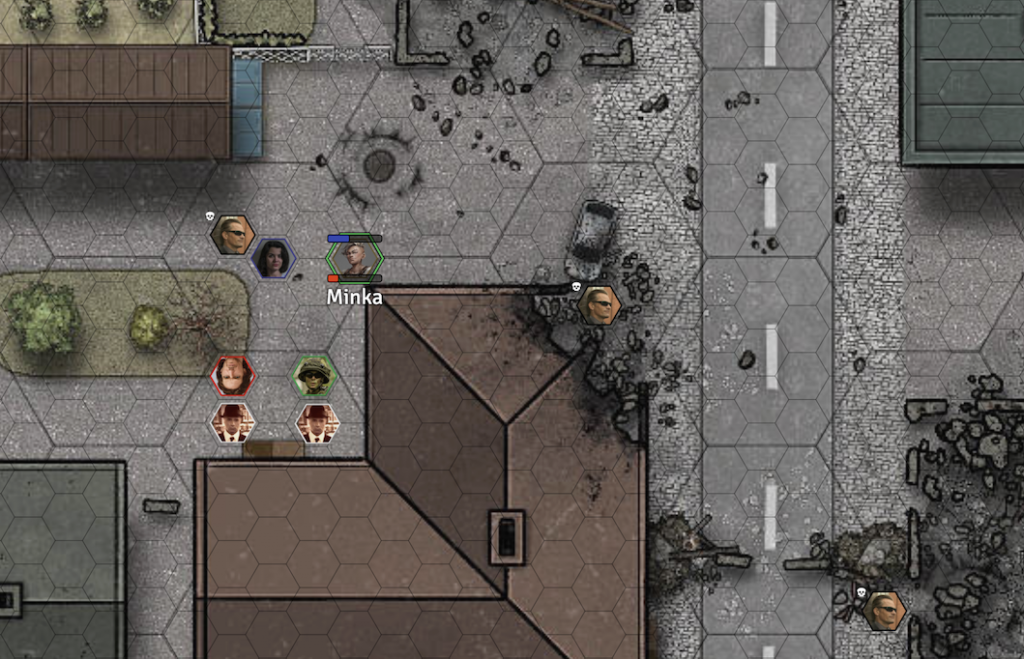
After taking down the GRU convoy, the team pulls back to Ponikla for a few days of maintenance and agriculture.
Red and Leks drive back down to Opoczno with some of the team’s stash of gold bars, as well as one of Leks’ vacuum-sealed bags of cacao beans. They spend the day haggling with the local merchants and itinerant traders and return with:
10 doses of antipsychotic meds
an industrial-size cylinder of compressed nitrogen
8 toothbrushes and 27 tubes of toothpaste, all in unopened original packaging
7 20kg sacks of locally-milled flour
4 barn cats, one of whom accosted Magda quite loudly on the team’s previous visit
an Uzi with 4 full magazines (Minka thinks she can adapt the magazines to also work in the Colt 635 that the team captured from the GRU troops)
a damaged M16A2 (Reliability 1/5) with 2 full magazines (acquired as a parts gun and extra ammo for Red’s problematic M4A1)
60 rounds of 5.56mm ammo
6 belts of 7.62x51mm ammo (Leks’ #1 priority by far, as he was getting dangerously low on MG3 food)
Pettimore heads out across the river in the newly-acquired Chevy S10 technical. He takes Stanisalw Jablonski, the one kid in Ponikla who hasn’t experienced a disappearance/missing time episode. Stanislaw was the village’s foremost hunter before Pettimore arrived and he reminds Pettimore a lot of his younger brother back in West Virginia, so the Marine sniper has taken the 15-year-old Polish orphan under his wing. They’re gone a couple of days on a trapping expedition, returning with two pregnant sows to add to the village’s livestock. They also make a stop by the highway maintenance garage to pick up the hydraulic log splitter that’s been sitting there.
For the rest of the team, it’s fuel brewing, harvesting (cherries, potatoes, and winter barley are coming in), and weapon and vehicle repair. Minka, Zenobia, and Arkadi combine forces to get the captured deuce-and-a-half back to full operating capacity.
My Kaserne on the Borderlands campaign has been experimenting with a couple of tweaks to specific weapon classes. Reception has been generally positive so far, so I’m posting them for public consumption.
The point of having a belt-fed machine gun is sustained automatic fire, whether for lethality or suppression. The problem I see with 4e’s rules as written is that the only thing making machine guns better at this than assault rifles or battle rifles is their larger magazine capacity. Given an equivalent shooter and rate of fire, all automatic weapons stand an equal chance of jamming or breaking down when pushed.
Shortly after the game released, there was some discussion on Kato’s forum about this topic. The usual suspects suggested a few different options. The solution my table is using is to ignore 1s on pushed ammo dice. When pushing a machine gun attack, only 1s on the base dice will reduce Reliability or cause jams.
We have one machine gunner in the party, and this doesn’t seem to be game-breaking so far. Balancing factors include increased ammo consumption (he’s encouraged to use his full ROF more) and rigid enforcement of the penalty for hip-shooting a MG (p. 65 for those following along in the Player’s Manual). The net effect is that he spends the first turn or two of combat getting into a good shooting location with partial cover before he opens up, which, to my mind, is functioning as designed.
Separately, the PCs recently scavenged a Steyr AUG from a downed opponent, which has forced me to codify something I’ve been chewing on for a while. I have a tiny bit of trigger time behind both AUGs and FS2000s and have handled several other bullpup assault rifles, and I was looking for a way to model their unique handling. Their balance and overall length makes them quite handy in tight quarters, but ergonomics can be awkward for certain actions.
My current solution is to treat a bullpup assault rifle as a carbine. This means that a bullpup takes a -1 rather than a -2 for attacks in the same hex, and a -2 rather than a -3 for one-handed fire. To offset this, reloading a bullpup is always a slow action – it’s impossible to make a Ranged Combat check to reload as a fast action.
(I’m not sure what I’ll do, if anything, if the PCs get their hands on a bullpup LMG or SMG. My interim solution is to just avoid letting them have a Steyr AUG Para or an L86.)
With Ellis away on his long-term secret-squirrel mission in Tomaszow, his player needed another PC for regular use. Enter Arkadi Sokolov, a former VIP protection specialist in the KGB Ninth Directorate who defected to NATO in early 1999 after several years of increasing compromise and disillusionment:
AKS-74U, vz.61 Skorpion, sap, tomahawk, KGB credentials
Arkadi Sikolov hasn’t been having a good summer. Once he was vetted and his handlers were reasonably sure of his reliability, the defector was farmed out to the special operations component of U.S. XI Corps, operating in northern Poland and along the Baltic coast. In May 2000, he was assigned to an intelligence support team that was inserted into Lodz. Their assignment was to prepare safehouses and emplace logistics for a SOF task force that was going to use the noise from the U.S. 5th Infantry Division’s deep raid as a distraction for another operation. He doesn’t know exactly what that op was supposed to be, but his team was preparing exfiltration routes not just for the task force but for up to four non-cooperative prisoners and a half-ton of sensitive material.
Their pre-insertion briefing indicated that Lodz was garrisoned by a Polish Border Guards brigade. Right before the 5th ID moved into the area, that garrison was reinforced by the Soviet 20th Tank Division. His team’s radios went down. They tried to exfiltrate to get a warning out, but things went sideways. He was cut off from the rest of his team and captured on 03 July.
Arkadi was held in Lodz for a couple of days by the military intelligence complement of the Soviet 20th Tank Division before being handed over to a GRU detachment from Lublin. They moved him down to Poitrkow Trybunalski, a slightly-smaller city, on 07 July. He was held there for a few days along with three Polish Home Army raiders.
On 11 July, four more Poles were brought in. These were all western-aligned defectors who had been integrated into the U.S. 5th Infantry Division. They’d been serving as line troops – specifically, part of 4-12 Cavalry. They were captured around Lodz while trying to probe the city’s defenses to determine just what 5th ID was facing.
He was held in Poitrkow Trybunalski until 14 July, when the GRU bundled all their prisoners and started moving them east, along with some captured American equipment (and Arkadi’s starting gear, which was seized as “evidence”). As far as he knows, he’s being taken back to Lublin for interrogation before his eventual execution.
Readers familiar with certain bits of first edition lore may recognize the op that Arkadi was supporting…
Meanwhile, in Ponikla, the team is curious about the apparent traders they saw near the railyard a few couple of weeks ago. Red, Leks, Minka, Magda, Zenobia, and Pettimore set out on foot (saving fuel – they want to build up a reserve) to explore southwest of that area. They cut through the railyard to check the message drop that they’ve been using with the remaining boxcar children, who they haven’t managed to recruit just yet [because I haven’t given the kids any more screen time], then head out along the road that the caravan was spotted traversing.
A few hours of careful travel through the forest and into more abandoned farm country leads them to a small rise overlooking a mid-sized town [Opoczno]. Some buildings on the community’s outskirts are in rubble, but the core looks intact, and plumes of wood and coal smoke are rising from the rooftops. In the farm fields north of the town, people are working, bringing in the harvest just as most of the locals are doing in Ponikla.
The map expands ever so slowly…
Pettimore and Magda sneak a little closer for detailed observations. They put eyes on a four-person militia patrol, as well as a crude bunker sited to command the northern approaches but currently unmanned. The folks working in the fields apparently know the patrol; there’s some casual banter amid the harvest work. The overall impression is of a functioning community, not one under duress.
The team circles clockwise around the town to get a feel for the area. On the south side of town, they sight a major highway and divert to check it out. Pettimore is the first to check the shoulders of the highway and see places where vehicles have pulled off for maintenance or crew breaks. He recognizes the signs of heavy traffic, mostly headed west – large trucks’ tire tracks and the tread marks of tanks and IFVs. Most aren’t crisp, probably a couple of weeks old, but there are signs of more recent passage in both directions.
The team approaches the town from the south – they’re already there and it seems prudent to mask the direction from which they actually arrived. They head up the road. On this side, they spot two bunkers with militia troops in them. As soon as the militia spots the PCs, a runner darts away into town. A few minutes later, the militia patrol shows up to backstop the bunker crew.
Red and Magda approach to negotiate. They’re met with curiosity and a reasonable level of suspicion, but Magda’s native accent and Red’s implied medical credentials smooth things over. The militia welcomes the team to Opoczno and peels off an escort to take them into town to meet the mayor.
The town square is war-damaged but still doing business. A few open-air shops are offering wares, and a quartet of merchant wagons are parked next to them. Across the way, a local watering hole is open – and appears to have some source of electrical power, as the neon beer sign in the window is lit.
More interesting, however, is the quartet of vehicles parked in the square: a BRDM-2, a Zil-131, an American M35 deuce-and-a-half, and a Chevrolet pickup with an M2HB on a pintle mount in the bed. The latter two vehicles both have bumper numbers identifying them as U.S. 5th Infantry Division property. They’re under the guard of a trio of Soviet troops. One of the junior enlisted and Leks get into a staredown before the NCO and Red corral their respective charges.
Pettimore plays it cool, but as the team enters the mayor’s office, he happens to glance past the vehicles. On the far side of the square is a damaged shop, its front blown out. Within its shadowed gloom, he sees a handful of men and women seated on the floor, guarded by a fourth Soviet trooper. One of the men looks up and catches Pettimore’s eye. There’s a flash of recognition…
Arkadi sits on the floor in a blown-out storefront, gnaws the stale bread that passes for prisoners’ rations in GRU custody, and contemplates escaping before the convoy’s meal and maintenance stop ends. The Poles in his company would probably back his play, but he’s the only uninjured one here, and the guards on the vehicles are keeping a close eye on the man detailed to watch the prisoners. His odds aren’t good.
The guards’ attention briefly goes to a small group of armed men and women being escorted in by the local militia. Arkadi considers seizing the opportunity, but then he recognizes one of the newcomers…
Pettimore excuses himself from meeting the mayor and wanders over to check out the shops and the traders’ wagons. He works his way around to the convoy guards. Pettimore’s primary weapon is a Dragunov, he’s in civilian attire, and he’s not displaying any obvious signs of American allegiance, so he’s able to elicit a little bit of information. The convoy is taking POWs and captured NATO equipment east to Lublin. However, the M35 doesn’t live up to the legends of American engineering, and it’s giving the detachment no end of headaches, especially since their regimental HQ pinched the platoon’s usual mechanic.
Pettimore excuses himself, tells the soldier to look him up for a drink when he gets off shift, and wanders into the tavern…
… where eight more Soviet troops look up from their meals to appraise the armed stranger who just walked in.
Meanwhile, the rest of the team meets Mayor Wiola Bosko and gets a briefing on the state of Opoczno. Mayor Bosko presides over about 1,100 citizens, down from the town’s prewar population of 15,000. Before the war, the major local industries were ceramic tile production, warehousing, and mechanical and maintenance services for both rail and highway transport. They’d been leveraging the remnants of the latter to set up some local trade, but a few weeks ago, the Soviet 124th Motor Rifle Division swept through the area and “requisitioned” all eight trucks that Opoczno’s citizens had restored to service. Bosko expects they’ll be back for regular infusions of fuel and food, but with only about fifty trained militia, there’s not a lot she can do.
Bosko is open to negotiation with other communities in the area. There’s a bit of small talk as each party feels out the other’s intentions and the PCs avoid being too specific about the precise location of their community. They eventually wander out to find Pettimore and lunch.
The chill in the tavern dissipates as the Soviets decide that Pettimore isn’t an immediate problem. The lights flicker as the man astride a bicycle dynamo generator coasts to a halt, having paid off his tab. The barkeep welcomes Pettimore and asks if he’ll be working for a meal or if he has something to barter. Pettimore grins, reaches into his ruck, and pulls out a roll of prewar toilet paper.
Barkeep: Pal, I can’t make change for that.
Pettimore opens a tab; he knows the other PCs will be arriving.
Over some pretty good venison stew and fresh bread, Pettimore deploys awkward Pig-Latin to inform Red that the Soviets are holding prisoners, and he recognizes one of them. Arkadi Sokolov is a Soviet a defector who Pettimore worked alongside during a few deep recon missions on the Baltic coast in the fall of ’99. With a known ally in a jam [and an illuminated “new PC” signal], the team quickly decides they’re going to break Arkadi loose. The mechanical problems the Soviets are having with their captured deuce-and-a-half and their lack of a mechanic suggest an option…
The lieutenant in charge of the GRU platoon “suggests” that it’s time for his men to change the guard shift and start trying to fix that American truck. Four of the troops kill their beers, gather their weapons, and head outside. A few minutes later, they’re replaced by the four who were on guard duty. Looking out the window, Zenobia sees the truck’s hood go up and parts start coming out.
Pettimore leverages his earlier conversation with the guard detail to negotiate a loan of his cousin, Zenobia, who’s a pretty good mechanic. The lieutenant agrees to let her try… she can’t do any worse than his men. Actually, she can do much, much worse, but it won’t be evident for a while…
Zenobia gets to work under the hood while the rest of the team checks out the merchants’ offerings. There’s no time for commerce right now, though – there’s an ambush to set. As soon as Zenobia is done, the team hightails it out of town. They know the route the Soviets will be taking. Pettimore catches Arkadi’s eye and gives him a sign.
About three kilometers east of Opoczno, a Chevrolet pickup technical rolls along at the head of a small GRU convoy. Its driver weaves around a cratered and pothole-riddled stretch of road. The two cargo trucks following it aren’t as agile, and the uneven asphalt repeatedly punishes their crews’ and passengers’ kidneys. Under the hood of one of the trucks, undersized and improperly-torqued bolts have been working their way loose, and this is the final insult. The truck’s driver curses and pulls over as a horrifying metallic clatter and the flailing of a loose belt emanate from the engine compartment.
This is Minka’s cue to touch off the directional mine that Leks has emplaced. The blast flays the left side of the BRDM-2 bringing up the rear of the convoy. When the smoke clears, the barrel of the armored car’s coaxial machine gun is skewed at an unhealthy angle.
The rest of the team opens up on the Soviets. Pettimore and Zenobia catch the gunner on the technical in a sniper crossfire and he falls, the .50’s barrel swinging skyward. Magda, Red, Leks, and Minka rake the vehicles with gunfire, trying to take out (or at least suppress) as many of the drivers as possible.
In the canvas-covered bed of the Zil-131, Arkadi has been waiting for a signal. This certainly sounds like one. He goes for the guard’s eyes and the Poles rise up alongside him. There’s a confused and inconclusive melee that terminates when Arkadi body-checks the Soviet soldier over the tailgate. The man hits the pavement headfirst.
The technical’s driver and front-seat passenger succumb to the massive amount of gunfire being directed their way. Leks sees the unattended M2HB in the truck’s bed and sprints through the firefight toward it. He leaps into the technical, yanks the machine gun’s charging handle, and swings it around just as the BRDM-2 pulls around the cargo trucks! His first burst chews through the armored car’s turret, fouling the ammo feed of its remaining weapon. The driver frantically reverses to put the M35 between his ride and the Estonian while the gunner struggles to get a usable belt into the KPV.
The team keeps up the pressure. Most of the GRU troops never get a shot off [suppression is a harsh mistress]. Arkadi and the Poles boil out of the back of the Zil. Arkadi reclaims his tomahawk from the man who’d taken it as a war trophy while one the Poles grabs the guy’s AK-74, and the mob is off toward one of the troops who’d managed to dismount.
The BRDM crew gets their KPB back into action and rolls forward. Leks stands his ground. 14.5mm rounds tear through the forest but, amazingly, Leks avoids taking a hit. His return fire injures the driver but the armored car is still in the fight – and still a threat that can turn this entire combat around.
From her firing position, Minka runs forward. Repeating her stunt from the fight with the marauders in Mysiakowiec, she hauls herself atop the BRDM and slams a Molotov cocktail through the gun port! Flames erupt within the vehicle as burning liquid begins running out the wheel wells and devouring the brake lines and tires!
Amazingly, the BRDM’s crew stays in the fight. Their fire is ineffectual, though, and Leks weathers the storm unscathed. As the flames reach his legs, the driver bails out, and Arkadi extinguishes him with a tomahawk blow. This is enough for the commander and gunner to throw in the towel. Red rummages through the trucks for a fire extinguisher, but just as he finds one, the BRDM’s ammo starts cooking off. There won’t be much left to salvage.
I actually used a Free League tactical map for once.
The Poles collect arms, ammo, and personal gear from the fallen and say their farewells to Arkadi. They’ll hole up in the area for a while and nurse their wounds before trying to find their way back to the vicinity of Lodz. Three of the GRU troops survived the fight, and while one of them breaks and pleads for clemency, the other two are made of sterner stuff. The Poles agree to take them off the team’s hands. Arkadi collects the rest of his gear from the back of the Zil before tossing the truck’s keys to one of the Poles.
Zenobia crawls back under the M35’s hood to undo her earlier sabotage and get the truck in shape to crawl back to Ponikla via the rail yard. Pettimore pulls Arkadi aside for a catch-up chat and gets Arkadi’s briefing on his recent experiences around Lodz. As Pettimore listens, he realizes with mounting horror that Ellis was right. It’s not the July 2001 that he thought he was living in. It’s July 2000 all over again – and at dawn yesterday, the U.S. 5th Infantry Division went down fighting as four Warsaw Pact divisions closed their jaws on Kalisz.
This was a solid session. Despite nearly going off the rails with shopping, we got in some great roleplaying (Pettimore’s player was in top form) and a good fight. I was a bit concerned about the BRDM-2 because the PCs deployed without any antitank weaponry whatsoever (they have three RPG-22s, an M72 LAW, and a few rifle grenades gathering dust in the armory). However, taking the technical out of the fight with the opening volley, and Leks’ immediate seizure of the M2, bought them some breathing room. I was not expecting Minka to conduct another boarding action, but she continues to make this stuff work despite the difficulties and multiple rolls she has to make to pull it off.
Red, Zenobia, and Leks limp back to town with a semi-conscious Malvina, a concussed Minka, and a slightly-used black Volga in tow (literally, in the latter case).
Minka will be on light duty for the next few days while her abused brain heals. The rest of the team settles in to attend to a variety of tasks around Ponikla: rebuilding their diminished fuel stockpiles, helping with the harvest, running the drilling rig, hunting, foraging, patrolling the area. But for Red, it’s time to do Science!!
After performing a field necropsy on some of the men who abducted Malvina, Red took blood samples from them. He has a microscope and some of the other makings of a laboratory, so he grabs Léonard as a lab assistant and settles in for a few days of research.
The following is a lightly-edited, low-effort copy and paste from our Discord server.
The blood of the four dead neckless mooks looks normal.
The samples Red took from the three men in black and the two creepy doctors appear to be blood to casual inspection, but under a microscope, it’s a red liquid without red or white blood cells or platelets. However, there is something in solution. It appears to be regular faceted geometric shapes with well-defined planes and edges, slightly smaller than red blood cells. The shapes are inert and a dull gray in color.
The sample of Malvina’s blood has the normal components you’d expect – plasma, red and white blood cells, and platelets. However, her blood also contains similar faceted shapes. These, however, are dark red and they appear to be independently mobile.
Red tests the samples to see which of them display the previously-observed behavior of boiling/sublimating when exposed to iron. Malvina’s blood does not have the same reaction, nor does the mooks’ blood. Running that test with the MIB blood samples under the microscope shows that the cause is the little geometric shapes undergoing what looks like extremely rapid oxidation.
Malvina is recovering rapidly but her caloric intake is about 1.5x normal and she has about a degree of fever.
Red and Léonard get together with the other PCs and the village elders (Léonard has been somewhat adopted into the elders’ ranks but this isn’t a decision he can make unilaterally). He wants to get some blood samples from other children who were abducted – but but he doesn’t want people to worry about the kids or, worse, invoke some sort of superstitious belief that they’re tainted. Léonard suggests spinning this as a routine medical exam (Minka’s probably the only other person in the village with enough medical knowledge to call bullshit) and the elders sign off on it.
All of the children’s blood samples have the same shapes in them, with the same color and behavior as Malvina’s. They’re also more prevalent – three to four times the concentration seen in Malvina. When Red pulls another sample from Malvina to compare, the number in her bloodstream has increased from what he saw the previous day.
Red: So they are replicating.
Referee: Leonard, who has been tracking the village’s food stores (you’re not in danger of starving if nothing fucks with the harvest), adjusts his glasses. “Um. Doctor. I’ve noticed something else. When you and your friends have come back from a mission wounded, you’ve also been consuming quite a bit more than I’d expect. I’d thought it was just the increased demand of, well, fighting and marching, compared to the starvation rations of the last two years, but…” he trails off and nods at the room where you’re keeping Minka under observation. “In my experience, people with concussions can’t keep food down well. And she just had second breakfast.”
Red: He’ll start with himself.
Referee: They’re in there. Slightly greater amount than Malvina’s current concentration, less than the village kids.
Red: This gets even more interesting…
Red spreads his net a little wider, testing Léonard for a baseline, then getting a sample from Stanislaw, the one kid in the village who has not yet been abducted. Léonard also has the shapes. Stanislaw does too, but his are noticeably more motile.
Red fires up a motorcycle and heads out to check on the farmers across the river; he’d promised them medical assistance anyway and this seems like a good opportunity to see if they’re a control group. One of Fryderyka’s partisans rides shotgun on the other BMW.
The farmers don’t have any history of child abduction, though a couple of them do ask jokingly if he’s seen a black Volga driven by a couple of nuns [Coolness Under Fire check to not react…]. Their blood samples, once Red gets them back to his lab, are normal. He does also note that the farmers get their water from wells on their farms, not from the river.
Red turns his attention to the river. With the additional equipment and information taken from the museum site, he has decent capability to analyze water quality. While he’s been working on blood research, he’s had Miko out gathering samples up and down the river.
The river is fairly clean… much cleaner, in fact, than he’d expect for a European river with heavy prewar industrialization. He lacks a direct prewar comparison sample (the museum project was on the Vistula, which the Pilica flows into), but he’s seeing maybe a tenth of the industrial chemical contamination that was in the Vistula’s 1996 reading.
There is one sample that Miko took on the south bank of the Pilica, immediately upriver from the ruins of Kozlowiec, that is… weird. It’s not reacting to any of Red’s chemical tests, but under a microscope, there is a weird oily-metallic rainbow shimmer to it that looks like something in solution that’s too small for his microscope to resolve clearly. That same sample has trace amounts of refined hydrocarbons – some sort of petroleum fuel.
This was a fun reveal to run, and it led to a roleplay-only session for the PCs to discuss Red’s findings and figure out WTF to do . The general conclusion is that… well, they can’t do much, and these things (Leks throws out “nanotechnology” from a bootleg movie tape he once watched) seem to be mostly beneficial. They do also discover that the… okay, call them nanites… are averse to strong magnetic fields.
Once Magda hears Red’s findings, something clicks for her as one of the village’s primary communal cooks. Whenever someone has come back from a mission injured, they’ve been eating about 3,000 to 4,000 calories a day while healing.
While all of this is happening, Zenobia sits down with Leks, Minka, and an assortment of wrenches. The black Volga offends her. She wants answers.
Other than the damage the PCs inflicted in the process of capturing it, it appears showroom-fresh despite being a 29-year-old model. It’s clean, it has no wear or corrosion, all the rubber and synthetic parts are in good condition, the tires look new. As previously noted, the tank is full of actual gasoline, not alcohol fuel. It appears to have a factory-fitted armor package – ceramic plates in the doors and the back of the rear seats, and bullet-resistant glass [Armor 2 on all facings]. There are no serial numbers on any parts and it has no registration tags.
(None of the firearms recovered from that fight have serial numbers or proof marks, either. They aren’t lasered or filed off – there are just blank spots where numbers apparently were never engraved in the first place.)
Léonard is one of the player-contributed NPCs who was resident in Ponikla when the PCs arrived. He got some “screen” time after the black Volga incident, so this seems a good time to post his profile.
Léonard was involved in humanitarian relief in and around Warsaw before the nukes went off. He fled with other refugees to the south, originally heading towards Lodz and then Wrocklaw. Wherever he ended up settling down, it was overtaken by Soviet troops recently and he and the few folks in his group that stuck together and were still alive were taken captive and put in a holding camp until they could decide what to do with them.
The camp was hit by locals and NATO remnants. The attack was technically thwarted and the attackers withdrew however the Soviets were were beaten badly enough that several of the captives escaped. Léonard was one of those individuals. He arrived in the village about 3 months ago.
With my Kaserne on the Borderlands campaign revolving around a village, one item that’s been on my players’ minds is the need for their characters to maintain awareness of their surroundings. A hex is something like 60 or 70 square kilometers, so exploring and mapping it doesn’t necessarily reveal everything it contains. Nor does this keep eyes on it after the initial pass. This is a bit of a gap in the core book’s rules, so we sat down at the virtual table to homebrew a downtime action. This also enables players who aren’t regularly able to make sessions to contribute outside “I brew fuel… again.” Here’s what we came up with:
Patrolling
Designate the hex that you’re patrolling (which may require travel time to reach). Roll Recon (additional recon team members may assist if they have Recon D or higher), modified as follows:
Scout specialty present in the group: +1
Open terrain: +1
Woods or mountains terrain: -1
Ruins terrain: -3
Dark: -1
Light precipitation: -1
Heavy precipitation: -2
Cumulative per person in the patrol above three: -1
The patrol finds one item of interest per success. These may be:
landmarks
exploitable resources
hazards
active threats
intel/clues
salvage items
plot
On double 1s, something unpleasant (but not lethal) befalls the patrol.
(It’s not as rigorously-programmed as the core rules’ actions, but it has worked for us so far. I try to get a general sense of what each PC is looking to get out of their patrol and provide appropriate results so the player feels like the time was well spent.)
This session picked up immediately after the previous one, in which the PCs had returned from finding the museum storage site only to learn that Malvina, one of the teenagers “rescued” from the PKP railyard, was missing. At the beginning of the campaign, I’d asked my players to give me three problems the village was facing. One of those was:
Something is taking the children.
Because of the village’s size, the table had tweaked that to recurring abductions from which each kid eventually returned with no memory of what happened while they were gone. This hadn’t appeared on screen since the campaign began, but Malvina and Jacob’s addition to the village gave me a great opportunity to bring it to the surface…
The team splits up [because three of the players who were present last time couldn’t make this session]. Pettimore and Miko set out to canvas the woods to the south. Magda stays in the village to organize a defense and to see if anyone saw or heard anything. Ellis, of course, has already jumped off on his infiltration mission to Tomaszów Mazowiecki. This leaves Minka, Red, Zenobia, and Leks [in play] to check the village’s north side.
Starting from the hostel, which was the last place anyone definitely saw Malvina, Leks begins looking for tracks. After about half an hour of stumbling around in the dark, he finds some of her hair and a few threads from her hoodie snagged on some thornbushes. That leads him to intermittent tracks which curve northwest through the woods, then back to the southwest. Following the tracks takes the team to the crossroads east of Ponikla, where the dirt road splits off down to the river and the flooded ruins of the spa village of Kozłowiec. There, they find more tracks: two sets of men’s dress shoes and the tires of a wheeled vehicle. It looks like a car pulled up (coming from the direction of Kozłowiec), two men got out, Malvina walked up and got in, and the car drove away to the west.
Also of note, the tires appear factory-new. There’s no wear evident.
The team walks back toward Ponikla along the darkened dirt track, scanning for other evidence. The village’s westernmost inhabited home is that of Kaja and Miroslav, who the PCs met and recruited during their first exploration of the area. The glow of firelight comes through the curtains, and as the PCs approach, Miroslav comes out to meet them. They inquire about anything odd he might have seen or heard the previous night, and he tells them that he and Kaja did hear an engine and see brake lights in the distance. At the time, they assumed it was Zenobia or one of the other PCs doing something with one of the village’s vehicles… but it’s further evidence of hinkiness.
At this point [I was really expecting the PCs to set off in pursuit, but] the consensus is that there’s very little to be gained by attempting to track tire marks in the dark. The team heads off to bed to grab a few hours of sleep before heading out at first light. Red and Minka both have awful dreams in which they’re restrained and paralyzed, but still conscious, as a masked surgical team begins cutting on them…
Early in the morning of July 15, the UAZ-469 rolls out of Ponikla, heading west. Zenobia is driving. Leks has mounted his spare PK on the pintle. Minka and Red are scanning the forest on either side.
No one in Ponikla has much cause to regularly travel west, and none at all in the past week. Thus, it’s easy to track the tire marks from whatever vehicle presumably carried Malvina away. About three kilometers out, it turned south at a crossroads. From there, the dirt track continues roughly south, turning into an old paved road just before passing through one of the ghost towns that dots the map out here. The team is somewhat familiar with this place from local patrols: a few collapsed and burned-out buildings, a couple of intact but thoroughly-looted shops and restaurants, and about a dozen uninhabited homes.
They park the UAZ on the north edge of town and walk in, weapons ready. Leks and Red are ranging about thirty meters ahead of Zenobia and Minka when Red catches a flash of movement in the ruins to his left. It’s just enough to negate the ambush, and the fight is on!
It’s a tougher fight than the team has experienced up to now. The opposition is four men with no necks, cheap suits, and unbreakable morale. Everyone takes some hits. One climbs onto the roof of the restaurant and rushes Zenobia’s sniping position, forcing her to use her rifle like a spear before shooting him point-blank in the face. Red’s M4 jams, so he pulls his axe and closes with his nearest opponent. Minka charges another and takes a shotgun blast to the chest which her armor can’t quite stop. She sledgehammers him to death – and his fall clears the line of fire for his teammate to put a burst into her head. She drops.
[ This was the first time so far that I’ve put a PC down with damage. Thankfully, the critical roll was “only” a concussion, not a permanent injury or an insta-kill. ]
Zenobia rushes to Minka’s aid. Red drops his adversary mook, only to be set upon by two more men who burst out of the adjacent building. These guys wear black suits and fedoras and carry Glock 18 machine pistols, with which they immediately open up, catching Red with a nasty arm wound. Leks dashes in, pulling his shotgun as he does so. Zenobia also converges, with Minka staggering close behind her, and the fight turns into a confused melee.
Another one of Pulpscape’s fine maps from Patreon.
The black-clad men don’t seem interested in negotiation but the team’s superior numbers eventually tell. One drops; Red and Leks wrestle the other one into submission and tie him up, at which point he… dies.
With a sudden growl, a black Volga bursts out from behind a building on the south side of town! The team unloads into it. The driver attempts to run down Leks, but miraculously misses the Estonian despite his prone position in the middle of the street. Leks spins in place and rakes a burst from his MG3 across the vehicle’s rear tires. The Volga spins out into a pile of rubble. The team approaches cautiously, finding a third black-clad man slumped behind the wheel, bullets from Minka’s AKM stitched across his upper chest. It doesn’t look bad enough to have been fatal, though. Like the tied-up man, he appears to have just… stopped living.
The building where the Volga was parked demands examination. It’s a boarded-up shop. They make their way to the back door. Leks is about to kick it but Zenobia waves her lockpicks in front of his face. The lock yields to her tender ministrations and Red enters. He dodges back as a scalpel cleaves the air in front of his nose!
Poland’s post-apocalyptic medical board isn’t too selective, it seems.
The two masked men fight with desperate aggression but little skill. The team’s axe, shotgun, sledgehammer, and hatchet quickly put them down.
Searching the building, Red finds Malvina. She’s unconscious, strapped to a table with IVs in both her arms. Both lines feed into a large steel apparatus with no external controls or markings. It looks like it’s circulating her blood through the machine. Red disconnects her and the device immediately begins emitting smoke. He kicks it out the window just as it bursts into magnesium-brilliant combustion.
Looking around the room, Red finds a set of surgical instruments and some unlabeled glass drug vials. He also notes that the head of his axe and Minka’s sledgehammer are both… smoking? On closer examination, the blood of the creepy doctors is boiling off. Some quick tests show that this happens on contact with iron or steel…
The team consolidates their loot and the bodies of the fallen while keeping watch over Malvina as she slowly struggles back to consciousness.
Taking a look at the opposition, the four goons are all of a type: large, burly, neckless. There’s a vague family resemblance among them, possibly all cousins. They’re all dressed in the same cheap suits, but equipped with guns that have… well… screen presence, for lack of a better word: an MP5K, a G3KA4, a Steyr AUG, and a Saiga-12. Each also carries a Walther PPK and a pearl-handled switchblade.
The three men in black suits are all of a type, too – with far more mutual resemblance. They’re completely hairless, nearly identical, and lacking navels. Each has a Glock 18.
The two “doctors” are also eerily-similar, though with different features than the black-clad men. They also lack navels.
The clothes, the weapons, the features… Red’s impression at this point is that these guys are exactly what he would expect if he told a prewar Hollywood director and propmaster to give him some Eastern European organized crime goons and a squad of men in black straight from UFO folklore. The whole situation, in fact, is eerily reminiscent of a fourth-season X-Files arc.
Red improvises some non-steel surgical implements from broken glass and other scrap materials. With Leks’ help, he conducts a couple of field necropsies and collects blood samples from each of the foes. The four goons appear human. The men in black and the “doctors” are… mostly human on gross examination, but their digestive tracts are completely empty and their genitals appear non-functional. Leks gets the whole thing on Betamax, thanks to the team’s earlier find of a CBS News video camera.
While Red and Leks are getting their hands bloody, Zenobia is getting hers dirty. The Volga’s existence profoundly offends her. She hauls the dead guy out of the driver’s seat and starts checking it over. Aside from the very recent damage, it appears to be fresh off the showroom floor. It has no serial numbers and no registration tags, and it looks like there’s some up-armoring of the body panels and glass. Also, it has a full tank of gasoline – something she hasn’t seen in at least two years.
Malvina regains consciousness. She’s weak, hungry, and dehydrated, and has no memory past walking out of the hostel and seeing a light in the woods. Perhaps that’s for the best. She’s also running a couple of degrees of fever and it looks like her body has been burning fat and calories at an accelerated rate.
Red has a lot of lab work ahead of him, but right now, his top priority is his patients. Zenobia takes the UAZ back to Ponikla to siphon fuel into the OT-64, then brings the APC back to the crossroads town so Red can move Malvina and Minka to his clinic on improvised stretchers. Leks gathers up the weapons, casting an acquisitive eye on the Saiga (and a couple of the Glock 18s find their way into people’s holsters too).
As the team pulls out, Leks tosses a road flare onto an alcohol-soaked pile of timber and bodies.
Despite nearly killing Minka, this session was a lot of fun to run. This sets up some downtime research that will answer a couple of long-standing questions for the team while prompting a few more.
Meanwhile, in Kalisz, the U.S. 5th Infantry Division has an appointment with destiny.
I’ve noted before that Pettimore is a recycled character from the first iteration of this campaign. At the end of the last session, this was made clear to the character.
Earlier…
As Ellis prepares to strike out on his own, Pettimore pulls him aside. From his ruck, he produces a thick brown paper envelope, held shut with string that’s tied in an elaborate knot and sealed with some sort of black gummy substance. “Before I got to the village, I was operating down in Krakow,” Pettimore says. “I was working with this spook named Broadstreet. Before we got separated, he gave me this, asked me to give it to the next trustworthy American intelligence officer I met. I figure that’s you.”
Broadstreet was the character that Ellis’ player ran in that same campaign. I’d set up this packet as part of Pettimore’s starting equipment and Ellis’ player had no idea it existed until now. I kind of wish we’d been on video so I could’ve seen his face as present-PC received a briefing packet from past-PC.
Ellis takes the packet and carefully opens it. Inside is a thick stack of typewritten papers. The cover sheet gives him what he’ll need – eventually. It’s a cipher he can decrypt, given sufficient time. For now, all he can determine is the date: 20 October 2000.
“So either this is a prediction of something that’s supposed to happen, or your guy sent me a letter from the future,” Ellis comments.
Pettimore doesn’t get this, and is rather insistent that today is 14 July 2001. Ellis points out that while he’s not an astronomer, several members of the team are sufficiently savvy in the ways of fieldcraft that it should be fairly trivial to determine the year from the moon phase. A quick side consultation with Leks reveals that, yes, the moon phase is correct for 14 July 2000.
“Why don’t you tell me what you’ve been doing since it was July 2000 for you,” Ellis not-quite-orders.
Pettimore infodumps as best he can, given the memory haze that shrouds large potions of his last year. The collapse of the final NATO offensive into central Poland. His breakout along with Broadstreet and a few others. Their delve into the ruins of Czestochowa and their recovery of a madman and a priceless artifact. Their passage to Krakow, finding something resembling sanctuary there, and a series of uncanny incidents that led to Broadstreet holing up in his room with a typewriter for three days to produce whatever was in that encrypted document. That’s where things got a little blurry for Pettimore until he found himself in Ponikla.
Something about the date’s still bugging Pettimore, though.
14 July.
14 July 2000.
14 July 2000 was the night that he, Broadstreet, and the rest of Broadstreet’s operators left the U.S. 5th Infantry Division’s lines to follow up on intel regarding an American physician [the former PC of Magda’s player] who was being held as a Soviet prisoner. They planned a quick raid, only one night out and back.
They never made it back to the 5th Infantry Division’s lines. And 96 hours later, there were no 5th Infantry Division lines for them to return to.
With the immediate area around Ponikla surveyed to some extent, conversation turns to which of the regional issues the team wants to investigate further. Ellis wants to go do his spook thing and perform a long-term infiltration of Tomaszow Mazowiecki to gather intel on the marauders infesting that city, so more direct action against them is off the table for now. Several PCs (and players) are interested in following up on the museum relocation lead, so it’s time to open up a new map hex. The team for this one is everyone but Miko (though Ellis will also take this opportunity to jump off on his operation).
Drinking water has been in short supply, but dehydration will kill, so some people have had to risk drinking from the river. Magda and Red both sleep poorly on the night of July 13. Red doesn’t remember his dreams but he awakens profoundly unsettled. Magda awakens in the pre-dawn hours with fragmentary memories of the river flooding the village and something crawling out of the water at the hostel’s front door…
[ Until the PCs solve the village’s water needs, I’m requiring everyone (when I remember) to start each session with a Survival roll. Failure means they didn’t forage or distill clean water and had to drink the river water, which brings a point of stress and a nightmare that may or may not be oracular…]
Following the driving directions salvaged from the truck that was carrying the fossils, the team crosses the river (carefully) and drives east. The directions terminate at the well-hidden entrance to a wilderness area. The native Poles in the party note that such sites were often used as private resorts for government officials… or as concealment for high-security military sites.
The team heads in slowly. Pettimore, ranging a bit ahead of the rest of the group, finds a large game trail and some sign that wisent frequent the area (which at least suggests some cleared routes that are unlikely to be mined). This prompts Pettimore to ask Minka to produce a few boar spears once she gets her forge up and running.
[ Wisent reintroduction in Poland is a bit anachronistic for the T2k timeline but I have a couple of things going here. From a mechanical perspective, I wanted something to replace the moose result on T2k 4e’s hunting table. From a plot perspective, this is another very small anomaly that ties into the overall framework of weirdness. ]
Moving further into the forest, a guard post appears, followed by a small parking area and the local equivalent of a ranger station. All show signs of minor combat followed by years-long abandonment. A somewhat-overbuilt road curves away from the parking area into the forest. With Pettimore still on point, the team creeps along.
Around a bend, Pettimore finds the first body.
It’s been there two or three months. It’s a Soviet soldier, apparently shot in the back with a high-caliber rifle. There’s an AKS-74 by the body, rusted into uselessness. Neither it nor the body have been looted.
About a hundred meters away in the direction from which the shot apparently came, visible through the summer foliage, is a cluster of buildings.
Fifty meters on, Pettimore finds another body. It’s another Soviet soldier, in similar condition, and similarly killed with a single shot. This one appears to have been taking cover behind a large tree and – from the empty magazine in his rifle and the 5.45mm casings scattered around – was returning fire when a round entered his right upper chest and exited somewhere around his shoulder blade.
All in all, the team finds a total of nine bodies. None have been looted. Their clothing and gear is heavily weathered, but some magazines and other items were protected in pouches or pockets. All were killed with through-and-through rifle hits.
The buildings are wood construction, probably fifty or sixty years old. At first glance, it’s some kind of camp or retreat complex. There are a dozen four-bedroom residential cabins, a communal restroom/shower facility, and a communal kitchen/dining/recreational facility. There are two sets of minor combat damage – one old, one new. And there are faded places on the wood exteriors where old decorations or plaques or signs were removed. On the dining hall, the weathered outline is clearly visible: a bird of prey with wings outstretched, atop a circular badge of some sort.
The road continues through the camp, still curving around the hill. Despite the summer sun, there’s a chill in the air as the PCs follow it past a few concrete pads that once held some sort of heavy machinery. Another couple of hundred meters on, the road ends at a turnaround and a massive bunker entrance. Despite aggressive use of a plasma torch at some point in the past, the emblem from the camp is clearer here.
The bunker door mechanism yields to Zenobia’s mechanical acumen and the team moves in. The UAZ-469’s headlights illuminate another guard post, which spans the entrance of a massive tunnel, easily wide and high enough to admit two tractor-trailers side by side. The main tunnel continues to a T-intersection. Off the cross tunnel are a total of 14 massive chambers, arranged all in one direction like the teeth of a comb. Each end of the cross tunnel has a ramp that curves upward to an upper level of the complex.
Ten of the individual chambers are empty, with cut-off pipes and wiring conduits and other marks showing where machinery was removed at some point in the distant past. Four, however, contain cargo pallets. Two of those appear to be copies of Warsaw’s municipal records from the decade before the war (1986-1996) – taxes, property ownership, city budget, city employees, survey plats.
[ Yes, I finally let them find maps. They’re just useless maps. ]
The final two chambers hold crates similar to those in which the team found the fossil collection. There’s enough for five truckloads – it seems the rest of Warsaw’s natural history museum made it here. Tearing open the crates, the team finds:
an ornithological specimen collection
an entomological specimen collection
a Polish minerals collection and a display on the history of mining in Poland, including a geologic survey map [okay, still not useful tactically, but I’m sure they’ll find a way to get some value out of this one…]
a fluid specimens collection (ichthyology and herpetology), along with a massive collection of water samples and a partial set of lab equipment from a long-term study of Vistula River ecology
an exhibit on the oceanography, hydrology, and ecology of the Polish Baltic coast
The team spends a fair amount of time cataloging in here, but that upper level beckons. They pile back into the UAZ and slowly ascend the massive curving ramp. The upper level is arranged much like the lower one, with eight more large chambers jutting off one side of the central corridor. Again, most of the machinery once located here has been removed, but one of the chambers holds a massive cistern fed from what appear to be rain collection channels cut into the hilltop. Some of the power generation, air handling, and water purification machinery is also in place.
One of the chambers is secured with a massive set of steel doors. Zenobia [gets four successes on a Tech roll] has seen its like before, though – the locking mechanism is the same as a bank vault she and her father once worked on. She sets to work and, within a few minutes, the doors slide open.
Inside is another cistern. Where the first one had a safety railing around its perimeter, this one has a grid of steel bars laid horizontally across its surface. It’s deeper than the other one – so deep that the team’s flashlights can’t reveal its bottom. Leks pulls a magnesium flare from the UAZ’s go-kit and tosses it into the water.
The flare sinks… and sinks… and sinks. Its dwindling spark of light passes any reasonable depth, and indeed seems to have fallen far beyond where the complex’s lower level lies. As that tiny flicker drops completely out of view, Leks, Ellis, and Zenobia all see a swirl of motion in the depths…
… and Magda realizes the team’s Geiger counter is clicking.
Leks is profoundly shaken by whatever his visual cortex couldn’t quite process down in that water [2 stress]. The others are able to rationalize it away, but it’s still not a great time to be in a dark bunker that was probably built during the Nazi occupation. A hurried radiological survey reveals that the room has a background count about twice that of the surrounding area. It’s the room, not the water, so far as they can tell – but Red takes samples from both cisterns for later analysis.
Somewhat disturbed, the team heads back outside, making a stop for Ellis to load the Warsaw tax records. He expects some serious downtime during his infiltration of Tomaszow Mazowiecki, and he’s looking for financial trails of the conspiracy whose outlines he’s starting to perceive…
Back outside, the team returns to the camp. It shows signs of habitation by about eighteen people, and indications that they evacuated hastily about the same time as all those Soviet troops were shot and left where they fell. From the remaining personal effects and research materials, this was a cross-section of the museum’s academic and maintenance staff. The team secures a few more books and a couple of half-written articles and dissertations, but nothing earth-shattering.
The top of the hill beckons. The team struggles up there and finds the expected air intakes and water collection channels. The view is pretty good – through their binoculars, they can see as far as Tomaszow Mazowiecki, though they can’t make out many details. Looking down at the base of the hill, they spot a clearing that appears to have been cultivated by the last residents – and at its far edge, a glint of metal.
They descend and investigate. The metal is a plaque set into a granite slab at the edge of a small forested bower. The Polish words on the plaque read:
Here lie ten heroes who sacrificed themselves for Poland's future on May 14, 1944. Their attack on the German garrison here disrupted the occupiers' plans for this site and prevented the expansion of Operation "Riese" to this land. Though their names are lost to history, may their deeds be remembered forever by free Poles.
The vegetation around the marker is neatly trimmed. Someone’s been tending this site.
The PCs attempt to track the responsible party – figuring it might be the same sniper who dropped nine Soviets and left them as a warning to others – but the trail runs out once it reaches a main road. They range around the area a little more, but nothing else of immediate interest turns up. Ellis says his goodbyes (just for now, hopefully) and the rest of the team piles into the UAZ and starts the long drive back to Ponikla.
It’s well after dark by the time Red, Magda, Minka, Zenobia, Leks, and Pettimore return to the village that is their home. Uncharacteristically, Ewalina [one of the player-generated NPCs, a former high school science teacher and now the town’s sole educator] is waiting for them. Anxiously, she approaches them and asks, “did Malvina go with you?”
I’m fairly happy with how this session turned out, despite a fair amount of improvisation. It also gave me the opportunity to end on an additional “oh, shit” note, as the disappearing-kids problem finally made an on-screen appearance. Technically, injecting an immediate and local problem broke strict adherence to West Marches principles, but it felt right and it immediately engaged the players. No one was carrying damage at the end of this session, but several PCs had stress from sleep deprivation, pushed rolls, or weirdness encountered in this session, so I knew they were going to be a little ragged going into the search for Malvina.
As my PCs are learning (and my players already knew), the world of Kaserne on the Borderlands is not a stock Twilight: 2000 setting. There are definite anomalous elements, starting with their own difficulty in recalling specific events before their arrival in Ponikla. What they’ve experienced so far:
Zenobia grew up in Ponikla and remembers the forest around the village being much less dense. She also recalls the Pilica River being not nearly as wide and deep as it is now. Childhood memories tend to make things bigger than we perceive them as adults… not smaller.
The river water has hallucinogenic properties with possible precognitive visions.
Something has been taking the village’s children… and returning them with missing time. I haven’t had this occur on-screen yet (it was a player-submitted problem for the village) and I really should do something with it soon…
The disappearing/appearing swamp road southwest of Ponikla where they acquired their UAZ-469.
The mysterious circumstances that led to that UAZ-469 being found abandoned and idled dry, with impact damage to the front end and lots of blood splatter on the ground around it.
So far, everyone they’ve encountered from outside Ponikla has had serious issues with long-term memory and any sort of planning or abstract thought, as well as a general inability to comprehend the concept of “map” or other recorded knowledge. Conversation that probes the latter topic has induced some sort of minor seizure, after which the issues have receded.
What’s a map? The PCs have failed to find maps in at least three places they would have expected to find them (highway maintenance facility, mobile command post vehicle, railroad maintenance facility).
For that matter, other recorded knowledge is profoundly rare, too. Ponikla only has about five books. The most blatant and recent example of this is the apparent erasure of a family library that Zenobia remembered being in a relative’s house at the village by the rail yard.
A pack of dogs with healed wounds that should have been fatal.
A couple of instances of weird howling or heavy wind noise coming from the river with no apparent weather pattern to account for this.
Pettimore’s memories of living through events of June through October 2000 before finding himself in Ponikla in May 2000.
I’m not saying there’s a pattern (because I may be making all of it up as I go along)… but there is definitely a direction I’m going with this.