These session notes are only about eight months overdue, backlogged from when we went on hiatus.
The team decides to spend a few days in Kamiensk making the area more habitable. Pettimore and Ellis (whose players were out for this session) take Hernandez and the UAZ and head east along the team’s backtrail to look for the Soviet deserters who’d been plaguing the town. Cat and Miko head out on foot for the same purpose. The rest of the team, under Betsy’s direction, begins surveying Kamiensk’s abandoned buildings to see what construction materials can be easily stripped for use in repairs or fortifications.
Cat has been through this area before, though it was mostly dark and Task Force Cobalt didn’t have much contact with the locals. Still, she knows a few landmarks – enough to effectively guess where a small marauder band might choose to hole up to avoid attention from Soviet regulars. After all, she did some of that same thinking a month or two ago.
The scout team finds the first marauder band in a former small dairy farm. There’s not a lot of activity, so it’s hard to get an exact count, but Cat and Miko estimate roughly a dozen men. They’ve dug a fighting position to cover both road approaches to the farm and have emplaced an SPG-9 recoilless rifle there. Other than that, they appear to be poorly-equipped, with only small arms. No vehicle or mounts are in evidence.
The team regroups, confers, verifies some details with Father Miroslav, and identifies these guys as a band of Kazakhs led by one Bulat Kadyrov. Father Miroslav’s description of Kadyrov suggests that he has his eye set on becoming a petty warlord somewhere. The team decides to stage a night raid.
Cat sneaks in and opens the fight with a grenade into the SPG-9 gun pit. Miko, meanwhile, has been low-crawling up to the farmhouse’s kitchen door (west side), and is nearly overrun when a fireteam of angry, half-awake Kazakhs comes boiling out that door. He spends the rest of the fight playing bullet tag with them.
In the gun pit, Cat is putting suppressive fire on the house’s south face with her M4. It jams, so she picks up an AKM whose former owner is no longer using it. That jams, so she picks up another Kalashnikov. This one at least lasts the fight.
Betsy is maneuvering to the southeast while Erick is maneuvering to the northeast. Both of them are trying to get firing angles on the house’s front door (east side). There’s some inadvertent crossfire action, thankfully with no effects on friendlies beyond suppression.
The team ends this fight with a stack of dead marauders and, for once, no major injuries. High on success, they decide to go after another group on the following night.
The second target is Oybek Musayev’s Uzbeks (remember, these three bands used to be one group before they fractured along ethnic lines). Pettimore and Ellis have located them farther east, where they’re encamped in the ruins of a small river+crossroads town. Interestingly, they appear to be trying to salvage a derelict PTS-M amphibious transport.
Another night raid seems like the way to go. This time, the team decides to secure the PTS-M first, since it’s some distance from the main camp. Cowboy, Pettimore, Cat, Octavia, and Comrade go after the vehicle while the rest of the team moves into position to hit anyone moving toward that location from the village.
The team’s stealthy approach is blown when Octavia attempts the swim and succumbs to the weight of her gear. Comrade drags her onto the sandbar where the PTS-M is stranded, but the splashing alerts the three guards there. Cowboy shanks one, Pettimore drops a second with an arrow through the throat, and Cat, Comrade, and Octavia subdue the third. There’s no gunfire – the blocking force actually has to start making noise to alert the marauders’ main body.
In the aftermath, the team discovers that the PTS-M is almost in working order – and it’s mounting an AGS-17 automatic grenade launcher.
Interrogation of the prisoners reveals that the marauders of Przedbórz (which is about twenty kilometers southeast of Kamiensk) didn’t stick together long after their Pyrrhic victory over Task Force Cobalt. The prisoners don’t know what happened, but they’ve heard that a bunch died of infighting or unspecified medical causes. Of the survivors, maybe three or four are still squatting there. The rest joined with Shotkin’s band. He doesn’t know anything about any scientists or material they may have recovered from TF Cobalt.
I’m preparing to resume running Kaserne on the Borderlands in the near future. I figured it might be useful for my three hypothetical readers to summarize the house rules my group currently uses. In no particular order:
Character creation strikes a balance between the book’s template-based player control and life path power level.
A PC starts with a C (d8) in each attribute. The player gets three increases to apply. If the player reduces one attribute to D (d6), they get a fourth increase.
The player chooses one skill at B (d10), two at C, and three at D.
The player chooses three specialties, one of which must be attached to the PC’s B skill.
The player chooses the PC’s starting Coolness Under Fire (as appropriate to the concept), then rolls that die. The die result is the PC’s starting permanent rads.
I assign starting equipment according to the situation in which the new PC enters play. As the game’s economy is largely driven by salvage and looting, this hasn’t been particularly unbalancing.
Character advancement occurs more-or-less normally (but see Coolness Under Fire changes, below). However, because we’re doing troupe play in which all but one of the players currently have two PCs each, XP is pooled at the player level and can be spent on any PC that player controls.
Coolness Under Fire changes occur at the end of each session in which combat occurred. For each PC who participated in combat, the player rolls their CUF die.
If die comes up its maximum value, CUF increases by one step.
If the die comes up a 1 and the PC took a critical hit or was incapacitated from stress, CUF decreases by one step.
Machine guns don’t suffer Reliability loss or jams from 1s on ammo dice – only base dice. We’ve found that this tweak makes belt-fed automatic weapons much more effective at laying down suppressive fire for multiple turns. They jam much less than assault rifles – but when they do, the party definitely feels their absence.
Initiative occurs each round in three phases:
Fast PCs
NPCs
Slow PCs
At the beginning of each round, each player rolls Coolness Under Fire. As usual, they add Unit Morale to this roll if their PC can see or hear at least one ally. If they succeed, the PC acts in the fast phase. If they fail, the PC acts in the slow phase.
During each PC phase, characters in that phase act in whatever order the table deems appropriate. During the NPCs phase, NPCs act in the order in which I deem appropriate.
(If friendly NPCs are in the fight, the NPC phase is split into friendly and hostile NPCs. GM fiat determines which group goes first. Usually, I give precedence to the side that has the greater in-narrative combination of volume of fire, position, numbers, morale, and effective command.)
Bullpup rifles are treated as carbines, getting a – 1 penalty (rather than -2) for attacks in the same hex and a -2 penalty (rather than -3) for one-handed attacks. However, they always reload as a slow action. This hasn’t come up much in play yet, as I don’t think any PCs have picked up the AUG I included in an early loot allocation, but it feels like a good fit for the handling advantages and disadvantages of the bullpup layout.
Patrolling is a sometimes-used downtime activity documented in this post. It’s basically wandering around an already-explored hex looking for details and trouble.
The Cook specialty has additional functionality if the PC is supervising large-scale mass feeding. Each day that the PC spends a shift on this work, the player makes a Survival check. Each success reduces the community’s total food consumption for that day by 5%. This represents increased efficiency in the communal kitchens – basically, the same effect as the specialization’s as-written function, but scaled up.
Command, as written, doesn’t do a whole lot, and neither does the vehicle commander crew position. We tinkered with making both of them a bit more relevant as discussed in this post, but we’re currently looking at a broader adaptation of the way the Aliens RPG handles it. Stay tuned.
It is late September 2000 of an alternate history in which the Cold War never ended.
In 1995, the Soviet Union and China went to war over border and resource disputes. Seeing an opportunity to weaken the Soviets by proxy, the United States and other Western nations provided military aid to China. As the tide turned against the Soviet Union, its leaders applied pressure to their Warsaw Pact clients/allies, demanding troops and material for the war effort. Tensions spiked in several Pact nations, and a covert request for aid ultimately led West Germany to cross the Inner German Border in the autumn of 1996. This attempt at German reunification triggered the broader European conflict for which NATO and the Warsaw Pact had been preparing since 1945.
The war went nuclear in 1997 – first with tactical-scale warheads on the battlefield, then strikes against rear-area targets, and finally escalating to a “limited” strategic exchange beginning in November. Governments collapsed, cities burned, industrial civilization crumbled – but the war continued in fitful, spiteful spasms.
By spring 2000, most nations and militaries were shells of their former selves. In northern Europe, the remaining NATO forces moved out of their winter cantonments in what would be the war’s last organized offensive. The objective was to clear the Baltic coast and north-central Poland of Warsaw Pact remnant forces, thereby securing a buffer zone and acquiring critical farmland, fishing grounds, and other natural resources. The U.S. Army’s 5th Infantry Division was tasked with a deep raid into south-central Poland, covering the offensive’s southern flank as the main group of NATO forces traveled east. Like most major units, the 5th ID had less than 20% of its prewar strength, with a sizeable majority of its troops drawn from the U.S. Air Force, Navy, and Marine Corps, stragglers from other NATO nations’ armies, and even a scattering of former Warsaw Pact troops who’d defected to the West and proven their loyalty and utility.
Veteran Twilight: 2000 fans know how this story ends… or begins. The 5th ID ran into overwhelming Soviet and Polish forces in the vicinity of Lodz, eventually being pushed back and encircled at Kalisz. Radio transmissions from higher-echelon HQs indicated that the entire NATO offensive was encountering heavy resistance – no help was coming. Running out of ammo, fuel, and personnel, the 5th ID attempted to break out of its encirclement. It failed. Only scattered bands of survivors escaped the Kalisz pocket, finding themselves on their own in a hostile Poland collapsing ever farther into post-nuclear ruin.
But our story began a bit earlier than that, and somewhat off to the side…
In May 2000, a handful of survivors arrived at Ponikla, a small village on the south bank of central Poland’s Pilica River. Some were Poles fleeing the war’s devastation; others were NATO stragglers who’d been cut off behind enemy lines. Well away from any major travel routes and untouched by combat, Ponikla seemed to be a safe haven.
The PCs knew very little about the area around Ponikla. Even Zenobia, who’d grown up in the village, found herself having difficulty remembering the surrounding area, and some major geographic features didn’t match her recollections from childhood. After about a month of resting and healing, they began cautiously exploring the surrounding countryside. They met a couple of other survivor bands and convinced some of them to join the community, skirmished with ex-Soviet Army marauders, and identified a site or two with salvage potential.
During these initial explorations, the PCs also made contact with a couple of other survivor communities. The first was a band of former militia from Tomaszów Mazowiecki, a city on the north bank of the Pilica about 20 kilometers to the southwest of Ponikla. From this group, the PCs learned that Tomaszów was now controlled by more ex-Soviet Army marauders (a problem which the team has, to date, reconnoitered and poked but not dealt with conclusively – though Ellis and Miko did mount a covert operation to sabotage the fuel supply used by the marauders’ flagship hovercraft). The second was a loose coalition of seven large family farms north of Ponikla.
Several… anomalies… also surfaced during this initial exploration phase. As of early July, these included (list copied from an earlier post, Cracks and Breakage)
Zenobia grew up in Ponikla and remembered the forest around the village being much less dense. She also recalled the Pilica River being not nearly as wide and deep as it is now. Childhood memories tend to make things bigger than we perceive them as adults… not smaller.
The river water had (and still has) hallucinogenic properties with possible precognitive visions.
Something had been taking the village’s children… and returning them with missing time. (I eventually addressed this with an encounter that nearly went horribly wrong. More horribly than planned, even.)
The mysterious circumstances that led to that UAZ-469 being found abandoned and idled dry, with impact damage to the front end and lots of blood splatter on the ground around it.
So far, everyone they’d encountered from outside Ponikla had serious issues with long-term memory and any sort of planning or abstract thought, as well as a general inability to comprehend the concept of “map” or other recorded knowledge. Conversation that probed the latter topic induced some sort of minor seizure, after which the issues usually receded.
What’s a map? The PCs failed to find maps in at least three places they would have expected to find them (highway maintenance facility, mobile command post vehicle, railroad maintenance facility).
For that matter, other recorded knowledge was (and remains) profoundly rare, too. Ponikla only had about five books. The most blatant and recent example of this was the apparent erasure of a family library that Zenobia remembered being in a relative’s house at the village by the rail yard.
A pack of dogs with healed wounds that should have been fatal.
A couple of instances of weird howling or heavy wind noise coming from the river with no apparent weather pattern to account for this. (This was eventually discovered to be the aforementioned marauder hovercraft.)
Pettimore’s memories of living through events of June through October 2000 before finding himself in Ponikla in May 2000. (This is an artifact of Pettimore being the one PC ported from a previous iteration of this campaign and setting.)
The next phase of the campaign, beginning in mid-June 2000, saw the PCs ranging farther afield. By this time, they had a couple of small alliances, they’d accumulated a decent motor pool, and they’d started building Ponikla up into a small but robust base of operations.
Their first expedition was a follow-up on an early discovery of a derelict tractor-trailer. Said vehicle contained a Stegosaurus skeleton, some other mineral samples, and documentation indicating that these contents were part of the collection from Warsaw’s natural history museum. Apparently, the collection’s most valuable assets were being relocated to a secure location before the war reached Warsaw. With written directions to a location, the team decided to head there to see if any of the museum staff were still present. What they discovered, instead, was a former Nazi bunker complex repurposed into a secure vault for government records and museum exhibits. They also found a mildly-radioactive room containing a cistern with no apparent bottom and hints of motion in its depths. They declined to further investigate.
Immediately upon returning from this expedition, the team discovered that one of Ponikla’s kids (actually one of a group of teenagers rescued/recruited from their hideaway in an abandoned railyard) was missing. The search for her led the team to a vicious encounter with mirrorshaded and exotically-armed Soviet surplus thugs, Slavic Men in Black, and profoundly creepy doctors, none of whom had normal human anatomical or medical traits, as well as a black Volga sedan. They recovered the teenager, who was being subjected to some sort of blood treatment. Further scientific investigation by Red revealed that the MiBs and doctors had some sort of oddly-regular microscopic things in their blood… and, upon following a hunch, Red discovered that the PCs and Ponikla’s other residents did as well.
(Speculation at the time, borne out by further observations, is that these are some sort of nanites. It’s uncertain whether they have undiscovered functions, but their effect is to drastically increase healing speed [at the expense of significantly-increased caloric intake]. On a meta level, this is both a creepifying plot element and a way to explain the core rules’ unnaturally-fast healing times. I’ll note that allied NPCs who don’t have these little passengers have shown healing times much closer to what medical science dictates they should display.)
Ranging farther southwest, the PCs made contact with Opoczno, a larger survivor community located on a major east-west highway. Opoczno, despite suffering from the same brain fog and memory loss (or mental blind spots) as other survivor enclaves, turned out to be the closest thing to a nearby trade center. The team also rescued Arkadi, a former KGB Ninth Directorate operator who’d defected to NATO and had previously served alongside Pettimore. From Arkadi, the PCs learned of the recent NATO offensive and the demise of the 5th Infantry Division… and Pettimore realized that he somehow was living the summer of 2000 again from a completely different perspective.
In early August, the PCs made contact with three loosely-affiliated groups of potential allies. One was White Eagle Battalion, a unit of the pro-Western Polish Home Army that was operating out of Skarzysko-Kamienna, some distance southeast of Ponikla. The second was the Bracia Wilkow – literally “Wolf-Brothers” – a group of Polish partisans who aren’t pro-Western so much as anti-invader. The Bracia Wilkow know things they shouldn’t know, and the team’s general suspicion was (and remains) that they’re something akin to lycanthropes. Or at least really creepy.
The third group of potential allies was a band of East German troops – but East Germans who’d been on the side of reunification, and who fought on NATO’s side as part of the reunified Bundeswehr. Under the command of former Oberstleutnant Boris Von Bahr, they were holding the town of Bialobrzegi, about thirty kilometers east/downriver of Ponikla. This included both an intact road bridge… and a small hydroelectric power plant. Somewhat accidentally, the PCs figured out how to weaponize the brain fog – while removing Von Bahr and his command staff from it.
Meeting Von Bahr set some events in motion that would move the campaign into a new and deadlier phase, though none of the PCs realized it at the time…
A few days after this meeting, the PCs received an urgent summons to the North Farms. They arrived to find a rapidly-spreading grass and field fire. In the process of attempting to fight it, Minka, Pettimore, and Arkadi became aware of invisible spirit-presences within the fire, and Pettimore demonstrated that Thoughts and Prayers, his Dragunov SVD, has some measure of power beyond ordinary ballistics. Following this incident, the PCs participated in an interfaith blessing/cleansing of those fields which demonstrated that two of Ponikla’s elders, Wilhelm and Aina, were quite well-versed in Slavic Pagan rites…
Von Bahr had previously warned the PCs about a large Soviet presence in the ruined city of Radom, and the team had several escalating encounters with these troops and other forces with whom they were in contact. This included the liberation of a number of POWs from the U.S. 5th Infantry Division (some of whom were later “adopted” as secondary PCs). Intensive reconnaissance in the Radom area identified most of the Soviet garrison there and linked it to Soviet Reserve Front HQ and the puppet Polish Communist government in Lublin.
Exploring south and west, the team had another encounter with the Bracia Wilkow. This pointed them to a patch of land south of Tomaszów under the claim of another unspecified power – but one which the Wolf-Brothers treat with very cautious respect. This began a clue chain which led the team to the remains of a crashed MH-53J – and the last survivors of Task Force Cobalt, a joint special operations team which raided the campus of the Politechnika Łódzka under cover of 5th Infantry’s assault on the city. TF Cobalt, it appears, was tasked with recovering materials and researchers who were involved in some questionable physics.
This was the point at which Ellis and Pettimore began seriously contemplating the likelihood that at least some of the war, as well as much of the weirdness they’d seen over the past few months, had been deliberately orchestrated. This was stoked by the Broadstreet Dossier, a document which one of Pettimore’s teammates handed off to him in his past-that-was.
As these various explorations and revelations had been progressing, the Soviets in Radom were getting more aggressive. They were pushing Von Bahr’s people and patrolling west along the highway. There was concern that they might try to get Opoczno under their thumb, or even discover and annex Ponikla itself.
The PCs’ response was to escalate before the problem escalated itself at them. A couple of weeks of additional recon, planning, and coalition-building resulted in a joint effort between the PCs, the White Eagle Battalion, Von Bahr’s people, and the Bracia Wilkow to neutralize the Soviet presence in Radom. On September 10, the alliance moved against the Soviets. It was a confused and bloody series of skirmishes that distinctly showed the difference between planned ambushes and unplanned meeting engagements, but the PCs and their allies carried the day.
In the battle’s aftermath, the team brokered a regional security and reconstruction agreement. They also negotiated a POW exchange with the Soviet command structure… and learned that at least some of the Soviets at Lublin are as awake as they are, and were trying to stabilize the region against whatever is happening. They also received a warning that whatever that unknown force is, some kind of escalation is brewing in Warsaw.
Edited to add: here’s the current campaign map. “Foggy” hexes are those which the PCs have on their fragmentary maps but haven’t yet explored. Hexes with little lightning icons are those in which electrical power could theoretically be restored from the hydro plant at Bialobrzegi.
The PCs’ visible map as of this point in the campaign. Click to embiggen.
That brings us to the current phase of the campaign. I recommend reading the following posts, in order, for the detailed catch-up:
Continuing our string of character introductions, we move on to Player B’s PCs, Alexei and Pettimore. Pettimore is an original PC (and the only one who was ported from a previous iteration of this campaign – with some unsettling story implications. Alexei is a later addition.
Alexei Brandt
East German civilian
Ponikla Team
Before the war, Alexei Brandt was a teenage metalhead, yearning for the freedom that his bootleg Western albums spoke of. He made a living doing odd jobs, anything from farming to radio repair (and he may or may not have been involved in pirate radio). As things broke down, Alexei became a drifter, trying to stay one step ahead of the war as he traded and worked and salvaged for food and shelter.
Alexei linked up with the team more or less by accident, as he was a bystander in the Battle of Radom. Minka recognized him from their prewar acquaintanceship and recruited him (which didn’t take much convincing). When the team split, Alexei elected to remain in Ponikla for the chance of a stable life, putting his hands to work on the village’s infrastructure.
Appearance: Alexei is an ’80’s metalhead in his late teens.
Buddy: Minka
Moral Code: You don’t have to be a bad guy to be metal.
Big Dream: Don’t get shot. Make money. Get girls.
Strength C: Close Combat D, Stamina C
Agility B: Driving D (Biker), Ranged Combat D
Intelligence B: Survival D (Jerry Rig [homebrew]), Tech C (Electrician)
Empathy B: Persuasion B (Storyteller [homebrew], Trader)
Other Key Equipment: Walkman and collection of bootleg punk albums and mixtapes, denim vest, bicycle with cargo trailer full of assorted salvage and trade goods
Album List: Black Sabbath – Paranoid; Jerry Lee Lewis – Live at the Star Club, Hamburg; Twisted Sister – Stay Hungry; Motorhead – Ace of Spades; Dio – Holy Diver; Panzerfaust der Wahrheit (Bazooka of Truth) – LAUF UM DEIN LEBEN, ER HAT EINE PANZERFAUST!
John Lee Pettimore
Staff Sergeant, U.S. Marine Corps – MOS 8541 (Scout Sniper)
Expedition Team
Pettimore hails from the mountains of eastern Kentucky. Born in coal-mining country, he saw the Corps as an escape from his home county’s endless cycle of poverty and outside exploitation. For a man who grew up hunting to put food on the table, scout/sniper school was a natural progression.
At some point during the war, Pettimore found himself in the orbit of an intelligence operative who called himself Broadstreet. Broadstreet’s small team bounced around the northwestern Poland area of operations, handling a variety of specialized tasks. When the U.S. Army’s 5th Infantry Division moved out for the summer 2000 offensive, Broadstreet’s team was attached to it.
As the 5th ID died at Kalisz, Broadstreet, Pettimore, and their associates were behind enemy lines, extracting a U.S. State Department physician from Soviet custody. With no friendly forces to rejoin, the team fled south into a darkening world. His subsequent experiences, recounted in a conversation with Ellis and supported by the Broadstreet Dossier, are not entirely synchronized with the surrounding world’s understanding of linear time…
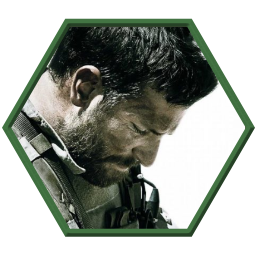
Appearance: Preeetty much Chris Kyle, but lankier.
Buddy: Arkadi
Moral Code: Never leave a man behind. Everybody goes home. God gave you the strength to ensure that.
Big Dream: Home.
Strength C: Close Combat C, Stamina D
Agility B: Mobility D, Ranged Combat B (Sniper)
Intelligence B: Recon C (Scout), Survival C (Hunter)
Empathy B: Persuasion D
Coolness Under Fire: C
Permanent Rads: 5
Armament: Thoughts and Prayers (SVD with the occasional uncanny ability of its own), hunting bow, M45 MEU(SOC)
Other Key Equipment: Bible, prayerbook, bear claw necklace
As my gaming group moves toward resuming play in Kaserne on the Borderlands, it’s probably time to refresh my three loyal readers on who the player charcters are. I have eight players, all but one of whom is running two characters. As a result of events that occurred shortly before the hiatus, the PCs have split into two teams. One team is staying in Ponikla, the village in which the campaign began, to continue with local stabilization and infrastructure recovery efforts. The other team is headed to Krakow by way of Czestochowa, seeking answers to a few different mysteries that have reared their ugly heads over the course of the campaign.
I think I’m going to do this as a series of eight posts, each one focusing on a single player’s PCs. We’ll start with Player M, who runs Red and Cowboy. Red is an original PC; Cowboy is a liberated POW NPC who was adopted and fleshed out.
William “Red” Grayson, M.D.
Lieutenant, U.S. Navy Medical Corps
Ponikla Team
“Red” was doing his residency when the war began. Drafted and direct-commissioned as a Navy trauma surgeon, he was attached to an infantry battalion in 2nd Marine Division. With the collapse of anything resembling international law and treaty enforcement, he’s picked up a rifle to defend his patients… and himself… and, really, anyone else who needs it.
Over the course of the campaign, Red has emerged as one of the party’s leaders (though not necessarily its tactical commander). He’s also been at the forefront of scientific inquiry into the various weird phenomena that the PCs have encountered. When the team split, he chose to stay in Ponikla to help drive regional recovery, as he’s the only known physician within at least a 50km radius. He’s established a decent pocket clinic in the one house in Ponikla with a geothermal climate control system.
Appearance: Tired, definitly has seen better days, with greying auburn hair and a scar across one cheek from flying shrapnel.
Buddy: Ellis
Moral Code: Never turn your back on family. Friends are just family that you choose.
Big Dream: Find a place to settle down, be a doctor, raise a family.
Strength C: Close Combat D, Stamina D (Load Carrier)
Agility C: Mobility D, Ranged Combat C
Intelligence B: Recon C, Survival D (Herbalist [homebrew]), Tech D
Empathy A: Command C (Logistician), Persuasion C (Trader), Medical Aid B (Combat Medic, Field Surgeon)
Coolness Under Fire A
Permanent Rads 8
Armament: M4A1, Glock 18C, axe, entrenching tool
Other Key Equipment: all the medical supplies
Kira “Cowboy” Lopez
Private First Class, U.S. Army – MOS 13F (Forward Observer), attached to 4th Ranger Battalion
Expedition Team
Kira was raised on a cattle ranch in the Texas panhandle by an impatient, frequently drunk, father and her Hispanic mother. Until her mother died in a car accident in the late ’89. Her father became unbearable and she blamed him for the accident. Their relationship got worse as she got older, and spent as much time away from the ranch as she could get away with. She left Texas for California as soon as she graduated from high school in ’93. She was sick of rural life, sick of her father, and everyone else knowing your business, and wanting to live pretty much anywhere else.
In Los Angeles, she apprenticed to an electrician, thinking it would be a good way to make a living doing gigs for rich people (or something like that) and it was alright for awhile. She worked hard, often being willing to work from before dawn until it was too dark to work safely. On the weekends she partied hard, hanging out with the metalheads and goths, going to concerts and night clubs. On Sundays, once she kicked out anyone she might have come home with the night before, and if she wasn’t too badly hung over, she’d go to church, thinking her mother would be even more disappointed in her if she didn’t.
When the war broke out, she had the misfortune of having an early draft number. Cowboy won out as her nickname in bootcamp because she was absolutely willing to throw fists over “Cowgirl” innuendos, and somebody else already got to be “Texas.” She ended up in artillery when her math skills and understanding of trajectories and coordinates indicated she’d be good at it.
Now that the war is effectively over, Madga’s speech has her reconsidering her desire to live anywhere other than some rural shithole, realizing that now…everywhere is a shithole, and it’s going to be mighty hard to find food in an urban shithole. For once, a small, close-knit community might be okay. Besides, if she ends up back in the States, they’d probably send her somewhere else to fight…and she knows she doesn’t want to get involvd in a civil war back home.While she used to think she’d prefer someplace like Valhalla for an afterlife, Kira always remembers to light a candle for her mother and her ancestors on Dias de Muerte, and has included people from her unit who’ve died over the course of the war.
Appearance: 5’3″ & dusky skinned, she has surpisingly light hair, and hazel eyes. She has a number of tattooes, a mix of pagan, hispanic culture, and heavy metal. She’s outwardly cheerful & reliable, and has an excellent singing voice, even if her music preference is heavy metal.
Moral Code: She isn’t a Ranger, but never leave someone behind.
Big Dream: Motivated by Madga & Red, maybe help make at least a small part of the world a better place.
Strength B: Heavy Weapons B (Redleg), Close Combat D, Stamina D
Agility B: Driving D, Mobility D, Ranged Combat C
Intelligence B: Recon C (Scout), Tech B (Chemist, Electrician)
Empathy C
Coolness Under Fire A
Permanent Rads 9
Armament: PKM, Sa vz.26, pearl-handled switchblade
Although Kaserne on the Borderlands is on vacation right now, I still have campaign thoughts. One of them is that the default in 4e is to separate non-threatening-but-edible animal encounters (hunting results) and dangerous animal encounters (card draw results), and I mislike that. I’ve been wanting something a bit more in-depth for both random encounters and Pettimore’s hunting expeditions. Here’s a first stab at it, informed by Wikipedia’s inventory of Polish wildlife:
Yeah, that’s a percentile table. Don’t judge me. Right-click it and select “open image in new tab” to embiggenate.
As mentioned in my previous post on my campaign’s homebrew specialties, I’ve also added a few more drugs to the team medics’ pharmaceutical inventories. Here’s how we’re handling them:
Antacid
Provides +1 STAMINA to resist food poisoning.
Anti-Diarrheal
Once you’re ill, one dose provides +1 to one infection (STAMINA) roll made for any disease that has diarrhea as a symptom. Dying ass-first sucks.
Anti-Psychotics
Provides +2 to your EMPATHY roll to recover from long-term mental trauma after your counselor makes a successful MEDICAL AID roll.
Antiseptic
A liquid compound suitable for cleaning medical equipment. Used during a surgical procedure, one unit ensures the patient doesn’t have to make a STAMINA roll to avoid infection.
Hydration Salts
When taken in conjunction with one ration of clean water, a character suffering from dehydration immediately heals one point of dehydration damage. Further doses have no additional effect.
Morphine
Used for sedation and pain relief. One does allows an attending physician to roll an extra d8 (treat as an ammo die) for stabilizing critical injuries or otherwise conducting surgery. A second dose allows an additional d6 on the roll, but one or more 1s on an extra die mean the patient is addicted (if he survives the procedure).
Multivitamins
A month’s supply for one character gives +1 STAMINA to resist disease or infection during that month.
Stimulant, Mild
Once per day, one dose restores one point of Stress.
[We’re also using this rule for coffee, which makes it a desirable trade good for more than – ahem – flavor reasons.]
Stimulant, Strong
Injected pharmaceutical. One dose provides a +2 to MEDICAL AID when getting a downed character back on their feet from incapacitating damage. Also usable for other story-appropriate effects.
With an advance team from Ponikla on site, the train wreck is secured. The expedition team breaks camp. With Betsy keeping an eye on the bridge and ground-guiding each driver in turn, they cross the Pilica without incident. They’re in unknown territory now – they have a map, but the map is not the terrain.
The team advances cautiously west. Intelligence gathered from the prisoners taken at Radom indicates that the shattered remains of the Soviet 124th Motor Rifle Division have moved into Piotrków Trybunalski, so they have little interest in getting too close to that city. Their intent is to pick up the main highway at Kamiensk, roll south to the Warta River, find a safe place to cross it, and make their way to the area of Czestochowa.
As the lead vehicle breaks out of the treeline into the late-morning sun, Betsy spots two people on the far side of the large clearing, a few hundred meters away. They also sight the vehicles and go to ground, but not before Betsy is able to glass them with her binoculars. They’re in civilian attire, and armed, but that’s all she can make out at this distance.
This is a band of 2 hunters. They are Experienced NPCs with civilian firearms. They are moving by foot.

Leader motivations: very sociable (heart 10), stubborn (club queen)
The team decides to try to make contact. Erick and Miko dismount (with Hernandez and Cat, respectively, taking over their crew positions). The initial communication is shaky, but Erick gradually draws out the elder of the pair. He introduces himself as Dawid Pasternack. Dawid is a weathered Pole in his 60s, carrying a hunting shotgun, and from his speech patterns, he’s probably as close as central Poland gets to an Appalachian redneck. This is a guy for whom the apocalypse was a step sideways, not down. He refers to Erick and Miko as “Minnesota” and “Warsaw” throughout the conversation – though he’s not too sure what Minnesota is, and asks if it’s anywhere near New York City.
Dawid advises them that the area in which they’re traveling is infested with Soviet deserters. He’s aware that a more organized force has occupied Piotrków Trybunalski, though he doesn’t know enough about military matters to identify specific units. He also informs them that several small groups of American survivors came through the area about a month ago, apparently fleeing some big battle up north.
Dawid has news of the team’s planned route, too. The town of Kamiensk was occupied by a large group of deserters, but they fled the town when the more organized Soviet force moved into the area. In their absence, Kamiensk is trying to put itself back together. The community’s de facto leader is Father Miroslav Kasprzak, a Catholic priest.
Erick sends Miko back to ILM to retrieve a bottle of good prewar liquor as thanks for the information. Dawid is suitably impressed by the team’s generosity and bids them a warm farewell as they resume their journey.
With the information Dawid provided, the team definitely wants to check out conditions in Kamiensk. Knowing that the area is full of potential marauders, though, they proceed a bit more cautiously, ready for a gunfight. They’ve made another twelve klicks or so when everyone on board Comms is subjected to a sudden inarticulate shout from Bell as he slams on the brakes. There’s an almost-unnoticed thump from under the vehicle. “Aw, man,” Bell sighs. “I think I hit something.”
Ellis keys up the radio to halt the rest of the column while several people dismount to investigate. A young feral pig apparently picked the wrong moment to bolt from cover. There’s not much left. At least the BTR-70K is undamaged. [Behind the screen, Bell failed his Driving roll for this hex of movement, and I rolled a “roadkill” result on the mishap table. The team did get one ration of wild food out of the deal.]
With the possibility of the piglet’s mother being in the area and angry, there’s not much reason to linger. Everyone remounts. The convoy is about to begin rolling when Betsy, who’s been watching the team’s flanks, returns her gaze to the road and spots something about forty meters ahead of the UAZ. There’s an odd depression stretched across the dirt track, almost like the ground has subsided over a small buried pipe – and a few meters off the trail, nestled into a dead bush, she sees a squat tripod topped with a stubby tube.
“Ready to roll?” Erick asks at this moment.
“No. Oh, hell, no. Hold up.”
The characters' line of movement crosses the trigger of an off-route anti-tank mine. Time has taken its toll on the mine's concealment.

Noticing the mine is an Average: Observation or Combat Engineer task for a character on foot or horseback, Difficult for a character riding in a vehicle, or Formidable for a character viewing the scenery through an AFV's vision blocks. A walking character will not set off the mine. A bicycle, motorcycle, or horse has a 50% chance of triggering it. The first vehicle to cross the trigger automatically detonates it.
Hernandez takes over the UAZ’s M2HB while Betsy moves up to investigate. Her suspicion is confirmed – it’s an off-route antitank mine with a pressure tube trigger. By the accumulation of rust and bird droppings, it’s been there at least a year, probably longer. Miko and Pettimore check the surrounding area and find a squad’s worth of fighting positions, also abandoned for quite a while.
There’s a brief debate on what to do about it. Betsy thinks she could defuse it and has a decent chance of recovering it safely, but there’s no telling how reliable it is at this point. It would be easy for the team to drive around it, but that would leave a problem for the next people to use this route. Ultimately, the team takes Betsy up on her offer to just detonate it in place. She cranks the launch tube around 90 degrees, then walks up, giggles to herself, and drops a full ammo can on the pressure tube. There’s a satisfying kaboom as the mine vents its fury on a stand of trees.
23 Sep 2000 - Day Shift (1200-1800)Weather: light rain, 73ºF
Terrain: open (speed modifier x1, Driving +1)
Order of March: UAZ-469 (Erick driver, Betsy gunner/lookout), Industrial Light and Mayhem (Ortiz driver, Miko gunner), Comms (Bell driver, Cowboy gunner)
The rest of the drive to Kamiensk passes without incident. The team finds a deserted commercial building about two kilometers short of the town where they can leave the vehicles in a tabor. Leaving Pettimore, Hernandez, Bell, Ortiz, and Comrade on guard, the rest of the group heads into town on foot. They’ve adopted a cover story as traveling traders – Ellis and Erick are the actual “merchants,” the rest of the group are caravan guards.
Before the war, Kamiensk had about 2,500 inhabitants now. It’s down to 190, and they’re struggling. As the team approaches, they can see that the community is barely managing to commit agriculture, and the half-dozen dairy cattle appear unhealthy (Octavia suspects parasitic infestation).
They’re only a few hundred meters outside the populated part of Kamiensk when the church bell starts ringing an alarm. The people in the fields drop their tools and run for shelter. There’s an awkward pause of a couple of minutes before the church’s door opens and a tall, white-haired man steps out. He’s carrying an AKM; a clerical collar is visible beneath the neckline of Soviet-issue flak jacket.
“I was expecting the village priest, not the village paladin,” Erick mutters.
Father Miroslav is suspicious at first, but he warms to the team once Erick name-drops Dawid and deploys some Church Latin. The community doesn’t have anything noteworthy to offer to traveling traders, and their capacity for hospitality is limited at best, but they’re welcome to spend the night under a roof.
The team settles into a warehouse on the east side of town, near the highway. It’s long since been stripped bare, but it’s good concealment for the vehicles and the service catwalks offer elevated observation and firing positions for defenders.
Ellis “directs” the setup, but his real motive for not doing a lot of hands-on work is to make some observations of the townsfolk. Demographics here are pretty typical – a general lack of military-aged men. The locals are warily assessing the team, too. There’s a general skittishness born from serious recent trauma. Ellis sees attitudes shifting a bit toward cautiously curious as Cat, Betsy, and Ortiz make themselves (and their personal autonomy and armament) visible.
Erick sets up a “hearts and minds” clinic. Octavia tags in with him – although she’s not too eager to draw attention to herself, being still somewhat skittish from her experiences in the last village she inhabited. Comrade, sensing his human’s mood, flops down nearby to keep an eye on the proceedings, and Cat also wanders over to provide security.
The medical team doesn’t have any urgent lifesaving work, but there’s a steady trickle of patients throughout the afternoon. Minor malnutrition and dietary deficiencies are nigh-universal. A number of the villagers are sporting half-healed blunt trauma injuries consistent with severe beatings; several have broken bones that have been inexpertly set, a couple of which are likely to result in permanent impairment without surgery that the expedition isn’t equipped to provide.
It’s also evident that Kamiensk is about to experience a baby boom. A majority of the women of childbrearing age are pregnant, between two and six months along. They’re also avoiding care from Erick, gravitating toward Octavia’s side of the makeshift clinic. Octavia and Cat exchange some dark looks as the pattern becomes evident.
Miko is gathering materials to feed the team’s fuel still when he gets the crawly “I’m being watched” sensation that’s becoming all too familiar to him. He looks around to see a small mob of pre-teen kids staring intently at him. After some whispering and nudging, the group pushes a spokes-urchin forward.
“What did you do to get them to let you carry that?” the child asks, pointing at Miko’s AK-74.
Miko shrugs. “Killed a Russian,” he says matter-of-factly.
There’s a faint screeching noise as several small paradigms undergo sudden, radical adjustment.
“Where are you from?”
“Um. Warsaw.”
“We heard Warsaw was all burned up.”
“It mostly is.”
There’s some more whispering and an awkward silence before the kids scurry off.
23 Sep 2000 - Evening Shift (1800-0000)Weather: cloudy, scattered showers, 65ºF
Actions: Pettimore and Comrade on watch; Hernandez brewing fuel; Bell and Ortiz gathering materials for fuel
Father Miroslav shows up as the team is starting dinner prep. He seems quietly relieved that these eleven outsiders and one giant murderdog won’t be consuming the community’s paltry food stores. He invites them to join him in the church after they’ve eaten – he can offer tea, which is the one luxury he has in abundance.
Once they’ve eaten, the PCs take him up on that offer. Night is falling and the village is mostly dark as they make their way to the church. Outside, the building shows the scars of conflict, with several windows boarded over and a few bullet holes in the wood.
Inside, it’s a different story. The wood is polished, the floor is swept, and the place is clean and in good repair. The glow of candlelight fills the sanctuary. At one side of the altar, the glow of an oil lamp flickers through the cracks in a door. That door opens and Father Miroslav emerges bearing a tray which contains a dozen mismatched teacups. He sets it down, goes back into his study, and returns with a large kettle and a small jar of honey.
Once pleasantries have been exchanged, the team asks about the village’s status. Father Miroslav confirms what they’ve pieced together so far and fills in some of the blanks. The deserters came to town about six months ago. In the process of taking over, they killed most of the local militia (which also reduced the community’s workforce and farming capacity by a measurable amount). The band originally numbered close to 50, but attrition and infighting reduced that somewhat. They fled about three weeks ago, after a couple of close encounters with patrols from the Soviets in Piotrków Trybunalski put the fear of capture and a field trial into them. There was some more infighting around that decision, which is how the village acquired the handful of weapons it currently possesses. He believes the marauders have split up into three bands, each with about a dozen men.
Octavia diplomatically approaches the subject of the pregnancies. The priest’s expression darkens and he confirms their suspicions. When the deserters took over, they took a number of “war brides.” He takes some pains to point out that he did not sanctify those “marriages.”
Father Miroslav also has some intel on the nearby city of Radomsko. Formerly home to some 44,000 people, it’s now down to about 4,000 – a quarter of those in the city, the rest scattered around its environs in farming collectives. It’s under the rule of a larger band of deserters (from which Kamiensk’s former occupiers were a splinter group). Radomsko’s current rulers number about 70 troops under the leadership of a man named Shotkin. The priest says they have something that looks like a tank, but which he’s told isn’t actually a tank – he’s not a military man.
Where is Radomsko? It’s about 16 kilometers south-southwest of Kamiensk. “I can show you if you have a map,” Father Miroslav offers.
record scratch
The team looks at one another in astonishment before pulling at that thread a little. Yep – thanks to Father Miroslav, Kamiensk is largely free of what the players and their characters have dubbed “the brain-fog.” He’s preserved his small church library and has been running elementary education sessions for the younger children, and his weekly church services and other outreach seem to be keeping it at bay for the adults. He’s seen the effects in smaller surrounding communities, as well as in Radomsko – to the point of seeing the light almost come back into someone’s eyes before some outside force flips a switch and makes them forget again.
If the team was leaning toward helping out Kamiensk before, they’re thoroughly committed now. In the long term, there may be a relocation effort – but for now, they need to find a way to help this place preserve itself and get through the winter before they move on. The obvious question, though – why haven’t they asked the 124th MRD for assistance in dealing with the deserters? Easy enough – they’re afraid that there’ll be a price for Soviet assistance, and the least-bad case is that the soldiers will take “payment” from the village’s food reserves.
The local harvest is struggling but Kamiensk will probably avoid starvation if nothing else goes wrong – and if no one else shows up looking for a share of those reserves. Beyond those basics, their greatest needs are defense and medical aid. There are only six firearms in the village, all of those seized in haste as the marauders cleared out, and precious few people know how to use them. Those marauders are likely to come back sooner or later, and as things currently stand, they’ll be able to walk right in and pick up where they left off.
On the medical aid front – well, the team does have a large supply of certain pharmaceuticals, including chewable children’s vitamins. Leaving a cut of those, with instructions to prioritize the pregnant women, will help with the worst of the dietary deficiencies until they can diversify their agriculture a bit more. There’s some other advice Octavia can leave – especially now that they’ve confirmed that the written word isn’t forbidden here.
As far as defensive measures, Ellis and Betsy have some thoughts. The community has ample building supplies free for stripping from the abandoned buildings. Moving everyone into a defensible core, hardening it, and making the rest of the town difficult terrain will be a force multiplier. If the marauders have split up into small groups, a few days of hunting them down and defeating them in detail will yield a good haul of weapons on which Pettimore can start training people.
With that, the team bids Father Miroslav good night and heads back to their bivouac to relieve the watchstanders, continue brewing fuel, and get some rest.
Overall, this session was the first real workout for the core rules’ hexcrawl mechanics. I used my own encounter generator rather than the 4e card draws, but still got plenty of emergent story from the randomization. Generator results are embedded in the narrative above.
As we’re in sandbox mode, resolution of the local marauder problem was entirely in the players’ hands. They’re interested in ensuring local security, so the next session or two will focus on that project.
The situation in Kamiensk and Radomsko – indeed, the entire regional infestation of ex-9th TD marauders – is drawn from the first edition boxed set’s Escape from Kalisz material. I have plenty of notes in case the PCs decide to tangle with Shotkin’s force down in Radomsko – or if he decides to mess with them first…
I’ve thrown together a few custom specialties over the last few months. Some fill gaps in the 4e character model that my group has identified. Others are just there to add flavor (but should still be worth the 10xp investment). The following are currently in play on PCs or allied NPCs.
Herbal Medicine (Medical Aid)
When you attempt to forage, you may choose to gather medicinal plants rather than edible ones. If you succeed, roll 1d12 on the following table and gain one dose per success of the indicated medicine:
Pain reliever
Pain reliever
Pain reliever
Anesthetic, local
Antibiotics
Antacid
Anti-diarrheal
Multivitamins
Sedative
Stimulant, mild
Stimulant, mild
Stimulant, strong
[Some of these meds are also homebrewed. I’ll eventually post them too.]
Jerry-Rig (Tech)
Gives a +1 bonus to SURVIVAL when scrounging for parts and a +1 bonus to TECH when repairing or improvising construction of simple machines.
[We’re currently monitoring this one to see if it’s too powerful.]
Meteorologist (Survival)
Roll SURVIVAL when you spend a stretch or more making weather observations. If you succeed, the Referee should tell you the upcoming weather trend for a number of days equal to the successes you rolled.
Storyteller (Persuasion)
Once per shift, roll Persuasion when you spend a stretch (5-10 minutes) telling a moving or inspirational story. For each success, choose one audience member who may remove 1 stress.
[We’re also monitoring this one to see if it’s calibrated appropriately.]
As noted in the last campaign update post, the PCs found a derelict train with some still-salvageable cargo on board:
After some dice-rolling to determine what from this survived the literal train wreck and its subsequent chlorine release, and then after splitting this among the parties involved in the salvage work (Ponikla, the White Eagles, Von Bahr’s Irregulars, and the emerging Opoczno merchant cartel), here’s the PCs’ share of the haul:
Consumables
1900 rations of canned vegetables 1000 rations of Portuguese Gatorade 3 tons beer = 6,000 bottles (500 mL each) 1.2 tons liquor = 1600 bottles (750 mL each)
3 tons shampoo, conditioner, and hair care products (1kg = 3 person-months) 1.2 tons moisturizing soap and hand lotion 6,000 personal medical kits (or equivalent wound care and surgical supplies) 600 kg antidepressants (pill; 1 kg = 1 person-year) 200 kg antihistamine (pill; 1 kg = 1 person-year) 300 kg potassium iodide (pill; 1 kg = 6 person-months) 600 kg chewable children’s vitamins (pill; 1 kg = 1 person-year) 100 kg anti-fungal (cream; 1 kg = 10 doses) 500 kg disposable syringes (1 kg = 500) 200 kg Lidocaine (injected; 1 kg = 100 doses) 200 kg gram-positive antibiotics (pill; 1 kg = 20 doses) 300 kg epinephrine (injected; 1 kg = 100 doses) 300 kg IV saline solution (1 kg = 1 liter)
anesthetic gas regulator 3x bedside medical monitors (blood pressure, heart rate, pulse oximetry, respiratory rate) medical spectrophotometer tabletop centrifuge CT scanner
I don’t think this is campaign-breaking, given how many things the PCs are trying to do that this won’t help with, but it is certainly an interesting, eclectic, and utterly massive haul.