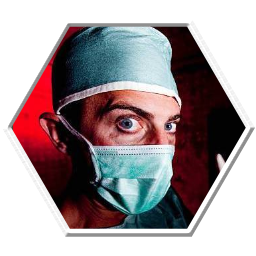
With Ellis away on his long-term secret-squirrel mission in Tomaszow, his player needed another PC for regular use. Enter Arkadi Sokolov, a former VIP protection specialist in the KGB Ninth Directorate who defected to NATO in early 1999 after several years of increasing compromise and disillusionment:

Ranged Combat B; Combat Awareness, Mechanic, Melee, Rifleman
AKS-74U, vz.61 Skorpion, sap, tomahawk, KGB credentials
Arkadi Sikolov hasn’t been having a good summer. Once he was vetted and his handlers were reasonably sure of his reliability, the defector was farmed out to the special operations component of U.S. XI Corps, operating in northern Poland and along the Baltic coast. In May 2000, he was assigned to an intelligence support team that was inserted into Lodz. Their assignment was to prepare safehouses and emplace logistics for a SOF task force that was going to use the noise from the U.S. 5th Infantry Division’s deep raid as a distraction for another operation. He doesn’t know exactly what that op was supposed to be, but his team was preparing exfiltration routes not just for the task force but for up to four non-cooperative prisoners and a half-ton of sensitive material.
Their pre-insertion briefing indicated that Lodz was garrisoned by a Polish Border Guards brigade. Right before the 5th ID moved into the area, that garrison was reinforced by the Soviet 20th Tank Division. His team’s radios went down. They tried to exfiltrate to get a warning out, but things went sideways. He was cut off from the rest of his team and captured on 03 July.
Arkadi was held in Lodz for a couple of days by the military intelligence complement of the Soviet 20th Tank Division before being handed over to a GRU detachment from Lublin. They moved him down to Poitrkow Trybunalski, a slightly-smaller city, on 07 July. He was held there for a few days along with three Polish Home Army raiders.
On 11 July, four more Poles were brought in. These were all western-aligned defectors who had been integrated into the U.S. 5th Infantry Division. They’d been serving as line troops – specifically, part of 4-12 Cavalry. They were captured around Lodz while trying to probe the city’s defenses to determine just what 5th ID was facing.
He was held in Poitrkow Trybunalski until 14 July, when the GRU bundled all their prisoners and started moving them east, along with some captured American equipment (and Arkadi’s starting gear, which was seized as “evidence”). As far as he knows, he’s being taken back to Lublin for interrogation before his eventual execution.
Readers familiar with certain bits of first edition lore may recognize the op that Arkadi was supporting…
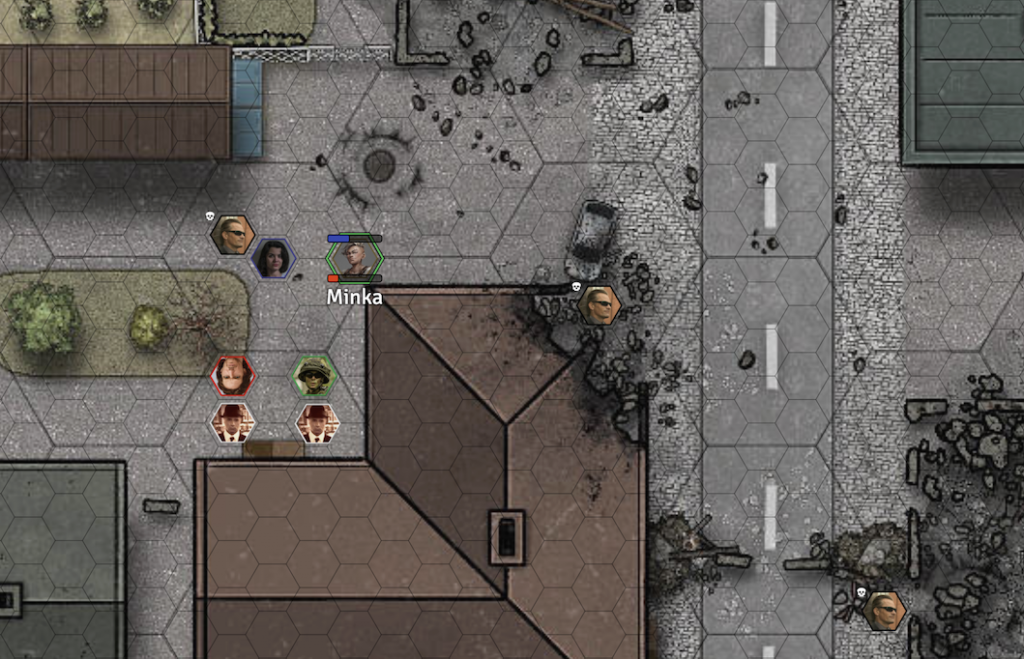
Meanwhile, in Ponikla, the team is curious about the apparent traders they saw near the railyard a few couple of weeks ago. Red, Leks, Minka, Magda, Zenobia, and Pettimore set out on foot (saving fuel – they want to build up a reserve) to explore southwest of that area. They cut through the railyard to check the message drop that they’ve been using with the remaining boxcar children, who they haven’t managed to recruit just yet [because I haven’t given the kids any more screen time], then head out along the road that the caravan was spotted traversing.
A few hours of careful travel through the forest and into more abandoned farm country leads them to a small rise overlooking a mid-sized town [Opoczno]. Some buildings on the community’s outskirts are in rubble, but the core looks intact, and plumes of wood and coal smoke are rising from the rooftops. In the farm fields north of the town, people are working, bringing in the harvest just as most of the locals are doing in Ponikla.

Pettimore and Magda sneak a little closer for detailed observations. They put eyes on a four-person militia patrol, as well as a crude bunker sited to command the northern approaches but currently unmanned. The folks working in the fields apparently know the patrol; there’s some casual banter amid the harvest work. The overall impression is of a functioning community, not one under duress.
The team circles clockwise around the town to get a feel for the area. On the south side of town, they sight a major highway and divert to check it out. Pettimore is the first to check the shoulders of the highway and see places where vehicles have pulled off for maintenance or crew breaks. He recognizes the signs of heavy traffic, mostly headed west – large trucks’ tire tracks and the tread marks of tanks and IFVs. Most aren’t crisp, probably a couple of weeks old, but there are signs of more recent passage in both directions.
The team approaches the town from the south – they’re already there and it seems prudent to mask the direction from which they actually arrived. They head up the road. On this side, they spot two bunkers with militia troops in them. As soon as the militia spots the PCs, a runner darts away into town. A few minutes later, the militia patrol shows up to backstop the bunker crew.
Red and Magda approach to negotiate. They’re met with curiosity and a reasonable level of suspicion, but Magda’s native accent and Red’s implied medical credentials smooth things over. The militia welcomes the team to Opoczno and peels off an escort to take them into town to meet the mayor.
The town square is war-damaged but still doing business. A few open-air shops are offering wares, and a quartet of merchant wagons are parked next to them. Across the way, a local watering hole is open – and appears to have some source of electrical power, as the neon beer sign in the window is lit.
More interesting, however, is the quartet of vehicles parked in the square: a BRDM-2, a Zil-131, an American M35 deuce-and-a-half, and a Chevrolet pickup with an M2HB on a pintle mount in the bed. The latter two vehicles both have bumper numbers identifying them as U.S. 5th Infantry Division property. They’re under the guard of a trio of Soviet troops. One of the junior enlisted and Leks get into a staredown before the NCO and Red corral their respective charges.
Pettimore plays it cool, but as the team enters the mayor’s office, he happens to glance past the vehicles. On the far side of the square is a damaged shop, its front blown out. Within its shadowed gloom, he sees a handful of men and women seated on the floor, guarded by a fourth Soviet trooper. One of the men looks up and catches Pettimore’s eye. There’s a flash of recognition…
Arkadi sits on the floor in a blown-out storefront, gnaws the stale bread that passes for prisoners’ rations in GRU custody, and contemplates escaping before the convoy’s meal and maintenance stop ends. The Poles in his company would probably back his play, but he’s the only uninjured one here, and the guards on the vehicles are keeping a close eye on the man detailed to watch the prisoners. His odds aren’t good.
The guards’ attention briefly goes to a small group of armed men and women being escorted in by the local militia. Arkadi considers seizing the opportunity, but then he recognizes one of the newcomers…
Pettimore excuses himself from meeting the mayor and wanders over to check out the shops and the traders’ wagons. He works his way around to the convoy guards. Pettimore’s primary weapon is a Dragunov, he’s in civilian attire, and he’s not displaying any obvious signs of American allegiance, so he’s able to elicit a little bit of information. The convoy is taking POWs and captured NATO equipment east to Lublin. However, the M35 doesn’t live up to the legends of American engineering, and it’s giving the detachment no end of headaches, especially since their regimental HQ pinched the platoon’s usual mechanic.
Pettimore excuses himself, tells the soldier to look him up for a drink when he gets off shift, and wanders into the tavern…
… where eight more Soviet troops look up from their meals to appraise the armed stranger who just walked in.
Meanwhile, the rest of the team meets Mayor Wiola Bosko and gets a briefing on the state of Opoczno. Mayor Bosko presides over about 1,100 citizens, down from the town’s prewar population of 15,000. Before the war, the major local industries were ceramic tile production, warehousing, and mechanical and maintenance services for both rail and highway transport. They’d been leveraging the remnants of the latter to set up some local trade, but a few weeks ago, the Soviet 124th Motor Rifle Division swept through the area and “requisitioned” all eight trucks that Opoczno’s citizens had restored to service. Bosko expects they’ll be back for regular infusions of fuel and food, but with only about fifty trained militia, there’s not a lot she can do.
Bosko is open to negotiation with other communities in the area. There’s a bit of small talk as each party feels out the other’s intentions and the PCs avoid being too specific about the precise location of their community. They eventually wander out to find Pettimore and lunch.
The chill in the tavern dissipates as the Soviets decide that Pettimore isn’t an immediate problem. The lights flicker as the man astride a bicycle dynamo generator coasts to a halt, having paid off his tab. The barkeep welcomes Pettimore and asks if he’ll be working for a meal or if he has something to barter. Pettimore grins, reaches into his ruck, and pulls out a roll of prewar toilet paper.
Barkeep: Pal, I can’t make change for that.
Pettimore opens a tab; he knows the other PCs will be arriving.
Over some pretty good venison stew and fresh bread, Pettimore deploys awkward Pig-Latin to inform Red that the Soviets are holding prisoners, and he recognizes one of them. Arkadi Sokolov is a Soviet a defector who Pettimore worked alongside during a few deep recon missions on the Baltic coast in the fall of ’99. With a known ally in a jam [and an illuminated “new PC” signal], the team quickly decides they’re going to break Arkadi loose. The mechanical problems the Soviets are having with their captured deuce-and-a-half and their lack of a mechanic suggest an option…
The lieutenant in charge of the GRU platoon “suggests” that it’s time for his men to change the guard shift and start trying to fix that American truck. Four of the troops kill their beers, gather their weapons, and head outside. A few minutes later, they’re replaced by the four who were on guard duty. Looking out the window, Zenobia sees the truck’s hood go up and parts start coming out.
Pettimore leverages his earlier conversation with the guard detail to negotiate a loan of his cousin, Zenobia, who’s a pretty good mechanic. The lieutenant agrees to let her try… she can’t do any worse than his men. Actually, she can do much, much worse, but it won’t be evident for a while…
Zenobia gets to work under the hood while the rest of the team checks out the merchants’ offerings. There’s no time for commerce right now, though – there’s an ambush to set. As soon as Zenobia is done, the team hightails it out of town. They know the route the Soviets will be taking. Pettimore catches Arkadi’s eye and gives him a sign.
About three kilometers east of Opoczno, a Chevrolet pickup technical rolls along at the head of a small GRU convoy. Its driver weaves around a cratered and pothole-riddled stretch of road. The two cargo trucks following it aren’t as agile, and the uneven asphalt repeatedly punishes their crews’ and passengers’ kidneys. Under the hood of one of the trucks, undersized and improperly-torqued bolts have been working their way loose, and this is the final insult. The truck’s driver curses and pulls over as a horrifying metallic clatter and the flailing of a loose belt emanate from the engine compartment.
This is Minka’s cue to touch off the directional mine that Leks has emplaced. The blast flays the left side of the BRDM-2 bringing up the rear of the convoy. When the smoke clears, the barrel of the armored car’s coaxial machine gun is skewed at an unhealthy angle.
The rest of the team opens up on the Soviets. Pettimore and Zenobia catch the gunner on the technical in a sniper crossfire and he falls, the .50’s barrel swinging skyward. Magda, Red, Leks, and Minka rake the vehicles with gunfire, trying to take out (or at least suppress) as many of the drivers as possible.
In the canvas-covered bed of the Zil-131, Arkadi has been waiting for a signal. This certainly sounds like one. He goes for the guard’s eyes and the Poles rise up alongside him. There’s a confused and inconclusive melee that terminates when Arkadi body-checks the Soviet soldier over the tailgate. The man hits the pavement headfirst.
The technical’s driver and front-seat passenger succumb to the massive amount of gunfire being directed their way. Leks sees the unattended M2HB in the truck’s bed and sprints through the firefight toward it. He leaps into the technical, yanks the machine gun’s charging handle, and swings it around just as the BRDM-2 pulls around the cargo trucks! His first burst chews through the armored car’s turret, fouling the ammo feed of its remaining weapon. The driver frantically reverses to put the M35 between his ride and the Estonian while the gunner struggles to get a usable belt into the KPV.
The team keeps up the pressure. Most of the GRU troops never get a shot off [suppression is a harsh mistress]. Arkadi and the Poles boil out of the back of the Zil. Arkadi reclaims his tomahawk from the man who’d taken it as a war trophy while one the Poles grabs the guy’s AK-74, and the mob is off toward one of the troops who’d managed to dismount.
The BRDM crew gets their KPB back into action and rolls forward. Leks stands his ground. 14.5mm rounds tear through the forest but, amazingly, Leks avoids taking a hit. His return fire injures the driver but the armored car is still in the fight – and still a threat that can turn this entire combat around.
From her firing position, Minka runs forward. Repeating her stunt from the fight with the marauders in Mysiakowiec, she hauls herself atop the BRDM and slams a Molotov cocktail through the gun port! Flames erupt within the vehicle as burning liquid begins running out the wheel wells and devouring the brake lines and tires!
Amazingly, the BRDM’s crew stays in the fight. Their fire is ineffectual, though, and Leks weathers the storm unscathed. As the flames reach his legs, the driver bails out, and Arkadi extinguishes him with a tomahawk blow. This is enough for the commander and gunner to throw in the towel. Red rummages through the trucks for a fire extinguisher, but just as he finds one, the BRDM’s ammo starts cooking off. There won’t be much left to salvage.

The Poles collect arms, ammo, and personal gear from the fallen and say their farewells to Arkadi. They’ll hole up in the area for a while and nurse their wounds before trying to find their way back to the vicinity of Lodz. Three of the GRU troops survived the fight, and while one of them breaks and pleads for clemency, the other two are made of sterner stuff. The Poles agree to take them off the team’s hands. Arkadi collects the rest of his gear from the back of the Zil before tossing the truck’s keys to one of the Poles.
Zenobia crawls back under the M35’s hood to undo her earlier sabotage and get the truck in shape to crawl back to Ponikla via the rail yard. Pettimore pulls Arkadi aside for a catch-up chat and gets Arkadi’s briefing on his recent experiences around Lodz. As Pettimore listens, he realizes with mounting horror that Ellis was right. It’s not the July 2001 that he thought he was living in. It’s July 2000 all over again – and at dawn yesterday, the U.S. 5th Infantry Division went down fighting as four Warsaw Pact divisions closed their jaws on Kalisz.
This was a solid session. Despite nearly going off the rails with shopping, we got in some great roleplaying (Pettimore’s player was in top form) and a good fight. I was a bit concerned about the BRDM-2 because the PCs deployed without any antitank weaponry whatsoever (they have three RPG-22s, an M72 LAW, and a few rifle grenades gathering dust in the armory). However, taking the technical out of the fight with the opening volley, and Leks’ immediate seizure of the M2, bought them some breathing room. I was not expecting Minka to conduct another boarding action, but she continues to make this stuff work despite the difficulties and multiple rolls she has to make to pull it off.