
Everyone is finally healed – physically, at least – after the Battle of Horse Eater Hill. Some of the team members have gotten out of town for various errands, but everyone has been going in separate directions for most of the past week. Red and Alexei confer with Wilhelm, Léonard, the Jaroses, Magda, and a few other key village leaders and come away with a solid list of needs and wants. They collect Minka, Miko, Zenobia, and Leks and pile into the Hilux technical and the deuce-and-a-half for a shopping run to Opoczno.
Since early September, when the Battle of Radom cut the Soviet line of communication between Lódz and Lublin, Opoczno has been hard at work to position itself as a regional trade center. There’s still a fair amount of concern about threats from marauders to the west, and a lot of the city’s limited military efforts have been designed to guard against the former Soviet airborne troops occupying Tomaszów Mazowiecki. Those guys have been oddly quiet since a reported large explosion and fire in August, though. The less organized marauders to the southwest, mostly splinters of the 9th Tank Division, have also been going dark over the past couple of months.
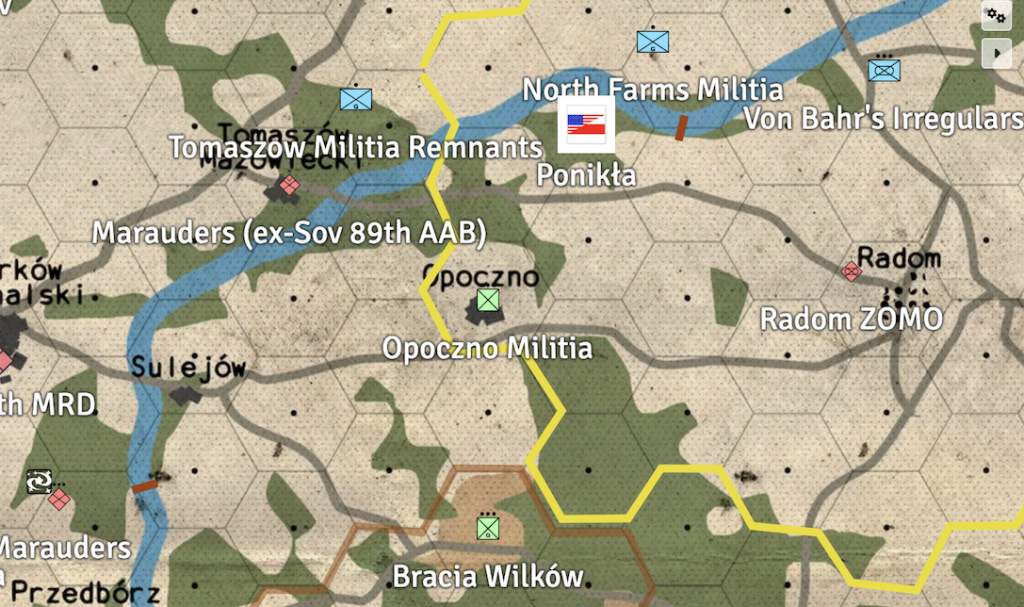
Several of the team members have been making regular Opoczno visits when time permits, so they aren’t surprised by the growing level of stabilization the community is putting out. The latest change is an enlarged checkpoint on the main route into town, which connects to the east-west highway south of the city. A sandbagged fighting position now features a heavy machine gun. Zenobia stops the Hilux about 500 meters out. Leks raises the muzzle of the pintle-mounted AGS-17 and waves as he sees the glint of binoculars. One of the guards trots out into the road, raises a pair of marshaling flags, and directs the vehicles to pull ahead slowly.
The team and their vehicles are familiar enough that the sergeant in charge of the checkpoint skips a few points on his checklist. He does brief them on the city’s new security posture, though. They can still carry sidearms, but long guns, explosives, and incendiaries all need to be checked at the perimeter. The team confers and decides to lock all their gear inside the Hilux rather than use one of the offered storage containers.
[ If I were a cruel GM, I would exploit the fact that it’s easier to break a truck window than to crack open a padlocked metal box. But I’m not that cruel. ]
Miko asks if there’s a limit on blade length and displays his saber. The sergeant furrows his brow. “Not yet. Don’t give us a reason to make a rule about it.”
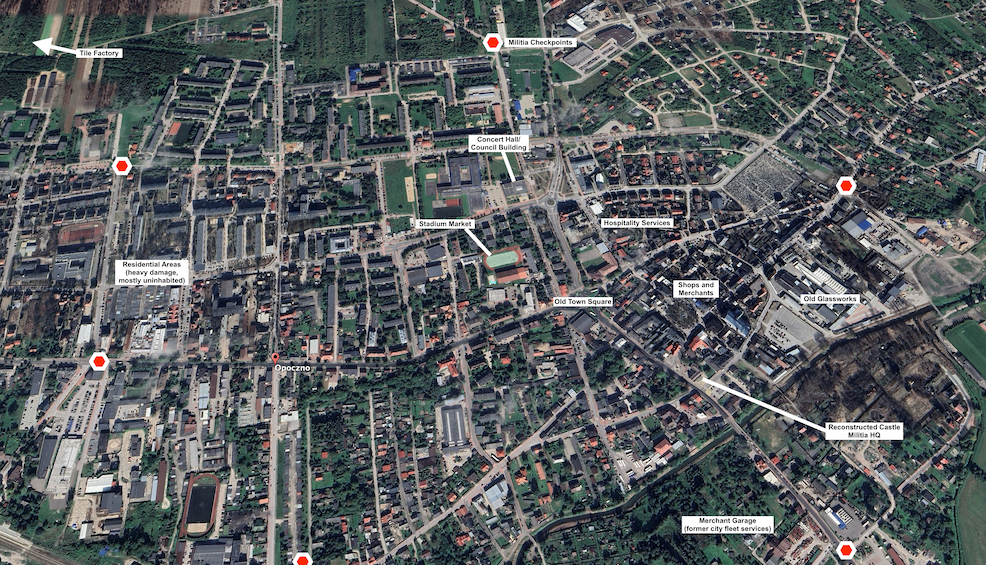
The team parks the deuce-and-a-half at the merchant garage and splits up on foot. Leks, Red, and Miko head toward the merchants, while Zenobia, Minka, and Alexei make their way to the glassworks.
Although the salvager and merchant caravans are slowing down in advance of winter, the local vendors are doing good business. Three tailors/clothiers are competing for the cold-weather clothing market. A trio of food sellers are hawking the yields of the harvest, both fresh and preserved. The weapons dealer has slowed down after fighting season, and now he’s selling mainly hunting weapons and small quantities of reloaded ammo. The eternal tinker and general hardware dealer is where he always is.
Red has a lead on a former radiologist rumored to be in the city. All he has is the man’s profession, his alcoholism, and a name: Ludwig. He and Miko make a circuit of the merchants’ square. One of the tailors points Red west into the burn-flat, the former residential area of Opoczno that suffered heavy damage during the war. He says Ludwig shows up about once a week to trade salvaged goods for food and booze.
Leks checks the pulse of business. It’s as healthy as he’s seen it yet. The owner of one of the city’s two functioning restaurants is very interested in procuring more of Magda’s plum preserves. Leks makes a note of a trade opportunity there. He’s about to close the conversation when something rubs his ankle. He looks down to see a small black cat taking an interest in the smells of his boot. He chuckles and scoops up the cat, who buzzes at him.
The restauranteur laughs and points to a storefront across the street. “Cecylia,” she explains. “Crazy cat lady, but now she’s raising mousers. Who knew she’d find a profit in that?”
“I’d better return her inventory, then, before I get accused of cat theft.” Leks heads in that direction. “I wonder how much longer you’ll want to be around me,” he murmurs to the cat.
“It’s not really a problem,” a voice says behind him. “Our still like us.”
Leks recognizes the voice. “Filip.” He turns.
The alpha of the Bracia Wilków nods. “I heard you took a hit in that fight up north. It’s good to see you’re back on your feet.” He holds up a hand as Leks starts to slip into NCO-sitrep mode. “Some of the pack is in town with me. Catch up at lunch?” He points to the nearby restaurant.
The glassworks is under reconstruction. Pallets of bricks occupy what was once the parking lot, and workers are bustling about the crumpled end of the main building. The flicker of orange heat from the undamaged side of the structure shows at least one of the kilns is running, though.
Minka pushes through the office door. A woman who looks to have seen about a century and change of hard labor looks up from her crocheting.
Alexei reaches into his bag for a few samples of glass power line insulators. “Can you make these?” he asks.
The woman – Ignacia Poplawska – inspects the specimens. “We can. These aren’t the best quality. We can do better.” She looks up. “How many
Zenobia clears her throat. “To start with, we’re looking at a project that would need fifty percent replacement for… call it sixty kilometers of line in the initial phase.”
Ignacia’s gaze sharpens. She puts down her crocheting and stands. “Let’s take this into the office.”
“The office” is a well-worn but well-appointed space. One entire wall is taken up with display shelves of the glassworks’ products, going back well over a hundred years. Ignacia seats herself behind a desk that appears to be equally old. “That’s not a village restoration. What do you have?”
Zenobia glances at Alexei and Minka. “We know where there’s a small hydroelectric plant that… might be recoverable.”
Ignacia’s eyes roll back for a second. “Bialobrzegi.” She focuses on Zenobia again. “I can’t commit to mass production on my own. That’s going to take the whole city pushing resources. You’ll need to talk to the council.” She flashes a sharp smile. “Good thing I’m on the council. One moment.” She stands, crosses to the door, opens it. “Marko! Get your ass in here!”
A pre-teen boy dashes in from the workshop floor. “You bellowed, Auntie?”
“No one likes a smartass.” Ignacia dashes off a note, folds it, stuffs it in the kid’s shirt pocket. “Get that to Mayor Bosko.” She returns to the desk and plops down in her swivel chair. “Now. Let’s talk specifics.”
The guards at the western checkpoint brief Red and Miko on conditions in the burn-flat. The militia runs enough security patrols that there isn’t what anyone would consider an organized threat. The usual leftover hazards of urban warfare are present, but the few remaining inhabitants mostly keep to themselves, eking out a bare living from salvage.
Red asks about Ludwig. One of the guards scratches his chin. “I know the guy.” He gives Red a description. “Comes through here about once a week, week and a half. Moves around. Last he mentioned, he was squatting in the apartment block with the MiG-21 parked in the top floor.” He points to a landmark about a kilometer away, where the charred empennage in question protrudes from the roofline.
“Thanks. I owe you a drink.”
Red and Miko move out. They’re about halfway to the apartment building when Miko spots a ragged man matching their subject’s description. He’s emerging from a half-flattened house with a wooden box full of random loot. They hang back and tail him as he heads for the building in question.
Inside, a well-worn trail in the moldy carpet leads to one of the stairwells. Miko stays on point. At the first landing, he freezes. A tripwire leads to a lever which leads to more wires which lead to… a deadfall of about a ton and a half of furniture. He points it out to Red. Both men carefully step over the wire and continue.
The trail and the smell of pigeon stew both indicate that Ludwig is lairing on the second floor. Red opens negotiations from the hallway. Ludwig is cagey and unhinged.
“We have water,” Red says. “Fresh. Clean. Guaranteed not contaminated.”
“What are you using for your filter medium?” Ludwig snaps back.
Red reels off the technical specifications. There’s a pause. “Huh. You sound like you know what you’re doing. Come in.”
Red throttles back his usual caginess about being an actual physician. Ludwig is pretty avoidant. He knows that doctors are high-value assets (and targets) these days. Red explains why he isn’t too concerned – Miko, the rest of the team, some of Ponikla’s capabilities. He unpacks why he needs Ludwig: he has a salvaged MRI machine and needs someone who knows how to get it working and use it.
Ludwig laughs when Red describes the luxuries Ponikla enjoys – and the capabilities his village clinic has. “Well, Doctor Red Greyson from America, you’re clearly a man of wealth and taste.”
Red can’t help himself. “Pleased to meet you, won’t you guess my name?”
Ludwig’s eyes narrow. “You’re not him. He’d come to me as an oncologist.”
“Actually… I originally trained as an oncologist.” Red has already taken note of Ludwig’s wasted condition. “Where is it?”
“Thyroid.” Ludwig grins ironically. “Not from the bombs. I was diagnosed three months before that started. Surprised I’ve lasted this long.” He pulls out a bottle of local vodka and looks at it for a long minute. “All right, Doctor Red Greyson from America. You have a radiologist. But the price is this: I’m your first patient.” He turns and convulsively hurls the bottle out the open window. It shatters on the pavement below.
Janek is killing time in the merchants’ square when he spots the familiar face he’s been hoping to see. He makes eye contact with Alexei long enough for recognition, then ducks into an alley. Alexei makes his way over, dragging Zenobia and Minka in his wake. Introductions are made all around. Alexei hasn’t seen Janek in over a year, and neither was sure the other was still alive.
Janek unslings his pack. “I have a couple of things you might find useful.” It’s evident to Zenobia and Minka, if not quite to Alexei, that Janek is trying to buy his way into Ponikla by proving his value.
Janek hands over a scuffed cassette tape case. Alexei unzips the cover and whimpers as he inspects the labels. Then Janek unstraps a large, heavy, oblong package from his pack frame and, with a cautious glance around the alley, unwraps it. Alexei paws at the air, eyes bulging.


Alexei finally gets his speech center to work. He looks imploringly at Minka. The farrier laughs. “Come on. Let’s find food.”
The team links back up for lunch in the aforementioned restaurant. (Red and Miko have dispatched Ludwig to the local bathhouse, laundry, and barbershop.) They’ve just put in their orders when Filip and four more Bracia Wilków – or, rather, two Bracia Wilków and two Siostry Wilków – walk in.
Alicja bounces over and enthusiastically high-fives Leks. “Hey! Good to see you again! I hope I didn’t break your cub.” Zofia’s greeting is less energetic, but she pointedly blocks her twin from claiming the empty seat next to the Estonian.
With the full group assembled, the team syncs up on their progress and catches up with this particular batch of local allies. Inevitably, conversation swings around to the Horse Eaters. Filip listens in stillness. When the briefing is over, he tilts his head toward Alexei, then Zenobia. “Your instincts are right. Fire was a good start. Keep that hill clear for a year and a day. Don’t let anyone build anything else on that crossroads and the way won’t reopen.”
The discussion is interrupted by the kid from the glassworks darting through the room to the team’s tables. “Auntie says you’ve got an appointment with the council at two,” he informs Alexei before scampering off again.
As the conversation resumes, several of the team take note of a group of five people across the room. It’s four men and a woman, all in civilian attire but of an age and physique to have fought in the war. They’re eating and conversing, but they’re also tense and wary, checking the door every time it opens. From nonverbal cues, the woman appears to be in charge. They’re definitely paying attention to the team and the Bracia Wilków, though that seems to be mainly a function of the group’s size.
Miko volunteers to try to get close to them and eavesdrop. Red suggests he settle down, and maybe trail them when they leave.
“Take a flare gun to signal if you get in trouble,” Leks snarks.
“Wait. We have flare guns? Why don’t I have a flare gun?” Miko asks.
“War crimes,” Minka, Leks, and Red chorus.
The quintet settles the matter by finishing their meal and leaving. The woman shoulders the strap of a bulky leather messenger bag. As they pass the team’s table, it becomes clear the group is speaking in Russian. It’s not illegal to be Russian in Opoczno, but this ratchets up the team’s suspicions another notch.
“I can back him up,” Janek offers. “I’m good at getting people to ignore me.”
Red looks at the new arrival for a moment, then nods. “Go.”
Alicja and Zofia exchange a look, then turn toward Filip, who cocks an eyebrow. Alicja slips off her wolfskin cloak, hands it to her sister, and slides out the door.
Leks observes the exchange and notes to Red, “we should start working on some kind of simple hand signs.”
Zofia rolls her eyes. “Can teach,” she croaks.
“Oh. Duh.” Leks turns crimson. Red cackles.
Leks catches Filip’s attention. “Can I get a word?”
Filip tilts his head toward the door. The two men exit and find a quiet alcove for a modicum of privacy.
“The last time we met,” Leks begins, “you made me an offer.” When he pauses, Filip makes a quiet noise for him to proceed. “The answer is yes.”
The Pole nods, unsurprised. “Take care of your business here. We were about to leave. I’ll find you in Ponikla once you’re back there.”
Miko and Janek rotate through tailing the Russians. It’s not a long journey, only a few blocks. They enter Opoczno’s barbershop, passing Ludwig on his way out. Miko settles in to observe. He’s there maybe a couple of minutes when a woman’s voice behind him asks, “and what do you find so interesting about us?”
Miko turns slowly. The Russian woman is standing in his alley, arms crossed, smiling thinly at him. He tries to play off his behavior as random curiosity. She’s not really buying it. She leaves him with something that’s less a warning than a polite caution with teeth behind it. As she walks back to the barbershop, Janek, who’s observing from farther back, notes that one of the men with her was standing in another alley, hands in his coat pockets, clearly poised for trouble.
The surveillance team returns to the restaurant to report the encounter. Red nods. “They may just be in town for the same reasons we are. Speaking of which,” he checks his watch, “I don’t see any problem with getting there early to check the place out.”
The group leaves the restaurant and Filip and his people take their leave. As the team comes within sight of Opoczno’s council building – formerly the city’s concert hall – Alicja detaches herself from the wall she’s been holding up. “Your Russians just went in,” she informs Red before heading south to rejoin her found-family.
The team ascends the concrete steps to the main entrance. A uniformed militiaman holds the door for them against the increasing chill wind. Red informs him that the team has an appointment; he checks a clipboard, nods, and offers directions. They’re early, but they’re welcome to take in the art gallery (largely local works) or have a seat in the waiting area outside the council chamber. The team opts for the latter option and climbs the stairs to the second floor.
A few minutes before their scheduled appointment with the council, the door to the chamber opens and a smartly-dressed aide ushers the Russians out. They tense when they see the PCs, but both sides’ discipline holds.
As the Russians pass, Alexei can’t resist a “do svidania.” The woman stops, cocks her head, and looks at him. “Do svidania, Ossi,” she replies before moving on.
“That’s not good,” Alexei observes once the Russians are out of earshot.
“How so?” Leks asks.
“‘Ossi.’ Two words and she recognized my accent.”
Red takes point on negotiations. He’s met Mayor Wiola Bosko before, but the establishment of a governing council is another sign that Opoczno is mirroring the surrounding area’s first steps toward recovery.
With the exception of Ignacia Poplawska, the council is astonished to learn that regional electrical restoration may be possible. By the end of the allotted hour, they’ve hammered out a rough agreement. The regional pact Red has been assembling – when put on the spot, he dubs it the Pilica Alliance and hopes it holds – will broker a raw materials deal with the Bracia Wilków, whose territory includes mines for the necessary minerals. The Alliance will also provide escort for an inspection team, to include one of Opoczno’s two electricians, to Bialobrzei to validate the power plant’s condition. Finally, the lines from Bialobrzegi to Opoczno will be the first to be restored. In return, the city will focus on mass production of the insulators, felling and fabricating new utility poles, salvage recovery of cables, and the other heavy infrastructure work that, even at this relatively small scale, requires a larger workforce than Ponikla can muster.
If everything goes well, all parties will spend the winter staging supplies and hammering out detailed planning, and restoration work can begin as soon as spring planting is done.
This was a roleplaying-heavy, roll-light session. Lots of moving pieces. I really haven’t done it justice, and the memory is only eight days old.