
The village’s spiritual leaders have been consulting. Father Maciej Frankowski (not to be confused with Maciej the Brewer, who produces that wonderful mead) is the village’s priest. Wilhelm Ziołkowski is about as far removed from Catholic as one can be: he leads the villagers who practice the old ways of Slavic paganism. The two man have reached a comfortable, ecumenical understanding over the last two years, and they’re both concerned by the reports the team brought back from the north farms.
With Pettimore healed up and Red’s other patients well enough to finish their convalescence in their own homes, it’s time to head north again. The team has some other unfinished business up there, as they’ve decided to donate their technical and its mounted M2HB to the farmers’ local militia as a stiffener against further predation by the Radom ZOMO or any other hostile parties. The team heading out consists of Red, Pettimore, Leks, Minka, and Zenobia.
Red makes the patients as comfortable as possible in the back of the M35. They’re not healing with the speed that Pettimore did, so they’ll be on bed rest for a few weeks at minimum, but he’s confident that he’s got them out of imminent danger.
The drive over to the rail bridge and up to the farms is uneventful. Low clouds attenuate some of the sun’s heat but the humidity is oppressive. Wilhelm, Father Maciej, and Aina are looking around with intense interest as Zenobia drives, and commenting on the scenery and the war’s remnants. This is the first time any of them have been out of the village since the PCs arrived in May – and, due to the memory haze, the first time any of them can remember leaving in the last couple-three years.
There’s a brief shuffle at the bridge as Zenobia takes the wheel for both vehicle crossings, one at a time. As the team is rearranging seating after that, Wilhelm approaches Zenobia to compare notes. He looks troubled; he, too, remembers the Pilica as being a smaller river and this bridge being less imposing.
The team arrives at the farm around 1000. There’s a small welcoming committee of the remaining able-bodied folks. They’re armed but stand down as they recognize the PCs – who, once again, are visiting in vehicles they haven’t seen before.
Wilhelm and Father Maciej have clearly discussed how they want to handle this. Father Maciej is up first. The more observant Catholics among the farmers shuffle to the front of the crowd and remove their hats.
Everyone unloads. There’s the expected kerfluffle of reunions and gratitude. It takes the better part of an hour before the group can start heading to the field. Wilhelm is ostentatiously consulting a pocket watch and glancing at the sun to hurry people along.
“Our help is in the name of the Lord,” Father Maciej begins.
“Who made heaven and earth,” the crowd responds.
“The Lord be with you.”
“And with your spirit.”
Father Maciej nods and looks out at the charred field. “Let us pray.”
“Almighty, everlasting God, Father of goodness and consolation, in virtue of the bitter suffering of thy Sole-Begotten Son, our Lord, Jesus Christ, endured for us sinners on the wood of the Cross, bless these crosses which thy faithful will erect in their vineyards, fields, and gardens. Protect the land where they are placed from hail, fire, storm, and every assault of the enemy, so that their fruits ripened to the harvest may be gathered to thy honor by those who place their hope in the holy Cross of thy Son, our Lord, Jesus Christ, Who liveth and reigneth with thee eternally. Amen.”
“Amen,” intone the farmers.
Father Maciej turns to Pettimore, who is carrying two wooden crosses, a hammer, and a handful of nails. With Pettimore’s help, Father Maciej drives the larger cross into the center of the area where the fire sprites were. He then walks to the small grove to the south of the field where the explosion occurred. There’s a large larch tree which somehow escaped with only a few small branches broken. Father Maciej holds the cross against the tree and Pettimore affixes it there.
Father Maciej steps back, thanks the farmers, nods respectfully to Wilhelm, and withdraws back to the main cluster of houses. About a third of the assembled farm residents follow him.
Wilhelm steps up. Nods to Aina, who steps up beside him, carrying a jug of mead and a basket of bread. He looks at his watch again, glances at the sky… and the two bow their heads and wait silently.
As far as anyone can tell, it is exactly noon when Wilhelm raises his head. He clears his throat and begins chanting. Those who aren’t native Polish speakers have difficulty following it. For the Poles (or linguists) in the audience – he’s invoking the protection of Perun on the land.
Wilhelm and Aina begin moving. It’s not quite a dance, but there is a ritual quality to their steps. They’re walking in circles, not doing laps but rather changing their direction to trace out a set of overlapping circles. Aina joins the chant, but her invocations are to Marzanna. At the completion of each circle, she tears off a chunk of the bread and casts it to the ground, and Wilhelm follows it with a libation of mead. Then Aina kneels to gather a handful of burnt wheat stalks.
They trace six circles. At the end, the jug is empty, the bread is gone, and the basket is full of wheat. Wilhelm holds the basket while Aina weaves. When she’s done, she holds up a small humanoid effigy. There’s a collective sigh from the farmers – anticipation and trepidation.
Aina leads the way to the nearest creek, holding the effigy high. Wilhelm follows, and the farmers trail along behind. On the creek’s bank, she cries out, “Marzanna, carry this evil away! In your name, we pray: bring back the spring!”
The effigy flickers into flame. Aina casts it into the water. There’s a hiss of steam and it’s rushing downriver, the current shredding it as it goes.
Aina staggers back a pace; Wilhelm is there to catch her. There’s an exchange of words that no one can make out. The two turn and smile wearily to the villagers, who seem to finally relax.
That seems to be what everyone was waiting for. The mood lifts as the group makes its way back to the houses, where a large lunch is laid out.
This was handled as an extended downtime item through writing on our Discord server (and the above narrative was copied and pasted straight from there with very light editing, so there may be some lingering verb tense or personal pronoun issues that I didn’t catch in reformatting it for the blog). I had thoughts of playing it out as a session, but that basically would have been an extended stretch of me talking and the players spectating, so I’m ultimately happier that I ran it this way.
Here are the Ponikla NPCs who were involved. All were player submissions when we were doing our campaign setup.
Father Maciej
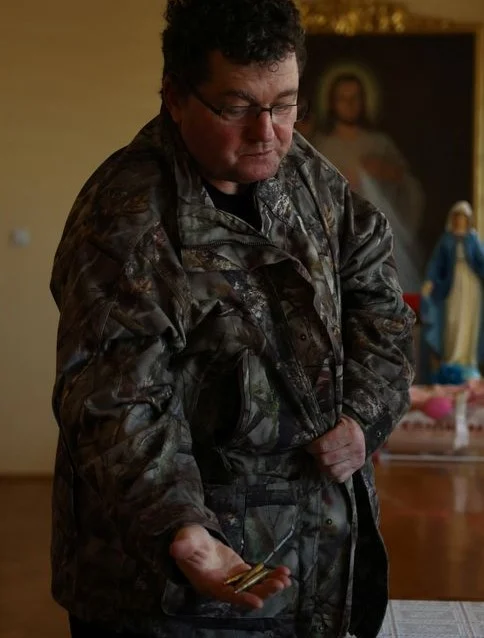
Born and raised in Lodz in 1969, and like most Poles, raised in the Roman Catholic Church, Maciej found solace in the church despite the oppressive communist regime of the 70’s and 80’s. The words of the murdered priest and activist Father Jerzy Popieluszko (1984) had Maciej enter seminary after schooling and compulsory military service. He was ordained in ’92, and took up as a junior priest in Brzeski soon thereafter. He was an advocate for the recovery in Poland from years under the Soviet yoke, and in the increasing tensions in the mid-90’s, his sermons became more fire-and-brimstone, much like his idol, Popieluszko. When the Soviets invaded, he railed against them, but words were not enough. As calls for conscription increased, he took up the call and volunteered with many of his flock.
After more than 2 years of fighting, Maciej is not the firebrand he once was. Though still looked to as a man of the cloth, he no longer has the faith. He perhaps has too much local mead, and rarely gives any kind of sermon anymore. He dutifully performs the necessities of last rites, each time seeming to shrink the man further into the shell of what he once was.
Wilhelm Ziołkowski

Wilhelm has lived in this village his entire life and knows the land – both what nourishes it and what ails it. His family have long been adherents of Rodzimowierstwo (Slavic Paganism). As a longtime member of the community he is one of the people that the villagers turn to for advice, arbitration and guidance.
Aina Jaros
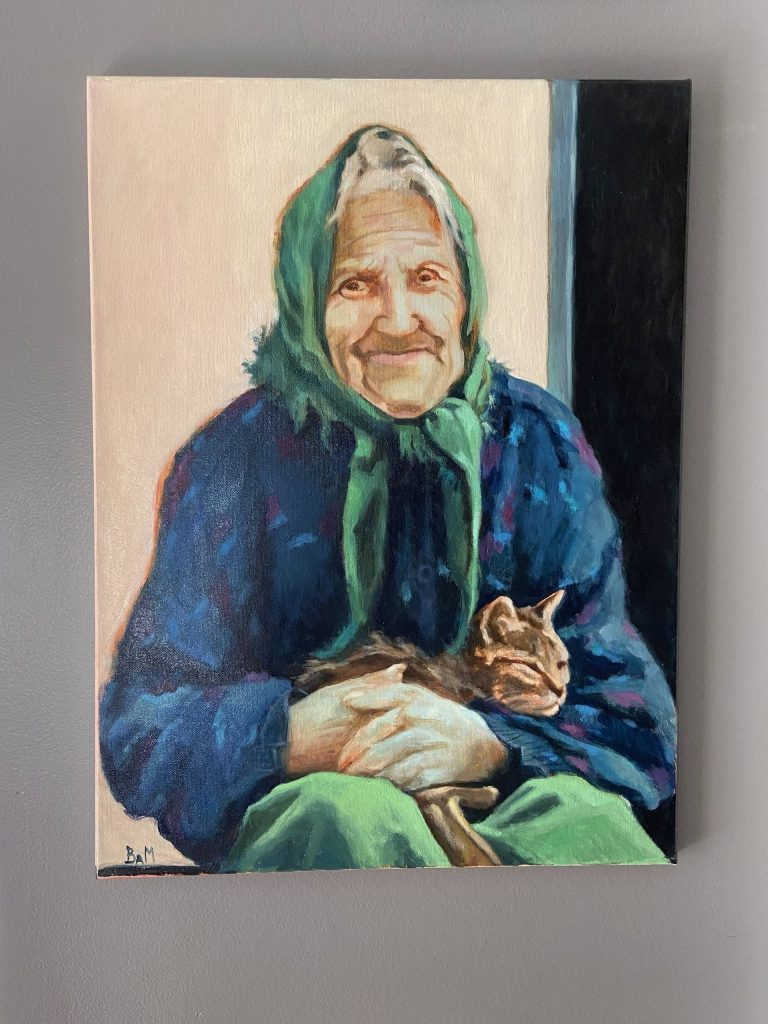
Ania is married to Maciej Jaros, the resident beekeeper and brewer. She has an amazing garden; it’s obvious that the bees are very happy with this arrangement. She still insists on growing her favorite flowers that are just for show, but most of her work is producing food as well as herbs for some basic medicinal use. [agriculture, herbalism, first aid] She enjoys knitting, very basic candle making, and salves and bodycare products from her herbs.
She is old enough to be a bit slow and creaky with her gardening, but she is starting to get one or two of the younger folk to help her out and learn gardening skills, themselves.