Composite Squadron II

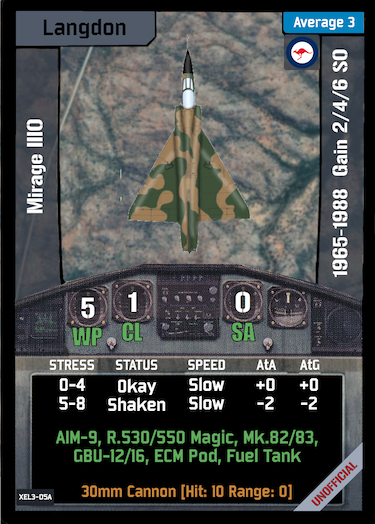
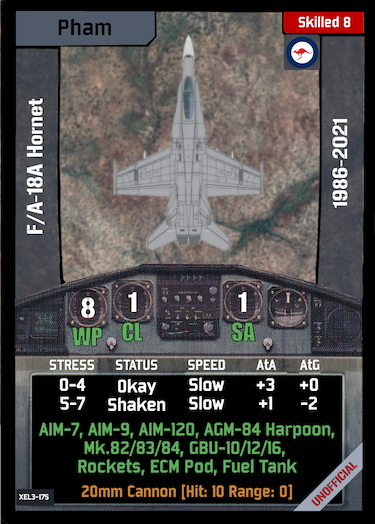
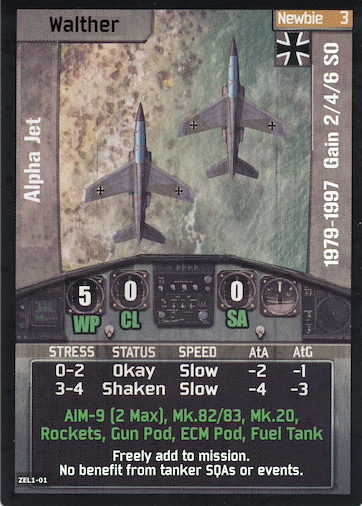
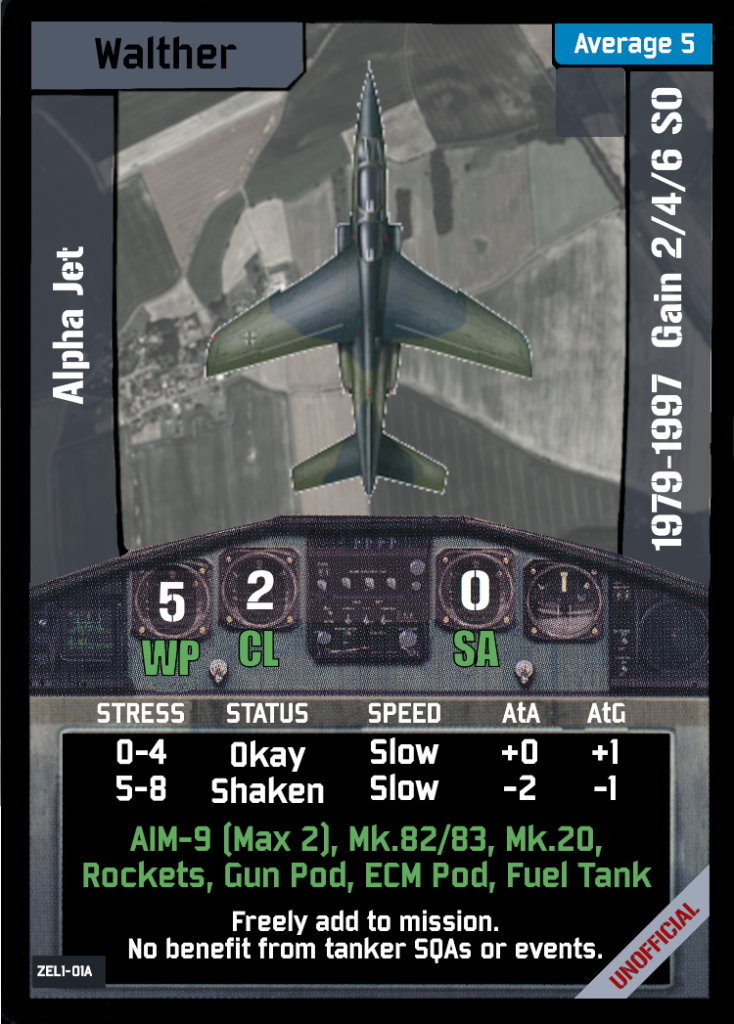
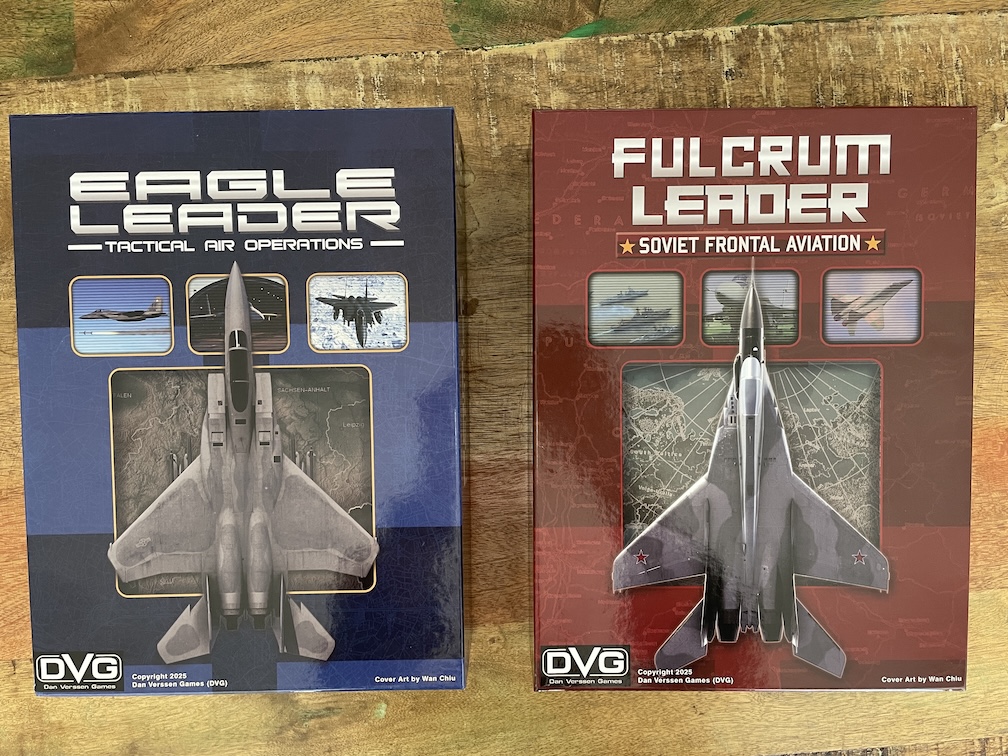
After having an inordinate amount of fun with Eagle Leader despite its editing and playtesting issues (thank the gods for an active and mostly-helpful boardgamegeek.com community), I broke down and picked up the full run of Fulcrum Leader. Despite some lingering misgivings about playing the default bad guys from my childhood (and, arguably, again from 2014 forward), I’m finding it an equally-enjoyable play experience – and arguably better-designed than its cousin.

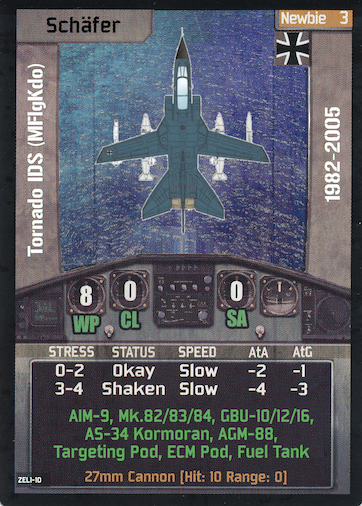
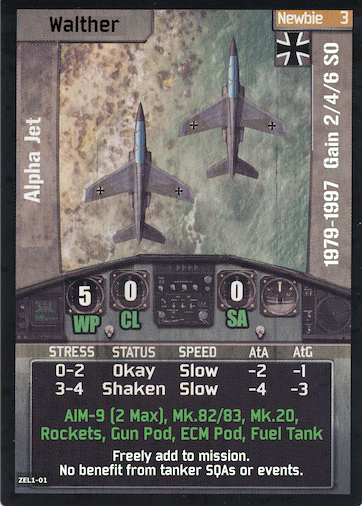
As my regular readers may anticipate, I’ve built out a random squadron generator here.

Cyclopean Skeleton

A random thought on a Shadowdark creature and the loot it may leave behind.


An animated skeleton with a glowing gem set in its forehead.

AC 15 (chainmail + shield), HP 11, ATK 1 longsword +1 (1d8) or 1 javelin (far) +0 (1d4), MV near, S +1, D +0, C +2, I -2, W +0, Ch -1, AL C, LV 3

Undead. Immune to morale checks.

Reflecting Cabochon. First hostile spell with a spellcasting check less than 20 is reflected at caster.


Reflecting Cabochon

A one-inch gem polished to a mirror sheen.

Benefit. When struck by hostile spell, destroy reflecting cabochon and roll DEX (DC equal to spellcasting check result). If you’re a spellcaster, may choose to make spellcasting check instead. With success, reflect spell at original caster.

The Appeal* of Solo Wargames

(* for me)

The Girl and I took the past week off work for our anniversary. We did some old married couple stuff and some maintenance, but a lot of the week was spent in our respective monotropic foci. For her, that was a lot of editing and gap-filling on her current fiction project. For me, it was entirely too much time spent playing, deconstructing, and sketching out house rules for Eagle Leader.

I’ve spent the past few posts braindumping on that game, and as I was wandering around the house today, I found myself considering just why it’s so compelling. It’s easy for me to lose myself in PC games, particularly turn-based tactical stuff (looking at you, X-Com and Doorkickers series), but what’s so fascinating about analog solo wargames? They’re not nearly as cost-effective or space-efficient – for what I’ve spent on Eagle Leader, I could make an immense dent in my Steam wishlist, and that wouldn’t require any shelf space.

Continue reading →

In Which I Wax Rhapsodic About Eagle Leader

Because of poor impulse control and a strong interest in late Cold War (i.e., my formative years) NATO air operations, I wound up snagging the full run of Eagle Leader from Atomic Empire and The Tabletop Strategist (good vendors, BTW; will doubtless give both them more money soon, especially before TTS’ current moving sale ends on Friday). Despite Dan Verssen Games’ long-standing and justly-deserved rep for crappy editing and questionable playtesting being fully borne out with this product, I have been having a ridiculous amount of fun.

A small amount of that is the fact that this is a physical product. Analog gaming feels innately healthier than my default mode of digitally-mediated work and play. It gets me away from screens and requires my brain to manipulate things in meatspace, something I’m realizing I need badly. With our recent rearrangement of furniture, it also gives me another reason to spend time in our now-much-more-welcoming library – either alone, or engaged in parallel play while The Girl is working on Lego kits or writing on her laptop.

The greater part of Eagle Leader‘s appeal, though, is its existence in my sweet spot of complexity (fiddly bits! options!) and speed of play, combined with the sort of emergent narrative I first encountered – and latched onto – in the original X-Com. This extends to the other Leader-series games in my library (currently more Cold War – Thunderbolt/Apache Leader, Spruance Leader, and Hornet Leader, with the Vietnam-era Huey Leader in my Kickstarter fulfillment queue). When my little dudes are individual pilots with names and callsigns, or named warships, with varying stress levels and damage and experience and improvement over time, it’s easy to get attached, and to start writing stories in my head.

Continue reading →

Composite Squadron

I recently acquired a copy of Dan Verssen Games’ long-delayed Eagle Leader solo wargame. I am trying to remain firm in my resolve to not play it until I finish my current North Atlantic WWIII grand campaign of Spruance Leader. However, a four-hour power outage on Saturday did give me some enforced tech-free time, part of which I used to punch out and sort the absolutely ridiculous amount of counters that are typical of DVG Leader-series games.

That, predictably, got me engaged in thinking about the game more, so I sat down that night and spent another three hours branching the code and data set of my earlier Hornet Leader random squadron generator to build one for Eagle Leader. Both are linked from the DVG games landing page of the main site.

The Mirrors and Masks of Mikolaj Krol

It’s time for another GM interjection regarding Kaserne on the Borderlands.

Sharp-eyed readers may have noted that the past couple of real-world years of gameplay have focused on the campaign’s expedition team, of which Miko was a part – but when the focus shifted back to the Ponikla team, Miko was also present. This is intentional.

In the lead-up to the Battle of Radom arc, most of my players created secondary PCs (or adopted recently-introduced NPCs, promoting them to PC status). This was to ensure everyone had someone to play in most scenes and to provide bench depth when primary PCs were down with injuries. By the time the expedition team headed south from Ponikla to validate the Broadstreet Dossier’s contents and Pettimore’s time-displaced memories, Miko’s player was the only one without a second character.

In the short term, this wasn’t an issue because we were focused exclusively on the expedition team. Whatever was happening back in Ponikla was irrelevant. However, as I started bringing the campaign closer to Czestochowa and a (partial) resolution of those questions, I knew I was going to have to address the second PC issue sooner or later, or I would have a player without a character to run when the focus returned to Ponikla.

(Among other issues, I’d inadvertently created a Miko power creep problem. To allow my players to develop their PCs as they see fit, my rule for this campaign is that XP accrues to the player, not the PC. Everyone else was spending XP on two PCs, but Miko was getting all the XP from that player. It’s not insurmountable, but it is noticeable.)

This post brings my hypothetical readers up to speed on an agreement that our table reached before we shifted back to Ponikla. For narrative purposes, the Miko with the expedition is separate from the Miko in Ponikla. As far as the other expedition members are concerned, Miko has always been with them. As far as the other Ponikla residents are concerned, Miko never left. The players, of course, are wholly cognizant of this artificiality – but the characters have no clue (and I have very good players).

I do, in fact, have a pretty good idea of what’s actually going on, but that will have to play out.

End of Summer Update

Happy equinox, everyone.

Posting frequency is likely to slow down for the next few months. Work has entered one of our busier seasons, so I’m not going to be running many game sessions in the autumn. I’ve also all but exhausted my backlog of pre-written and re-posted material, which has been a majority of the content here when I haven’t been actively blogging Kaserne on the Borderlands session reports.